
Lesson type
Difficulty level

This lecture contains an overview of the China-Cuba-Canada neuroinformatics ecosystem for Quantitative Tomographic EEG Analysis (qEEGt).
Difficulty level: Beginner
Duration: 12:56
Speaker: : Pedro Valdes-Sosa

This lecture covers the ethical implications of the use of brain-computer interfaces, brain-machine interfaces, and deep brain stimulation to enhance brain functions and was part of the Neuro Day Workshop held by the NeuroSchool of Aix Marseille University.
Difficulty level: Beginner
Duration: 1:02:00
Speaker: : Jens Clausen

Course:
This module covers many types of invasive neurotechnology devices/interfaces for the central and peripheral nervous systems. Invasive neurotech devices are crucial, as they often provide the greatest accuracy and long-term use applicability.
Difficulty level: Beginner
Duration: 9:40
Speaker: : Colin Fausnaught

Course:
Overview of the content for Day 1 of this course.
Difficulty level: Beginner
Duration: 00:01:59
Speaker: : Tristan Shuman

Course:
Overview of Day 2 of this course.
Difficulty level: Beginner
Duration: 00:03:28
Speaker: : Tristan Shuman

Course:
Best practices: the tips and tricks on how to get your Miniscope to work and how to get your experiments off the ground.
Difficulty level: Beginner
Duration: 00:53:34

Course:
This talk compares various sensors and resolutions for in vivo neural recordings.
Difficulty level: Beginner
Duration: 00:24:03
Speaker: : Susie Feng, Zach Pennington, Caleb Kemere
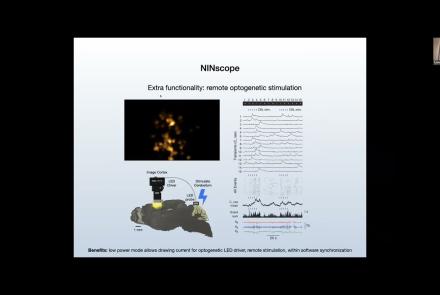
Course:
This talk delves into challenges and opportunities of Miniscope design, seeking the optimal balance between scale and function.
Difficulty level: Beginner
Duration: 00:21:51
Speaker: : Susie Feng, Zach Pennington, Tycho Hoogland

Course:
Attendees of this talk will learn aobut computational imaging systems and associated pipelines, as well as open-source software solutions supporting miniscope use.
Difficulty level: Beginner
Duration: 00:17:56
Speaker: : Susie Feng, Zach Pennington, Laura Waller

Course:
This talk covers the present state and future directions of calcium imaging data analysis, particularly in the context of one-photon vs two-photon approaches.
Difficulty level: Beginner
Duration: 00:21:06

Course:
In this talk, results from rodent experimentation using in vivo imaging are presented, demonstrating how the monitoring of neural ensembles may reveal patterns of learning during spatial tasks.
Difficulty level: Beginner
Duration: 00:19:43
Speaker: : Susie Feng, Zach Pennington, William Mau

Course:
How to start processing the raw imaging data generated with a Miniscope, including developing a usable pipeline and demoing the Minion pipeline.
Difficulty level: Beginner
Duration: 00:57:26
Speaker: : Daniel Aharoni, Phil Dong

Course:
The direction of miniature microscopes, including both MetaCell and other groups.
Difficulty level: Beginner
Duration: 00:49:16
Speaker: : Daniel Aharoni, Frederico N Sangiuliano

Course:
Overview of the content for Day 2 of this course.
Difficulty level: Beginner
Duration: 00:11:01
Speaker: : Tristan Shuman

Course:
Summary and closing remarks for this three-day course.
Difficulty level: Beginner
Duration: 00:04:56
Speaker: : Stephen Larson

Course:
This hands-on tutorial explains how to run your own Minion session in the MetaCell cloud using jupityr notebooks.
Difficulty level: Beginner
Duration: 01:28:03
Speaker: : Daniel Aharoni, Phil Dong

Course:
In this hands-on analysis tutorial, users will mimic a kernel crash and learn the steps to restore inputs in such a case.
Difficulty level: Beginner
Duration: 00:20:34
Speaker: : Phil Dong

Course:
This lesson introduces various methods in MATLAB useful for dealing with data generated by calcium imaging.
Difficulty level: Intermediate
Duration: 5:02
Speaker: : Mike X. Cohen

Course:
This lesson will go through how to extract cells from video that has been cleaned of background noise and motion.
Difficulty level: Beginner
Duration: 01:49:40
Speaker: : Phil Dong

Course:
This tutorial demonstrates how to use MATLAB to generate and visualize animations of calcium fluctuations over time.
Difficulty level: Intermediate
Duration: 15:01
Speaker: : Mike X. Cohen