
Lesson type
Difficulty level

Course:
The state of the field regarding the diagnosis and treatment of major depressive disorder (MDD) is discussed. Current challenges and opportunities facing the research and clinical communities are outlined, including appropriate quantitative and qualitative analyses of the heterogeneity of biological, social, and psychiatric factors which may contribute to MDD.
Difficulty level: Beginner
Duration: 1:29:28
Speaker: : Brett Jones, Victor Tang

This lesson gives a description of the BrainHealth Databank, a repository of many types of health-related data, whose aim is to accelerate research, improve care, and to help better understand and diagnose mental illness, as well as develop new treatments and prevention strategies.
This lesson corresponds to slides 46-78 of the PDF below.
Difficulty level: Beginner
Duration: 1:12:25
Speaker: : Joanna Yu

This lesson describes not only the need for precision medicine, but also the current state of the methods, pharmacogenetic approaches, utility and implementation of such care today.
This lesson corresponds to slides 1-50 of the PowerPoint below.
Difficulty level: Beginner
Duration: 1:24:30
Speaker: : Dan Felsky

This lecture discusses what defines an integrative approach regarding research and methods, including various study designs and models which are appropriate choices when attempting to bridge data domains; a necessity when whole-person modelling.
Difficulty level: Beginner
Duration: 1:28:14
Speaker: : Dan Felsky

This is the first of two workshops on reproducibility in science, during which participants are introduced to concepts of FAIR and open science. After discussing the definition of and need for FAIR science, participants are walked through tutorials on installing and using Github and Docker, the powerful, open-source tools for versioning and publishing code and software, respectively.
Difficulty level: Intermediate
Duration: 1:20:58
Speaker: : Erin Dickie and Sejal Patel

Course:
In this lesson, while learning about the need for increased large-scale collaborative science that is transparent in nature, users also are given a tutorial on using Synapse for facilitating reusable and reproducible research.
Difficulty level: Beginner
Duration: 1:15:12
Speaker: : Abhi Pratap

This lesson contains the first part of the lecture Data Science and Reproducibility. You will learn about the development of data science and what the term currently encompasses, as well as how neuroscience and data science intersect.
Difficulty level: Beginner
Duration: 32:18
Speaker: : Ariel Rokem

In this second part of the lecture Data Science and Reproducibility, you will learn how to apply the awareness of the intersection between neuroscience and data science (discussed in part one) to an understanding of the current reproducibility crisis in biomedical science and neuroscience.
Difficulty level: Beginner
Duration: 31:31
Speaker: : Ashley Juavinett

Course:
The lecture provides an overview of the core skills and practical solutions required to practice reproducible research.
Difficulty level: Beginner
Duration: 1:25:17
Speaker: : Fernando Perez

Course:
This lecture provides an introduction to reproducibility issues within the fields of neuroimaging and fMRI, as well as an overview of tools and resources being developed to alleviate the problem.
Difficulty level: Beginner
Duration: 1:03:07
Speaker: : Russell Poldrack

Course:
This lecture provides a historical perspective on reproducibility in science, as well as the current limitations of neuroimaging studies to date. This lecture also lays out a case for the use of meta-analyses, outlining available resources to conduct such analyses.
Difficulty level: Beginner
Duration: 55:39
Speaker: : Angela Laird

This workshop will introduce reproducible workflows and a range of tools along the themes of organisation, documentation, analysis, and dissemination.
Difficulty level: Beginner
Duration: 01:28:43
Speaker: :

This lesson contains practical exercises which accompanies the first few lessons of the Neuroscience for Machine Learners (Neuro4ML) course.
Difficulty level: Intermediate
Duration: 5:58
Speaker: : Dan Goodman

This video briefly goes over the exercises accompanying Week 6 of the Neuroscience for Machine Learners (Neuro4ML) course, Understanding Neural Networks.
Difficulty level: Intermediate
Duration: 2:43
Speaker: : Marcus Ghosh

Course:
This lecture covers the description and characterization of an input-output relationship in a information-theoretic context.
Difficulty level: Beginner
Duration: 1:35:33
Speaker: : Jonathan D. Victor

This lesson is part 1 of 2 of a tutorial on statistical models for neural data.
Difficulty level: Beginner
Duration: 1:45:48
Speaker: : Jonathan Pillow
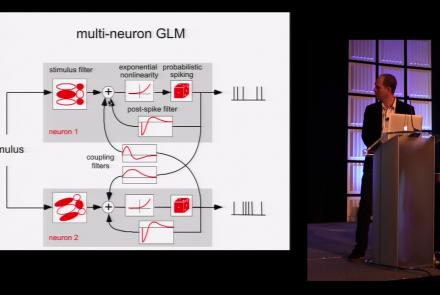
This lesson is part 2 of 2 of a tutorial on statistical models for neural data.
Difficulty level: Beginner
Duration: 1:50:31
Speaker: : Jonathan Pillow

Course:
This lesson provides an introduction to modeling single neurons, as well as stability analysis of neural models.
Difficulty level: Intermediate
Duration: 1:26:06
Speaker: : Bard Ermentrout

Course:
This lesson continues a thorough description of the concepts, theories, and methods involved in the modeling of single neurons.
Difficulty level: Intermediate
Duration: 1:25:38
Speaker: : Bard Ermentrout

Course:
In this lesson you will learn about fundamental neural phenomena such as oscillations and bursting, and the effects these have on cortical networks.
Difficulty level: Intermediate
Duration: 1:24:30
Speaker: : Bard Ermentrout