
Displaying 938 results

This webinar will introduce the integration of JASP Statistical Software with the Open Science Framework (OSF).
Difficulty level: Beginner
Duration: 30:56
Speaker: : Alexander Etz

Course:
This lesson describes the value of version control, as well as how to do so with your own files and data on OSF.
Difficulty level: Beginner
Duration: 22:07
Speaker: : Courtney Soderberg

Course:
This lecture focuses on where and how Jupyter notebooks can be used most effectively for education.
Difficulty level: Beginner
Duration: 34:53
Speaker: : Thomas Kluyver

Course:
JupyterHub is a simple, highly extensible, multi-user system for managing per-user Jupyter Notebook servers, designed for research groups or classes. This lecture covers deploying JupyterHub on a single server, as well as deploying with Docker using GitHub for authentication.
Difficulty level: Beginner
Duration: 1:36:27
Speaker: : Thomas Kluyver

Course:
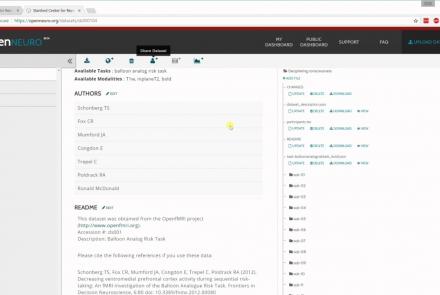
In this tutorial, you will learn the basic features of uploading and versioning your data within OpenNeuro.org.
Difficulty level: Beginner
Duration: 5:36
Speaker: : OpenNeuro
Course:
This tutorial shows how to share your data in OpenNeuro.org.
Difficulty level: Beginner
Duration: 1:22
Speaker: : OpenNeuro

Course:
Following the previous two tutorials on uploading and sharing data with OpenNeuro.org, this tutorial briefly covers how to run various analyses on your datasets.
Difficulty level: Beginner
Duration: 2:26
Speaker: : OpenNeuro

This lecture provides an introduction to neuron anatomy and signaling, and different types of models, including the Hodgkin-Huxley model.
Difficulty level: Beginner
Duration: 1:23:01
Speaker: : Gaute Einevoll

This lecture describes non-spiking simple neuron models used in artificial neural networks and machine learning.
Difficulty level: Beginner
Duration: 8:23
Speaker: : Geoffrey Hinton
This lesson provides an introduction to simple spiking neuron models.
Difficulty level: Beginner
Duration: 48 Slides
Speaker: : Zubin Bhuyan

In this lesson you will learn about the ionic basis of the action potential, including the Hodgkin-Huxley model.
Difficulty level: Beginner
Duration: 28:29
Speaker: : Carl Petersen

This lesson provides an overview of plasticity on many levels, including short-term, long-term, metaplasticity, and structural plasticity. The lesson also provides xamples related to modelling of biochemical networks.
Note: The sound uptake is a bit noisy the first few minutes, but gets better from about 5 mins in
Difficulty level: Beginner
Duration: 1:11:29
Speaker: : Upi Bhalla

This lesson gives an introduction to the modelling of chemical computation in the brain.
Difficulty level: Beginner
Duration: 1:00:11
Speaker: : Upi Bhalla

In this lesson you will hear about several computationally demanding studies of synaptic plasticity on the molecular level.
Difficulty level: Advanced
Duration: 15:44
Speaker: : Kim "Avrama" Blackwell

This lesson gives an introduction to stability analysis of neural models.
Difficulty level: Intermediate
Duration: 1:26:06
Speaker: : Bard Ermentrout

This lesson continues from the previous lectures, providing introduction to stability analysis of neural models.
Difficulty level: Intermediate
Duration: 1:25:38
Speaker: : Bard Ermentrout

In this lesson, you will learn about phenomena of neural populations such as synchrony, oscillations, and bursting.
Difficulty level: Intermediate
Duration: 1:24:30
Speaker: : Bard Ermentrout

This lesson continues from the previous lecture, giving an overview of various neural phenomena such as oscillations and bursting.
Difficulty level: Intermediate
Duration: 1:31:57
Speaker: : Bard Ermentrout

This lesson provides more context around weakly coupled oscillators.
Difficulty level: Intermediate
Duration: 1:26:02
Speaker: : Bard Ermentrout

This lesson builds upon previous lectures in this series, providing an overview of coupled oscillators.
Difficulty level: Intermediate
Duration: 1:24:44
Speaker: : Bard Ermentrout