
Displaying 938 results

Course:
This lesson characterizes the pattern generation observed in visual system hallucinations.
Difficulty level: Intermediate
Duration: 1:20:42
Speaker: : Bard Ermentrout

This lesson provides an introduction to the role of models in theoretical neuroscience, particularly focusing on David Marr's work on levels of description/analysis of the brain as a complex system: computation, algorithm & representation, and implementation.
Difficulty level: Beginner
Duration: 19:26
Speaker: : Jakob Macke

In this lesson, you will learn about different types of models, model complexity, and how to choose an appropriate model.
Difficulty level: Beginner
Duration: 39:09
Speaker: : Astrid Prinz

This lesson provides an overview of balanced excitatory-inhibitory (E-I) networks, stability, and gain modulation.
Difficulty level: Beginner
Duration: 1:22:11
Speaker: : Kenneth Miller

This lesson introduces methods for dimensionality reduction of data, with focus on factor analysis.
Difficulty level: Beginner
Duration: 1:16:47
Speaker: : Byron Yu

This lecture delves into the dynamics of neural computation, from the spiking activity of single neurons to regional cortical population coding and network activity.
Difficulty level: Beginner
Duration: 1:39:32
Speaker: : Julijana Gjorgjieva

This lesson provides an overview on spiking neuron networks and linear response models.
Difficulty level: Beginner
Duration: 1:24:22
Speaker: : Tatjana Tchumatchenko

In this lesson, you will learn about Bayesian neuron models and parameter estimation.
Difficulty level: Beginner
Duration: 1:12:38
Speaker: : Jakob Macke

This lecture describes Bayesian memory and learning; how to go from observations to latent variables.
Difficulty level: Beginner
Duration: 1:33:34
Speaker: : Máté Lengyel

This lesson introduces the concept of constraints on information processing, and how studying these constraints can reveal valuable knowledge about how the brain and other systems function.
Difficulty level: Beginner
Duration: 1:34:42
Speaker: : Simon Laughlin
This lecture discusses approaching neural systems from an evolutionary perspective.
Difficulty level: Beginner
Duration: 1:29:38
Speaker: : Gilles Laurent

This lecture describes non-spiking simple neuron models used in artificial neural networks and machine learning.
Difficulty level: Beginner
Duration: 8:23
Speaker: : Geoffrey Hinton

This lesson provides a short reel on who we are, what we're doing and why we're doing it.
Difficulty level: Beginner
Duration: 2:38
Speaker: :

In this webinar, educators currently implementing collaborative annotation in their classrooms discuss their experiences with collaborative annotation and using Hythothes.is and Canvas App.
Difficulty level: Beginner
Duration: 53:14
Speaker: : Jeremy Dean

This tutorial provides an overview of how to use the feature of Hypothes.is.
Difficulty level: Beginner
Duration: 09:30
Speaker: :

This lesson gives a brief overview of the Hypothes.is functionality from an end user's perspective.
Difficulty level: Beginner
Duration: 5:36
Speaker: : Heather Staines

Course:
This video will teach you the basics of navigating the Open Science Framework and creating your first projects.
Difficulty level: Beginner
Duration: 2:11
Speaker: :

Course:
This webinar walks you through the basics of creating an OSF project, structuring it to fit your research needs, adding collaborators, and tying your favorite online tools into your project structure.
Difficulty level: Beginner
Duration: 55:02
Speaker: : Ian Sullivan
Course:
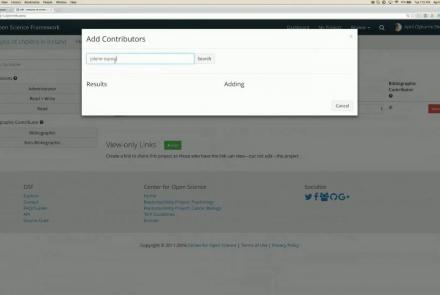
This webinar will introduce how to use the Open Science Framework (OSF) in a classroom setting.
Difficulty level: Beginner
Duration: 32:01
Speaker: : April Clyburne-Sherin

Course:
This lesson provides instruction on how to organize related projects with OSF features such as links, forks, and templates.
Difficulty level: Beginner
Duration: 51:14
Speaker: : Ian Sullivan