
Lesson type
Difficulty level
In this talk, you will learn about the standardization schema for data formats among two of the US BRAIN Initiative networks: the Cell Census Network (BICCN) and the Cell Atlas Network (BICAN).
Difficulty level: Beginner
Duration: 14:58
Speaker: : Michael Hawrylycz

This lesson describes the current state of brain-computer interface (BCI) standards, including the present obstacles hindering the forward movement of BCI standardization as well as future steps aimed at solving this problem.
Difficulty level: Beginner
Duration: 15:01
Speaker: : Martijn de Neeling

Course:
Brief introduction to Research Resource Identifiers (RRIDs), persistent and unique identifiers for referencing a research resource.
Difficulty level: Beginner
Duration: 1:30
Speaker: : Anita Bandrowski

Research Resource Identifiers (RRIDs) are ID numbers assigned to help researchers cite key resources (e.g., antibodies, model organisms, and software projects) in biomedical literature to improve the transparency of research methods.
Difficulty level: Beginner
Duration: 1:01:36
Speaker: : Maryann Martone

Course:
The Brain Imaging Data Structure (BIDS) is a standard prescribing a formal way to name and organize MRI data and metadata in a file system that simplifies communication and collaboration between users and enables easier data validation and software development through using consistent paths and naming for data files.
Difficulty level: Beginner
Duration: 0:56
Speaker: : Jean-Babtiste Poline

Course:
Neurodata Without Borders (NWB) is a data standard for neurophysiology that provides neuroscientists with a common standard to share, archive, use, and build common analysis tools for neurophysiology data.
Difficulty level: Beginner
Duration: 1:11
Speaker: : Ben Dichter

Course:
The Neuroimaging Data Model (NIDM) is a collection of specification documents that define extensions the W3C PROV standard for the domain of human brain mapping. NIDM uses provenance information as means to link components from different stages of the scientific research process from dataset descriptors and computational workflow, to derived data and publication.
Difficulty level: Beginner
Duration: 0:53
Speaker: : Jean-Babtiste Poline

Course:
This lesson provides a brief introduction to the Neuroscience Information Exchange (NIX) Format data model, which allows storing fully annotated scientific datasets, i.e., data combined with rich metadata and their relations in a consistent, comprehensive format.
Difficulty level: Beginner
Duration: 1:03
Speaker: : Thomas Wachtler

This lecture provides an overview of successful open-access projects aimed at describing complex neuroscientific models, and makes a case for expanded use of resources in support of reproducibility and validation of models against experimental data.
Difficulty level: Beginner
Duration: 1:00:39
Speaker: : Sharon Crook

This lecture provides an introduction to the Brain Imaging Data Structure (BIDS), a standard for organizing human neuroimaging datasets.
Difficulty level: Intermediate
Duration: 56:49
Speaker: : Chris Gorgolewski

This lesson provides an overview of Neurodata Without Borders (NWB), an ecosystem for neurophysiology data standardization. The lecture also introduces some NWB-enabled tools.
Difficulty level: Beginner
Duration: 29:53
Speaker: : Oliver Ruebel
Course:
This lesson outlines Neurodata Without Borders (NWB), a data standard for neurophysiology which provides neuroscientists with a common standard to share, archive, use, and build analysis tools for neurophysiology data.
Difficulty level: Intermediate
Duration: 29:53
Speaker: : Oliver Ruebel
In February 2020, the Canadian government published its "Roadmap for Open Science" to provide overarching principles and recommendations to guide Open Science activities in federally funded scientific research. It outlines broad guidelines for making science in Canada open to all while respecting privacy, security, ethical considerations, and appropriate intellectual property protection.
Difficulty level: Beginner
Duration:
Speaker: :

Course:
This lecture covers the rationale for developing the DAQCORD, a framework for the design, documentation, and reporting of data curation methods in order to advance the scientific rigour, reproducibility, and analysis of data.
Difficulty level: Intermediate
Duration: 17:08
Speaker: : Ari Ercole

Course:
This tutorial demonstrates how to use PyNN, a simulator-independent language for building neuronal network models, in conjunction with the neuromorphic hardware system SpiNNaker.
Difficulty level: Intermediate
Duration: 25:49
Speaker: : Christian Brenninkmeijer

This lightning talk describes an automated pipline for positron emission tomography (PET) data.
Difficulty level: Intermediate
Duration: 7:27
Speaker: : Soodeh Moallemian
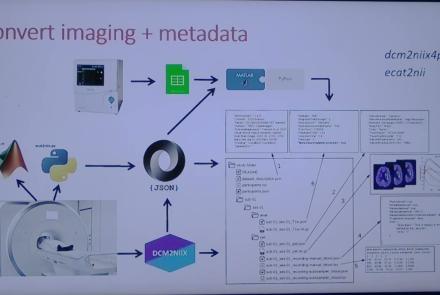
This session introduces the PET-to-BIDS (PET2BIDS) library, a toolkit designed to simplify the conversion and preparation of PET imaging datasets into BIDS-compliant formats. It supports multiple data types and formats (e.g., DICOM, ECAT7+, nifti, JSON), integrates seamlessly with Excel-based metadata, and provides automated routines for metadata updates, blood data conversion, and JSON synchronization. PET2BIDS improves human readability by mapping complex reconstruction names into standardized, descriptive labels and offers extensive documentation, examples, and video tutorials to make adoption easier for researchers.
Difficulty level: Intermediate
Duration: 9:23
Speaker: : Cyril Pernet
This session introduces the PET-to-BIDS (PET2BIDS) library, a toolkit designed to simplify the conversion and preparation of PET imaging datasets into BIDS-compliant formats. It supports multiple data types and formats (e.g., DICOM, ECAT7+, nifti, JSON), integrates seamlessly with Excel-based metadata, and provides automated routines for metadata updates, blood data conversion, and JSON synchronization. PET2BIDS improves human readability by mapping complex reconstruction names into standardized, descriptive labels and offers extensive documentation, examples, and video tutorials to make adoption easier for researchers.
Difficulty level: Intermediate
Duration: 41:04
Speaker: : Martin Nørgaard
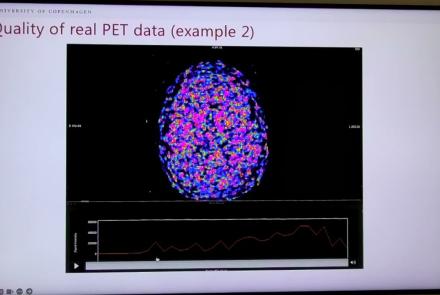
This session dives into practical PET tooling on BIDS data—showing how to run motion correction, register PET↔MRI, extract time–activity curves, and generate standardized PET-BIDS derivatives with clear QC reports. It introduces modular BIDS Apps (head-motion correction, TAC extraction), a full pipeline (PETPrep), and a PET/MRI defacer, with guidance on parameters, outputs, provenance, and why Dockerized containers are the reliable way to run them at scale.
Difficulty level: Intermediate
Duration: 1:05:38
Speaker: : Martin Nørgaard

This session introduces two PET quantification tools—bloodstream for processing arterial blood data and kinfitr for kinetic modeling and quantification—built to work with BIDS/BIDS-derivatives and containers. Bloodstream fuses autosampler and manual measurements (whole blood, plasma, parent fraction) using interpolation or fitted models (incl. hierarchical GAMs) to produce a clean arterial input function (AIF) and whole-blood curves with rich QC reports ready. TAC data (e.g., from PETPrep) and blood (e.g., from bloodstream) can be ingested using kinfitr to run reproducible, GUI-driven analyses: define combined ROIs, calculate weighting factors, estimate blood–tissue delay, choose and chain models (e.g., 2TCM → 1TCM with parameter inheritance), and export parameters/diagnostics. Both are available as Docker apps; workflows emphasize configuration files, reports, and standard outputs to support transparency and reuse.
Difficulty level: Intermediate
Duration: 1:20:56
Speaker: : Granville Matheson