
Lesson type
Difficulty level

Course:
The state of the field regarding the diagnosis and treatment of major depressive disorder (MDD) is discussed. Current challenges and opportunities facing the research and clinical communities are outlined, including appropriate quantitative and qualitative analyses of the heterogeneity of biological, social, and psychiatric factors which may contribute to MDD.
Difficulty level: Beginner
Duration: 1:29:28
Speaker: : Brett Jones, Victor Tang

This lesson gives a description of the BrainHealth Databank, a repository of many types of health-related data, whose aim is to accelerate research, improve care, and to help better understand and diagnose mental illness, as well as develop new treatments and prevention strategies.
This lesson corresponds to slides 46-78 of the PDF below.
Difficulty level: Beginner
Duration: 1:12:25
Speaker: : Joanna Yu

This lesson describes not only the need for precision medicine, but also the current state of the methods, pharmacogenetic approaches, utility and implementation of such care today.
This lesson corresponds to slides 1-50 of the PowerPoint below.
Difficulty level: Beginner
Duration: 1:24:30
Speaker: : Dan Felsky

This lecture discusses what defines an integrative approach regarding research and methods, including various study designs and models which are appropriate choices when attempting to bridge data domains; a necessity when whole-person modelling.
Difficulty level: Beginner
Duration: 1:28:14
Speaker: : Dan Felsky

In this lesson you will learn about current efforts towards integrating multimodal human brain data using the open source SCORE HED library schema.
Difficulty level: Beginner
Duration: 23:29
Speaker: : Dora Hermes

This talk covers the differences between applying HED annotation to fMRI datasets versus other neuroimaging practices, and also introduces an analysis pipeline using HED tags.
Difficulty level: Beginner
Duration: 22:52
Speaker: : Monique Denissen

This lecture discusses the FAIR principles as they apply to electrophysiology data and metadata, the building blocks for community tools and standards, platforms and grassroots initiatives, and the challenges therein.
Difficulty level: Beginner
Duration: 8:11
Speaker: : Thomas Wachtler
This lecture contains an overview of electrophysiology data reuse within the EBRAINS ecosystem.
Difficulty level: Beginner
Duration: 15:57
Speaker: : Andrew Davison

This video explains what metadata is, why it is important, and how you can organize your metadata to increase the FAIRness of your data on EBRAINS.
Difficulty level: Beginner
Duration: 17:23
Speaker: : Ulrike Schlegel

Course:
Overview of the content for Day 1 of this course.
Difficulty level: Beginner
Duration: 00:01:59
Speaker: : Tristan Shuman

Course:
Overview of Day 2 of this course.
Difficulty level: Beginner
Duration: 00:03:28
Speaker: : Tristan Shuman

Course:
Best practices: the tips and tricks on how to get your Miniscope to work and how to get your experiments off the ground.
Difficulty level: Beginner
Duration: 00:53:34

Course:
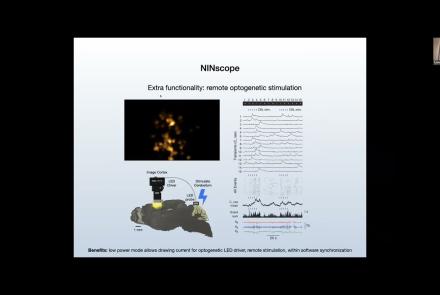
This talk compares various sensors and resolutions for in vivo neural recordings.
Difficulty level: Beginner
Duration: 00:24:03
Speaker: : Susie Feng, Zach Pennington, Caleb Kemere
Course:
This talk delves into challenges and opportunities of Miniscope design, seeking the optimal balance between scale and function.
Difficulty level: Beginner
Duration: 00:21:51
Speaker: : Susie Feng, Zach Pennington, Tycho Hoogland

Course:
Attendees of this talk will learn aobut computational imaging systems and associated pipelines, as well as open-source software solutions supporting miniscope use.
Difficulty level: Beginner
Duration: 00:17:56
Speaker: : Susie Feng, Zach Pennington, Laura Waller

Course:
This talk covers the present state and future directions of calcium imaging data analysis, particularly in the context of one-photon vs two-photon approaches.
Difficulty level: Beginner
Duration: 00:21:06

Course:
In this talk, results from rodent experimentation using in vivo imaging are presented, demonstrating how the monitoring of neural ensembles may reveal patterns of learning during spatial tasks.
Difficulty level: Beginner
Duration: 00:19:43
Speaker: : Susie Feng, Zach Pennington, William Mau

Course:
How to start processing the raw imaging data generated with a Miniscope, including developing a usable pipeline and demoing the Minion pipeline.
Difficulty level: Beginner
Duration: 00:57:26
Speaker: : Daniel Aharoni, Phil Dong

Course:
The direction of miniature microscopes, including both MetaCell and other groups.
Difficulty level: Beginner
Duration: 00:49:16
Speaker: : Daniel Aharoni, Frederico N Sangiuliano