
Lesson type
Difficulty level

This lecture presents the Medical Informatic Platform's data federation for Traumatic Brain Injury.
Difficulty level: Intermediate
Duration: 25:55
Speaker: : Stefano Finazzi

This lecture gives insights into the Medical Informatics Platform's current and future data privacy model.
Difficulty level: Intermediate
Duration: 17:29
Speaker: : Yannis Ioannidis

This lecture explains the concept of federated analysis in the context of medical data, associated challenges. The lecture also presents an example of hospital federations via the Medical Informatics Platform.
Difficulty level: Intermediate
Duration: 19:15
Speaker: : Yannis Ioannidis

This talk discusses what are usually considered successful outcomes of scientific research consortia, and how those outcomes can be translated into lasting impacts.
Difficulty level: Beginner
Duration: 18:24
Speaker: : Anita Bandrowski
In this lesson, you will learn about the BRAIN Initiative Cell Atlas Network (BICAN) and how this project adopts a federated approach to data sharing.
Difficulty level: Beginner
Duration: 11:23
Speaker: : Owen White

This talks presents an overview of the potential for data federation in stroke research.
Difficulty level: Intermediate
Duration: 21:37
Speaker: : Maurizio A. Leone

This lecture explains the need for data federation in medicine and how it can be achieved.
Difficulty level: Intermediate
Duration: 27:09
Speaker: : Philippe Ryvlin
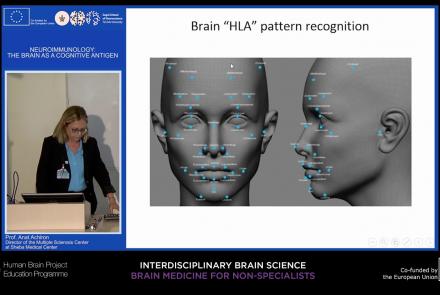
This lecture focuses on how the immune system can target and attack the nervous system to produce autoimmune responses that may result in diseases such as multiple sclerosis, neuromyelitis, and lupus cerebritis manifested by motor, sensory, and cognitive impairments. Despite the fact that the brain is an immune-privileged site, autoreactive lymphocytes producing proinflammatory cytokines can cause active brain inflammation, leading to myelin and axonal loss.
Difficulty level: Beginner
Duration: 37:36
Speaker: : Anat Achiron

This lecture provides an introduction to the application of genetic testing in neurodevelopmental disorders.
Difficulty level: Beginner
Duration: 37:47
Speaker: : Diana-Laura Miclea

This lesson describes the fundamentals of genomics, from central dogma to design and implementation of GWAS, to the computation, analysis, and interpretation of polygenic risk scores.
Difficulty level: Intermediate
Duration: 1:28:16
Speaker: : Dan Felsky

This is a hands-on tutorial on PLINK, the open source whole genome association analysis toolset. The aims of this tutorial are to teach users how to perform basic quality control on genetic datasets, as well as to identify and understand GWAS summary statistics.
Difficulty level: Intermediate
Duration: 1:27:18
Speaker: : Dan Felsky

This is a tutorial on using the open-source software PRSice to calculate a set of polygenic risk scores (PRS) for a study sample. Users will also learn how to read PRS into R, visualize distributions, and perform basic association analyses.
Difficulty level: Intermediate
Duration: 1:53:34
Speaker: : Dan Felsky
This lesson contains the slides (pptx) of a lecture discussing the necessary concepts and tools for taking into account population stratification and admixture in the context of genome-wide association studies (GWAS). The free-access software Tractor and its advantages in GWAS are also discussed.
Difficulty level: Intermediate
Duration:
Speaker: : Dan Felsky

This lesson is an overview of transcriptomics, from fundamental concepts of the central dogma and RNA sequencing at the single-cell level, to how genetic expression underlies diversity in cell phenotypes.
Difficulty level: Intermediate
Duration: 1:29:08
Speaker: : Shreejoy Tripathy

This is a tutorial introducing participants to the basics of RNA-sequencing data and how to analyze its features using Seurat.
Difficulty level: Intermediate
Duration: 1:19:17
Speaker: : Sonny Chen

This tutorial demonstrates how to perform cell-type deconvolution in order to estimate how proportions of cell-types in the brain change in response to various conditions. While these techniques may be useful in addressing a wide range of scientific questions, this tutorial will focus on the cellular changes associated with major depression (MDD).
Difficulty level: Intermediate
Duration: 1:15:14
Speaker: : Keon Arbabi

Similarity Network Fusion (SNF) is a computational method for data integration across various kinds of measurements, aimed at taking advantage of the common as well as complementary information in different data types. This workshop walks participants through running SNF on EEG and genomic data using RStudio.
Difficulty level: Intermediate
Duration: 1:21:38
Speaker: : Dan Felsky

In this lesson, you will learn about how genetics can contribute to our understanding of psychiatric phenotypes.
Difficulty level: Beginner
Duration: 55:15
Speaker: : Sven Cichon

The Allen Mouse Brain Atlas is a genome-wide, high-resolution atlas of gene expression throughout the adult mouse brain. This tutorial describes the basic search and navigation features of the Allen Mouse Brain Atlas.
Difficulty level: Beginner
Duration: 6:40
Speaker: : Allen Institute for Brain Science

The Allen Developing Mouse Brain Atlas is a detailed atlas of gene expression across mouse brain development. This tutorial describes the basic search and navigation features of the Allen Developing Mouse Brain Atlas.
Difficulty level: Beginner
Duration: 6:35
Speaker: : Unknown