
Lesson type
Difficulty level

Course:
This lesson teaches users how MATLAB can be used to apply image processing techniques to identify cell bodies based on contiguity.
Difficulty level: Intermediate
Duration: 11:23
Speaker: : Mike X. Cohen

Course:
This tutorial demonstrates how to extract the time course of calcium activity from each clusters of neuron somata, and store the data in a MATLAB matrix.
Difficulty level: Intermediate
Duration: 22:41
Speaker: : Mike X. Cohen

Course:
This lesson demonstrates how to use MATLAB to implement a multivariate dimension reduction method, PCA, on time series data.
Difficulty level: Intermediate
Duration: 17:19
Speaker: : Mike X. Cohen

This lesson explores how researchers try to understand neural networks, particularly in the case of observing neural activity.
Difficulty level: Intermediate
Duration: 8:20
Speaker: : Marcus Ghosh

Course:
This introductory lesson welcomes users to the virtual learning series, explaining some of the background behind open-source miniscopes, as well as outlining the rest of the lessons in this course.
Difficulty level: Beginner
Duration: 16:23

Course:
This lesson provides an overview of the Miniscope project, explaining the motivation behind the how and why of Miniscope development, why Miniscopes may be useful for researchers, and the differences between previous and current versions.
Difficulty level: Beginner
Duration: 42:16
Speaker: : Daniel Aharoni

Course:
This lesson will go through the theory and practical techniques for implanting a GRIN lens for imaging in mice.
Difficulty level: Beginner
Duration: 1:00:40
Speaker: : Tristan Shuman and Susie Feng
Course:
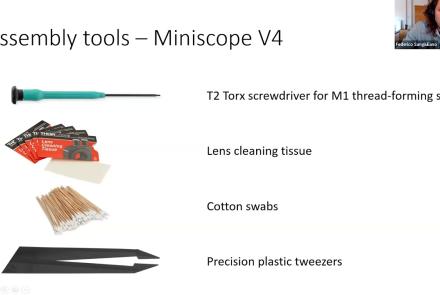
This lesson provides instruction on how to build a Miniscope and stream data, including an overview of the software involved.
Difficulty level: Beginner
Duration: 1:04:28
Speaker: : Daniel Aharoni and Federico Sangiuliano

This talks discusses data sharing in the context of dementia. It explains why data sharing in dementia is important, how data is usually shared in the field and illustrates two examples: the Netherlands Consortium Dementia cohorts and the European Platform for Neurodegenerative Diseases.
Difficulty level: Intermediate
Duration: 21:21
Speaker: : Pieter Jelle Visser

The Medical Informatics Platform (MIP) Dementia had been installed in several memory clinics across Europe allowing them to federate their real-world databases. Research open access databases had also been integrated such as ADNI (Alzheimer’s Dementia Neuroimaging Initiative), reaching a cumulative case load of more than 5,000 patients (major cognitive disorder due to Alzheimer’s disease, other major cognitive disorder, minor cognitive disorder, controls). The statistic and machine learning tools implemented in the MIP allowed researchers to conduct easily federated analyses among Italian memory clinics (Redolfi et al. 2020) and also across borders between the French (Lille), the Swiss (Lausanne) and the Italian (Brescia) datasets.
Difficulty level: Intermediate
Duration: 16:44
Speaker: : Mélanie Leroy

The number of patients with dementia is estimated to increase given the aging population. This will lead to a number of challenges in the future in terms of diagnosis and care for patients with dementia. To meet these needs such as early diagnsosis and development of prognostic biomarkers, large datasets, such as the federated datasets on dementia. The EAN Dementia and cognitive disorders scientific panel can play an important role as coordinator and connecting panel members who wish to participate in e.g. consortia.
Difficulty level: Intermediate
Duration: 15:39
Speaker: : Kristian Steen Frederiksen