
Lesson type
Difficulty level

This lesson explains the fundamental principles of neuronal communication, such as neuronal spiking, membrane potentials, and cellular excitability, and how these electrophysiological features of the brain may be modelled and simulated digitally.
Difficulty level: Intermediate
Duration: 1:20:42
Speaker: : Etay Hay

This lecture focuses on the structured validation process within computational neuroscience, including the tools, services, and methods involved in simulation and analysis.
Difficulty level: Beginner
Duration: 14:19
Speaker: : Michael Denker

Course:
This session will include presentations of infrastructure that embrace the FAIR principles developed by members of the INCF Community.
This lecture provides an overview of The Virtual Brain Simulation Platform.
Difficulty level: Beginner
Duration: 9:36
Speaker: : Petra Ritter

Course:
This tutorial demonstrates how to use PyNN, a simulator-independent language for building neuronal network models, in conjunction with the neuromorphic hardware system SpiNNaker.
Difficulty level: Intermediate
Duration: 25:49
Speaker: : Christian Brenninkmeijer

Course:
Overview of the content for Day 1 of this course.
Difficulty level: Beginner
Duration: 00:01:59
Speaker: : Tristan Shuman

Course:
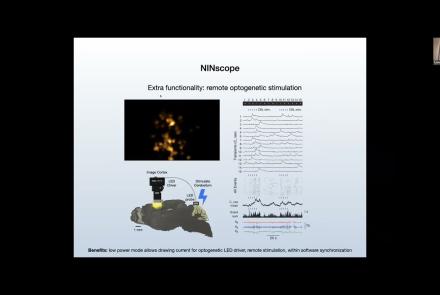
Best practices: the tips and tricks on how to get your Miniscope to work and how to get your experiments off the ground.
Difficulty level: Beginner
Duration: 00:53:34
Course:
This talk delves into challenges and opportunities of Miniscope design, seeking the optimal balance between scale and function.
Difficulty level: Beginner
Duration: 00:21:51
Speaker: : Susie Feng, Zach Pennington, Tycho Hoogland

Course:
Attendees of this talk will learn aobut computational imaging systems and associated pipelines, as well as open-source software solutions supporting miniscope use.
Difficulty level: Beginner
Duration: 00:17:56
Speaker: : Susie Feng, Zach Pennington, Laura Waller

Course:
This talk covers the present state and future directions of calcium imaging data analysis, particularly in the context of one-photon vs two-photon approaches.
Difficulty level: Beginner
Duration: 00:21:06

Course:
In this talk, results from rodent experimentation using in vivo imaging are presented, demonstrating how the monitoring of neural ensembles may reveal patterns of learning during spatial tasks.
Difficulty level: Beginner
Duration: 00:19:43
Speaker: : Susie Feng, Zach Pennington, William Mau

Course:
How to start processing the raw imaging data generated with a Miniscope, including developing a usable pipeline and demoing the Minion pipeline.
Difficulty level: Beginner
Duration: 00:57:26
Speaker: : Daniel Aharoni, Phil Dong

Course:
The direction of miniature microscopes, including both MetaCell and other groups.
Difficulty level: Beginner
Duration: 00:49:16
Speaker: : Daniel Aharoni, Frederico N Sangiuliano

Course:
Overview of the content for Day 2 of this course.
Difficulty level: Beginner
Duration: 00:11:01
Speaker: : Tristan Shuman

Course:
Summary and closing remarks for this three-day course.
Difficulty level: Beginner
Duration: 00:04:56
Speaker: : Stephen Larson

This lesson explores how researchers try to understand neural networks, particularly in the case of observing neural activity.
Difficulty level: Intermediate
Duration: 8:20
Speaker: : Marcus Ghosh

Course:
This introductory lesson welcomes users to the virtual learning series, explaining some of the background behind open-source miniscopes, as well as outlining the rest of the lessons in this course.
Difficulty level: Beginner
Duration: 16:23

Course:
This lesson provides an overview of the Miniscope project, explaining the motivation behind the how and why of Miniscope development, why Miniscopes may be useful for researchers, and the differences between previous and current versions.
Difficulty level: Beginner
Duration: 42:16
Speaker: : Daniel Aharoni

Course:
This lesson will go through the theory and practical techniques for implanting a GRIN lens for imaging in mice.
Difficulty level: Beginner
Duration: 1:00:40
Speaker: : Tristan Shuman and Susie Feng
Course:
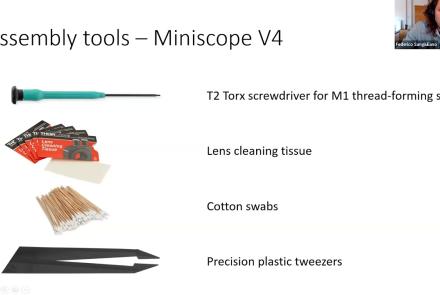
This lesson provides instruction on how to build a Miniscope and stream data, including an overview of the software involved.
Difficulty level: Beginner
Duration: 1:04:28
Speaker: : Daniel Aharoni and Federico Sangiuliano