
Lesson type
Difficulty level

This lecture covers the emergence of cognitive science after the Second World War as an interdisciplinary field for studying the mind, with influences from anthropology, cybernetics, and artificial intelligence.
Difficulty level: Beginner
Duration: 51:07
Speaker: : Paul F.M.J. Verschure

This lecture provides an introduction to Plato’s concept of rationality and Aristotle’s concept of empiricism, and the enduring discussion between rationalism and empiricism to this day.
Difficulty level: Beginner
Duration: 1:13:45
Speaker: : Paul F.M.J. Verschure

This lecture covers different perspectives on the study of the mental, focusing on the difference between Mind and Brain.
Difficulty level: Beginner
Duration: 1:16:30
Speaker: : Paul F.M.J. Verschure

This lecture goes into further detail about the hard problem of developing a scientific discipline for subjective consciousness.
Difficulty level: Beginner
Duration: 58:03
Speaker: : Paul F.M.J. Verschure

This lecture outlines various approaches to studying Mind, Brain, and Behavior.
Difficulty level: Beginner
Duration: 1:02:34
Speaker: : Paul F.M.J. Verschure

This lecture covers a lot of post-war developments in the science of the mind, focusing first on the cognitive revolution, and concluding with living machines.
Difficulty level: Beginner
Duration: 2:24:35
Speaker: : Paul F.M.J. Verschure

This lesson delves into the the structure of one of the brain's most elemental computational units, the neuron, and how said structure influences computational neural network models.
Difficulty level: Intermediate
Duration: 6:33
Speaker: : Marcus Ghosh

In this lesson you will learn how machine learners and neuroscientists construct abstract computational models based on various neurophysiological signalling properties.
Difficulty level: Intermediate
Duration: 10:52
Speaker: : Dan Goodman

This lesson describes spike timing-dependent plasticity (STDP), a biological process that adjusts the strength of connections between neurons in the brain, and how one can implement or mimic this process in a computational model. You will also find links for practical exercises at the bottom of this page.
Difficulty level: Intermediate
Duration: 12:50
Speaker: : Dan Goodman

In this lesson, you will learn about some of the many methods to train spiking neural networks (SNNs) with either no attempt to use gradients, or only use gradients in a limited or constrained way.
Difficulty level: Intermediate
Duration: 5:14
Speaker: : Dan Goodman

In this lesson, you will learn how to train spiking neural networks (SNNs) with a surrogate gradient method.
Difficulty level: Intermediate
Duration: 11:23
Speaker: : Dan Goodman

In this lesson, you will hear about some of the open issues in the field of neuroscience, as well as a discussion about whether neuroscience works, and how can we know?
Difficulty level: Intermediate
Duration: 6:54
Speaker: : Marcus Ghosh
Course:
This lesson gives an introduction to simple spiking neuron models.
Difficulty level: Beginner
Duration: 48 Slides
Speaker: : Zubin Bhuyan
This lesson provides an introduction to simple spiking neuron models.
Difficulty level: Beginner
Duration: 48 Slides
Speaker: : Zubin Bhuyan
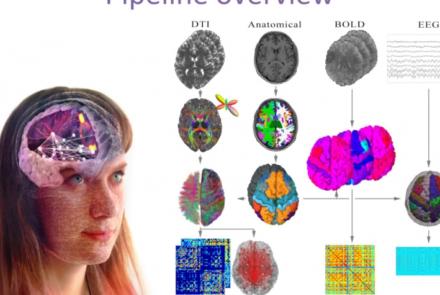
This presentation accompanies the paper entitled: An automated pipeline for constructing personalized virtual brains from multimodal neuroimaging data (see link below to download publication).
Difficulty level: Beginner
Duration: 4:56

This lecture on model types introduces the advantages of modeling, provide examples of different model types, and explain what modeling is all about.
Difficulty level: Beginner
Duration: 27:48
Speaker: : Gunnar Blohm

Course:
This lecture focuses on how to get from a scientific question to a model using concrete examples. We will present a 10-step practical guide on how to succeed in modeling. This lecture contains links to 2 tutorials, lecture/tutorial slides, suggested reading list, and 3 recorded Q&A sessions.
Difficulty level: Beginner
Duration: 29:52
Speaker: : Megan Peters

Course:
This lecture formalizes modeling as a decision process that is constrained by a precise problem statement and specific model goals. We provide real-life examples on how model building is usually less linear than presented in Modeling Practice I.
Difficulty level: Beginner
Duration: 22:51
Speaker: : Gunnar Blohm

Course:
This lecture focuses on the purpose of model fitting, approaches to model fitting, model fitting for linear models, and how to assess the quality and compare model fits. We will present a 10-step practical guide on how to succeed in modeling.
Difficulty level: Beginner
Duration: 26:46
Speaker: : Jan Drugowitsch

Course:
This lecture summarizes the concepts introduced in Model Fitting I and adds two additional concepts: 1) MLE is a frequentist way of looking at the data and the model, with its own limitations. 2) Side-by-side comparisons of bootstrapping and cross-validation.
Difficulty level: Beginner
Duration: 38.17
Speaker: : Kunlin Wei