
Lesson type
Difficulty level

This tutorial provides instruction on how to use the TVB-NEST toolbox co-simulation in HBP collab.
Difficulty level: Beginner
Duration: 3:11

In this tutorial, you will learn how to use TVB-NEST toolbox on your local computer.
Difficulty level: Beginner
Duration: 2:16
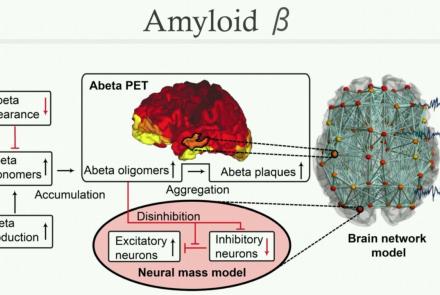
This tutorial provides instruction on how to perform multi-scale simulation of Alzheimer's disease on The Virtual Brain Simulation Platform.
Difficulty level: Beginner
Duration: 29:08
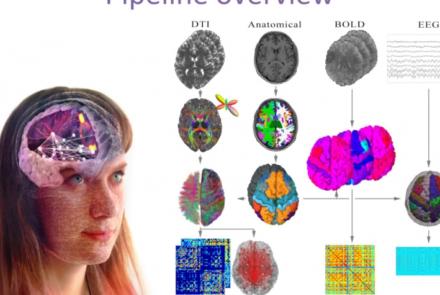
This presentation accompanies the paper entitled: An automated pipeline for constructing personalized virtual brains from multimodal neuroimaging data (see link below to download publication).
Difficulty level: Beginner
Duration: 4:56

This lesson consists of a supplementary video for the publication: Inferring multi-scale neural mechanisms with brain network modelling.
Difficulty level: Beginner
Duration: 3:06

This tutorial provides instruction on how to simulate brain tumors with TVB (reproducing publication: Marinazzo et al. 2020 Neuroimage). This tutorial comprises a didactic video, jupyter notebooks, and full data set for the construction of virtual brains from patients and health controls.
Difficulty level: Intermediate
Duration: 10:01

The tutorial on modelling strokes in TVB includes a didactic video and jupyter notebooks (reproducing publication: Falcon et al. 2016 eNeuro).
Difficulty level: Intermediate
Duration: 7:43

This tutorial covers how to import appropriate data into The Virtual Brain, as well as how to begin constructing detailed brain models.
Difficulty level: Intermediate
Duration: 23:03
Speaker: : Patrik Bey

In this tutorial, you will learn how to run a typical TVB simulation.
Difficulty level: Intermediate
Duration: 1:29:13
Speaker: : Paul Triebkorn

This tutorial introduces The Virtual Mouse Brain (TVMB), walking users through the necessary steps for performing simulation operations on animal brain data.
Difficulty level: Intermediate
Duration: 42:43
Speaker: : Patrik Bey

In this tutorial, you will learn the necessary steps in modeling the brain of one of the most commonly studied animals among non-human primates, the macaque.
Difficulty level: Intermediate
Duration: 1:00:08
Speaker: : Julie Courtiol

This lecture provides an introduction to entropy in general, and multi-scale entropy (MSE) in particular, highlighting the potential clinical applications of the latter.
Difficulty level: Intermediate
Duration: 39:05
Speaker: : Jil Meier

In this lecture, you will learn about various neuroinformatic resources which allow for 3D reconstruction of brain models.
Difficulty level: Intermediate
Duration: 1:36:57
Speaker: : Michael Schirner

This lecture on model types introduces the advantages of modeling, provide examples of different model types, and explain what modeling is all about.
Difficulty level: Beginner
Duration: 27:48
Speaker: : Gunnar Blohm

Course:
This lecture focuses on how to get from a scientific question to a model using concrete examples. We will present a 10-step practical guide on how to succeed in modeling. This lecture contains links to 2 tutorials, lecture/tutorial slides, suggested reading list, and 3 recorded Q&A sessions.
Difficulty level: Beginner
Duration: 29:52
Speaker: : Megan Peters

Course:
This lecture focuses on the purpose of model fitting, approaches to model fitting, model fitting for linear models, and how to assess the quality and compare model fits. We will present a 10-step practical guide on how to succeed in modeling.
Difficulty level: Beginner
Duration: 26:46
Speaker: : Jan Drugowitsch

This lecture provides an overview of the generalized linear models (GLM) course, originally a part of the Neuromatch Academy (NMA), an interactive online summer school held in 2020. NMA provided participants with experiences spanning from hands-on modeling experience to meta-science interpretation skills across just about everything that could reasonably be included in the label "computational neuroscience".
Difficulty level: Beginner
Duration: 33:58
Speaker: : Cristina Savin

In this lesson you will learn about the Bayesian Virtual Epileptic Patient (BVEP), a research use case using TVB supported on the EBRAINS infrastructure.
Difficulty level: Intermediate
Duration: 15:39
Speaker: : Meysam Hashemi

Course:
This lecture introduces the core concepts of dimensionality reduction.
Difficulty level: Beginner
Duration: 31:43
Speaker: : Byron Yu
Course:
This is the first of a series of tutorials on fitting models to data. In this tutorial, we start with simple linear regression, using least squares optimization.
Difficulty level: Beginner
Duration: 6:18
Speaker: : Anqi Wu