
Lesson type
Difficulty level

This lightning talk describes an automated pipline for positron emission tomography (PET) data.
Difficulty level: Intermediate
Duration: 7:27
Speaker: : Soodeh Moallemian
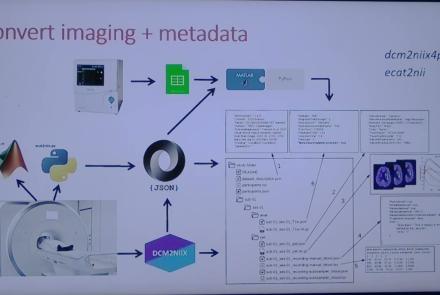
This session introduces the PET-to-BIDS (PET2BIDS) library, a toolkit designed to simplify the conversion and preparation of PET imaging datasets into BIDS-compliant formats. It supports multiple data types and formats (e.g., DICOM, ECAT7+, nifti, JSON), integrates seamlessly with Excel-based metadata, and provides automated routines for metadata updates, blood data conversion, and JSON synchronization. PET2BIDS improves human readability by mapping complex reconstruction names into standardized, descriptive labels and offers extensive documentation, examples, and video tutorials to make adoption easier for researchers.
Difficulty level: Intermediate
Duration: 9:23
Speaker: : Cyril Pernet
This session introduces the PET-to-BIDS (PET2BIDS) library, a toolkit designed to simplify the conversion and preparation of PET imaging datasets into BIDS-compliant formats. It supports multiple data types and formats (e.g., DICOM, ECAT7+, nifti, JSON), integrates seamlessly with Excel-based metadata, and provides automated routines for metadata updates, blood data conversion, and JSON synchronization. PET2BIDS improves human readability by mapping complex reconstruction names into standardized, descriptive labels and offers extensive documentation, examples, and video tutorials to make adoption easier for researchers.
Difficulty level: Intermediate
Duration: 41:04
Speaker: : Martin Nørgaard
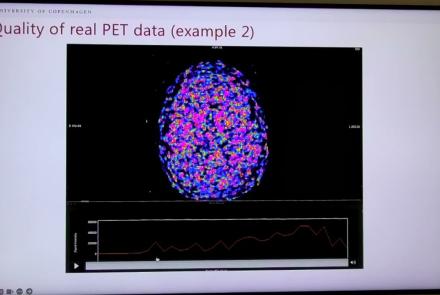
This session dives into practical PET tooling on BIDS data—showing how to run motion correction, register PET↔MRI, extract time–activity curves, and generate standardized PET-BIDS derivatives with clear QC reports. It introduces modular BIDS Apps (head-motion correction, TAC extraction), a full pipeline (PETPrep), and a PET/MRI defacer, with guidance on parameters, outputs, provenance, and why Dockerized containers are the reliable way to run them at scale.
Difficulty level: Intermediate
Duration: 1:05:38
Speaker: : Martin Nørgaard

This session introduces two PET quantification tools—bloodstream for processing arterial blood data and kinfitr for kinetic modeling and quantification—built to work with BIDS/BIDS-derivatives and containers. Bloodstream fuses autosampler and manual measurements (whole blood, plasma, parent fraction) using interpolation or fitted models (incl. hierarchical GAMs) to produce a clean arterial input function (AIF) and whole-blood curves with rich QC reports ready. TAC data (e.g., from PETPrep) and blood (e.g., from bloodstream) can be ingested using kinfitr to run reproducible, GUI-driven analyses: define combined ROIs, calculate weighting factors, estimate blood–tissue delay, choose and chain models (e.g., 2TCM → 1TCM with parameter inheritance), and export parameters/diagnostics. Both are available as Docker apps; workflows emphasize configuration files, reports, and standard outputs to support transparency and reuse.
Difficulty level: Intermediate
Duration: 1:20:56
Speaker: : Granville Matheson

This lecture covers positron emission tomography (PET) imaging and the Brain Imaging Data Structure (BIDS), and how they work together within the PET-BIDS standard to make neuroscience more open and FAIR.
Difficulty level: Beginner
Duration: 12:06
Speaker: : Melanie Ganz

Course:
This module covers many of the types of non-invasive neurotech and neuroimaging devices including electroencephalography (EEG), electromyography (EMG), electroneurography (ENG), magnetoencephalography (MEG), and more.
Difficulty level: Beginner
Duration: 13:36
Speaker: : Harrison Canning

The number of patients with dementia is estimated to increase given the aging population. This will lead to a number of challenges in the future in terms of diagnosis and care for patients with dementia. To meet these needs such as early diagnsosis and development of prognostic biomarkers, large datasets, such as the federated datasets on dementia. The EAN Dementia and cognitive disorders scientific panel can play an important role as coordinator and connecting panel members who wish to participate in e.g. consortia.
Difficulty level: Intermediate
Duration: 15:39
Speaker: : Kristian Steen Frederiksen

This lesson gives an in-depth introduction of ethics in the field of artificial intelligence, particularly in the context of its impact on humans and public interest. As the healthcare sector becomes increasingly affected by the implementation of ever stronger AI algorithms, this lecture covers key interests which must be protected going forward, including privacy, consent, human autonomy, inclusiveness, and equity.
Difficulty level: Beginner
Duration: 1:22:06
Speaker: : Daniel Buchman

This lesson describes a definitional framework for fairness and health equity in the age of the algorithm. While acknowledging the impressive capability of machine learning to positively affect health equity, this talk outlines potential (and actual) pitfalls which come with such powerful tools, ultimately making the case for collaborative, interdisciplinary, and transparent science as a way to operationalize fairness in health equity.
Difficulty level: Beginner
Duration: 1:06:35
Speaker: : Laura Sikstrom

This lesson is the first part of a three-part series on the development of neuroinformatic infrastructure to ensure compliance with European data privacy standards and laws.
Difficulty level: Beginner
Duration: 1:10:05
Speaker: : Michael Schirner

This is the second of three lectures around current challenges and opportunities facing neuroinformatic infrastructure for handling sensitive data.
Difficulty level: Beginner
Duration: 48:26
Speaker: : Michael Schirner

This lesson contains the first part of the lecture Data Science and Reproducibility. You will learn about the development of data science and what the term currently encompasses, as well as how neuroscience and data science intersect.
Difficulty level: Beginner
Duration: 32:18
Speaker: : Ariel Rokem

This lecture gives a tour of what neuroethics is and how it applies to neuroscience and neurotechnology, while also addressing justice concerns within both fields.
Difficulty level: Beginner
Duration: 58:45
Speaker: : Tim Brown

This lecture presents selected theories of ethics as applied to questions raised by the Human Brain Project.
Difficulty level: Beginner
Duration: 38:49
Speaker: : Christine Mitchell

The HBP as an ICT flagship project crucially relies on ICT and will contribute important input into the development of new computing principles and artefacts. Individuals working on the HBP should therefore be aware of the long history of ethical issues discussed in computing. This lessson provides an overview of the most widely discussed ethical issues in computing and demonstrate that privacy and data protection are by no means the only issue worth worrying about.
Difficulty level: Beginner
Duration: 46:12
Speaker: : Bernd Stahl

This lecture explores two questions regarding the ethics of robot development and use. Firstly, the increasingly urgent question of the ethical use of robots: are there particular applications of robots that should be proscribed, in eldercare, or surveillance, or combat? Secondly, the talk deals with the longer-term question of whether intelligent robots themselves could or should be ethical.
Difficulty level: Beginner
Duration: 31:35
Speaker: : Alan Winfield

In this lesson, attendees will learn about the challenges involved in working with life scientists to enhance their capacity for understanding, and taking responsibility for, the social implications of their research.
Difficulty level: Beginner
Duration: 50:15
Speaker: : Nikolas Rose

This lecture considers some of the key social and ethical issues raised by the ‘big brain projects’ currently under way in Europe, the USA, China, Japan, and many other regions.
Difficulty level: Beginner
Duration: 53:08
Speaker: : Nikolas Rose

This lecture aims to give an introduction and overview of the dual-use challenge as it applies to neuroscience today and will apply in coming decades.
Difficulty level: Beginner
Duration: 40:11
Speaker: : Malcolm Dando