
Lesson type
Difficulty level

This lecture covers the history of behaviorism and the ultimate challenge to behaviorism.
Difficulty level: Beginner
Duration: 1:19:08
Speaker: : Paul F.M.J. Verschure

In this lesson, you will learn how to utilize various features and tools included in the EBRAINS platform, particularly focusing on rodent brain atlases and how to incorporate them into your analyses.
Difficulty level: Beginner
Duration: 15:48
Speaker: : Sharon Yates
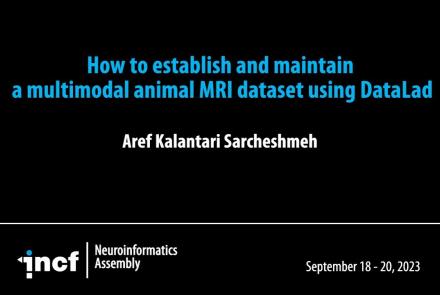
This talk describes how to use DataLad for your data management and curation techniques when dealing with animal datasets, which often contain several disparate types of data, including MRI, microscopy, histology, electrocorticography, and behavioral measurements.
Difficulty level: Beginner
Duration: 3:35
Speaker: : Aref Kalantari Sarcheshmeh

In this short talk you will learn about The Neural System Laboratory, which aims to develop and implement new technologies for analysis of brain architecture, connectivity, and brain-wide gene and molecular level organization.
Difficulty level: Beginner
Duration: 8:38
Speaker: : Trygve Leergard

In this lesson, you will learn about the connectome, the collective system of neural pathways in an organism, with a closer look at the neurons, synapses, and connections of particular species.
Difficulty level: Intermediate
Duration: 6:48
Speaker: : Marcus Ghosh

This lesson introduces the practical exercises which accompany the previous lessons on animal and human connectomes in the brain and nervous system.
Difficulty level: Intermediate
Duration: 4:10
Speaker: : Dan Goodman

Course:
In this lecture, attendees will learn how Mutant Mouse Resource and Research Center (MMRRC) archives, cryopreserves, and distributes scientifically valuable genetically engineered mouse strains and mouse ES cell lines for the genetics and biomedical research community.
Difficulty level: Beginner
Duration: 43:38
Speaker: : Kent Lloyd

This lecture discusses how to standardize electrophysiology data organization to move towards being more FAIR.
Difficulty level: Beginner
Duration: 15:51
Speaker: : Sylvain Takerkart

Course:
In this lesson, while learning about the need for increased large-scale collaborative science that is transparent in nature, users also are given a tutorial on using Synapse for facilitating reusable and reproducible research.
Difficulty level: Beginner
Duration: 1:15:12
Speaker: : Abhi Pratap

This lecture discusses what defines an integrative approach regarding research and methods, including various study designs and models which are appropriate choices when attempting to bridge data domains; a necessity when whole-person modelling.
Difficulty level: Beginner
Duration: 1:28:14
Speaker: : Dan Felsky

Similarity Network Fusion (SNF) is a computational method for data integration across various kinds of measurements, aimed at taking advantage of the common as well as complementary information in different data types. This workshop walks participants through running SNF on EEG and genomic data using RStudio.
Difficulty level: Intermediate
Duration: 1:21:38
Speaker: : Dan Felsky

This lesson provides an introduction the International Neuroinformatics Coordinating Facility (INCF), its mission towards FAIR neuroscience, and future directions.
Difficulty level: Beginner
Duration: 20:29
Speaker: : Maryann Martone

This brief video provides an introduction to the third session of INCF's Neuroinformatics Assembly 2023, focusing on how to streamling cross-platform data integration in a neuroscientific context.
Difficulty level: Beginner
Duration: 5:55
Speaker: : Bing-Xing Huo

This final lesson of the course consists of the panel discussion for Streamlining Cross-Platform Data Integration session during the first day of INCF's Neuroinformatics Assembly 2023.
Difficulty level: Beginner
Duration: 50:16
Speaker: :

This lightning talk describes the heterogeneity of the MR field regarding types of scanners, data formats, protocols, and software/hardware versions, as well as the challenges and opportunities for unifying these datasets in a common interface, MRdataset.
Difficulty level: Beginner
Duration: 5:15
Speaker: : Harsh Sinha

This session covers the framework of the International Brain Lab (IBL) and the data architecture used for this project.
Difficulty level: Beginner
Duration: 23:37
Speaker: : Kenneth Harris

Course:
This lesson describes the principles underlying functional magnetic resonance imaging (fMRI), diffusion-weighted imaging (DWI), tractography, and parcellation. These tools and concepts are explained in a broader context of neural connectivity and mental health.
Difficulty level: Intermediate
Duration: 1:47:22
Speaker: : Erin Dickie and John Griffiths

Course:
This tutorial introduces pipelines and methods to compute brain connectomes from fMRI data. With corresponding code and repositories, participants can follow along and learn how to programmatically preprocess, curate, and analyze functional and structural brain data to produce connectivity matrices.
Difficulty level: Intermediate
Duration: 1:39:04
Speaker: : Erin Dickie and John Griffiths

This lesson delves into the human nervous system and the immense cellular, connectomic, and functional sophistication therein.
Difficulty level: Intermediate
Duration: 8:41
Speaker: : Marcus Ghosh

In this lesson, you will hear about some of the open issues in the field of neuroscience, as well as a discussion about whether neuroscience works, and how can we know?
Difficulty level: Intermediate
Duration: 6:54
Speaker: : Marcus Ghosh