
Lesson type
Difficulty level

Course:
The Mouse Phenome Database (MPD) provides access to primary experimental trait data, genotypic variation, protocols and analysis tools for mouse genetic studies. Data are contributed by investigators worldwide and represent a broad scope of phenotyping endpoints and disease-related traits in naïve mice and those exposed to drugs, environmental agents or other treatments. MPD ensures rigorous curation of phenotype data and supporting documentation using relevant ontologies and controlled vocabularies. As a repository of curated and integrated data, MPD provides a means to access/re-use baseline data, as well as allows users to identify sensitized backgrounds for making new mouse models with genome editing technologies, analyze trait co-inheritance, benchmark assays in their own laboratories, and many other research applications. MPD’s primary source of funding is NIDA. For this reason, a majority of MPD data is neuro- and behavior-related.
Difficulty level: Beginner
Duration: 55:36
Speaker: : Elissa Chesler

In this lesson you will learn about current efforts towards integrating multimodal human brain data using the open source SCORE HED library schema.
Difficulty level: Beginner
Duration: 23:29
Speaker: : Dora Hermes

This talk covers the differences between applying HED annotation to fMRI datasets versus other neuroimaging practices, and also introduces an analysis pipeline using HED tags.
Difficulty level: Beginner
Duration: 22:52
Speaker: : Monique Denissen

This lecture discusses the FAIR principles as they apply to electrophysiology data and metadata, the building blocks for community tools and standards, platforms and grassroots initiatives, and the challenges therein.
Difficulty level: Beginner
Duration: 8:11
Speaker: : Thomas Wachtler
This lecture contains an overview of electrophysiology data reuse within the EBRAINS ecosystem.
Difficulty level: Beginner
Duration: 15:57
Speaker: : Andrew Davison

This video explains what metadata is, why it is important, and how you can organize your metadata to increase the FAIRness of your data on EBRAINS.
Difficulty level: Beginner
Duration: 17:23
Speaker: : Ulrike Schlegel

This lesson contains practical exercises which accompanies the first few lessons of the Neuroscience for Machine Learners (Neuro4ML) course.
Difficulty level: Intermediate
Duration: 5:58
Speaker: : Dan Goodman

This video briefly goes over the exercises accompanying Week 6 of the Neuroscience for Machine Learners (Neuro4ML) course, Understanding Neural Networks.
Difficulty level: Intermediate
Duration: 2:43
Speaker: : Marcus Ghosh

Course:
This lecture covers the description and characterization of an input-output relationship in a information-theoretic context.
Difficulty level: Beginner
Duration: 1:35:33
Speaker: : Jonathan D. Victor

This lesson is part 1 of 2 of a tutorial on statistical models for neural data.
Difficulty level: Beginner
Duration: 1:45:48
Speaker: : Jonathan Pillow
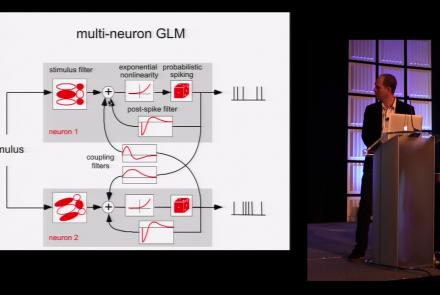
This lesson is part 2 of 2 of a tutorial on statistical models for neural data.
Difficulty level: Beginner
Duration: 1:50:31
Speaker: : Jonathan Pillow

Course:
This lesson provides an introduction to modeling single neurons, as well as stability analysis of neural models.
Difficulty level: Intermediate
Duration: 1:26:06
Speaker: : Bard Ermentrout

Course:
This lesson continues a thorough description of the concepts, theories, and methods involved in the modeling of single neurons.
Difficulty level: Intermediate
Duration: 1:25:38
Speaker: : Bard Ermentrout

Course:
In this lesson you will learn about fundamental neural phenomena such as oscillations and bursting, and the effects these have on cortical networks.
Difficulty level: Intermediate
Duration: 1:24:30
Speaker: : Bard Ermentrout

Course:
This lesson continues discussing properties of neural oscillations and networks.
Difficulty level: Intermediate
Duration: 1:31:57
Speaker: : Bard Ermentrout

Course:
In this lecture, you will learn about rules governing coupled oscillators, neural synchrony in networks, and theoretical assumptions underlying current understanding.
Difficulty level: Intermediate
Duration: 1:26:02
Speaker: : Bard Ermentrout

Course:
This lesson provides a continued discussion and characterization of coupled oscillators.
Difficulty level: Intermediate
Duration: 1:24:44
Speaker: : Bard Ermentrout

Course:
This lesson gives an overview of modeling neurons based on firing rate.
Difficulty level: Intermediate
Duration: 1:26:42
Speaker: : Bard Ermentrout

Course:
This lesson characterizes the pattern generation observed in visual system hallucinations.
Difficulty level: Intermediate
Duration: 1:20:42
Speaker: : Bard Ermentrout