
Lesson type
Difficulty level

This lesson gives a description of the BrainHealth Databank, a repository of many types of health-related data, whose aim is to accelerate research, improve care, and to help better understand and diagnose mental illness, as well as develop new treatments and prevention strategies.
This lesson corresponds to slides 46-78 of the PDF below.
Difficulty level: Beginner
Duration: 1:12:25
Speaker: : Joanna Yu

This lesson describes not only the need for precision medicine, but also the current state of the methods, pharmacogenetic approaches, utility and implementation of such care today.
This lesson corresponds to slides 1-50 of the PowerPoint below.
Difficulty level: Beginner
Duration: 1:24:30
Speaker: : Dan Felsky

Course:
This lecture covers the needs and challenges involved in creating a FAIR ecosystem for neuroimaging research.
Difficulty level: Beginner
Duration: 12:26
Speaker: : Camille Maumet

This lecture covers how to make modeling workflows FAIR by working through a practical example, dissecting the steps within the workflow, and detailing the tools and resources used at each step.
Difficulty level: Beginner
Duration: 15:14
Speaker: : Salvador Dura-Bernal
This lecture focuses on the structured validation process within computational neuroscience, including the tools, services, and methods involved in simulation and analysis.
Difficulty level: Beginner
Duration: 14:19
Speaker: : Michael Denker

Course:
This session provides users with an introduction to tools and resources that facilitate the implementation of FAIR in their research.
Difficulty level: Beginner
Duration: 38:36

This lecture covers the linking neuronal activity to behavior using AI-based online detection.
Difficulty level: Beginner
Duration: 30:39
Speaker: : Martin K. Schwarz and Jens Schweihoff

This lesson gives an in-depth introduction of ethics in the field of artificial intelligence, particularly in the context of its impact on humans and public interest. As the healthcare sector becomes increasingly affected by the implementation of ever stronger AI algorithms, this lecture covers key interests which must be protected going forward, including privacy, consent, human autonomy, inclusiveness, and equity.
Difficulty level: Beginner
Duration: 1:22:06
Speaker: : Daniel Buchman

This lecture provides an introduction to the course "Cognitive Science & Psychology: Mind, Brain, and Behavior".
Difficulty level: Beginner
Duration: 1:06:49
Speaker: : Paul F.M.J. Verschure

This lecture goes into further detail about the hard problem of developing a scientific discipline for subjective consciousness.
Difficulty level: Beginner
Duration: 58:03
Speaker: : Paul F.M.J. Verschure

This lecture covers a lot of post-war developments in the science of the mind, focusing first on the cognitive revolution, and concluding with living machines.
Difficulty level: Beginner
Duration: 2:24:35
Speaker: : Paul F.M.J. Verschure

This brief talk goes into work being done at The Alan Turing Institute to solve real-world challenges and democratize computer vision methods to support interdisciplinary and international researchers.
Difficulty level: Beginner
Duration: 7:10
Speaker: : Alden Connor & Beatriz Costa Gomes

In this final lecture of the INCF Short Course: Introduction to Neuroinformatics, you will hear about new advances in the application of machine learning methods to clinical neuroscience data. In particular, this talk discusses the performance of SynthSeg, an image segmentation tool for automated analysis of highly heterogeneous brain MRI clinical scans.
Difficulty level: Intermediate
Duration: 1:32:01
Speaker: : Juan Eugenio Iglesias

Course:
Overview of the content for Day 1 of this course.
Difficulty level: Beginner
Duration: 00:01:59
Speaker: : Tristan Shuman

Course:
Overview of Day 2 of this course.
Difficulty level: Beginner
Duration: 00:03:28
Speaker: : Tristan Shuman

Course:
Best practices: the tips and tricks on how to get your Miniscope to work and how to get your experiments off the ground.
Difficulty level: Beginner
Duration: 00:53:34

Course:
This talk compares various sensors and resolutions for in vivo neural recordings.
Difficulty level: Beginner
Duration: 00:24:03
Speaker: : Susie Feng, Zach Pennington, Caleb Kemere
Course:
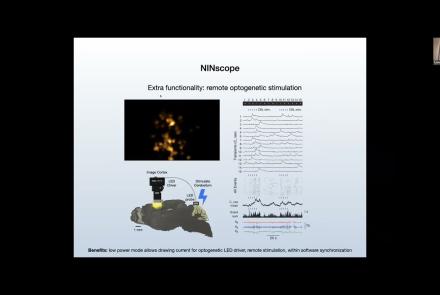
This talk delves into challenges and opportunities of Miniscope design, seeking the optimal balance between scale and function.
Difficulty level: Beginner
Duration: 00:21:51
Speaker: : Susie Feng, Zach Pennington, Tycho Hoogland

Course:
Attendees of this talk will learn aobut computational imaging systems and associated pipelines, as well as open-source software solutions supporting miniscope use.
Difficulty level: Beginner
Duration: 00:17:56
Speaker: : Susie Feng, Zach Pennington, Laura Waller

Course:
This talk covers the present state and future directions of calcium imaging data analysis, particularly in the context of one-photon vs two-photon approaches.
Difficulty level: Beginner
Duration: 00:21:06