
Lesson type
Difficulty level

Course:
This lesson provides an overview of the database of Genotypes and Phenotypes (dbGaP), which was developed to archive and distribute the data and results from studies that have investigated the interaction of genotype and phenotype in humans.
Difficulty level: Beginner
Duration: 48:22
Speaker: : Michael Feolo

This lightning talk describes an automated pipline for positron emission tomography (PET) data.
Difficulty level: Intermediate
Duration: 7:27
Speaker: : Soodeh Moallemian
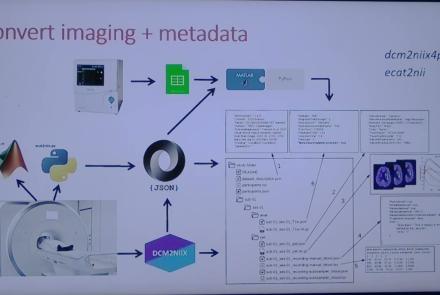
This session introduces the PET-to-BIDS (PET2BIDS) library, a toolkit designed to simplify the conversion and preparation of PET imaging datasets into BIDS-compliant formats. It supports multiple data types and formats (e.g., DICOM, ECAT7+, nifti, JSON), integrates seamlessly with Excel-based metadata, and provides automated routines for metadata updates, blood data conversion, and JSON synchronization. PET2BIDS improves human readability by mapping complex reconstruction names into standardized, descriptive labels and offers extensive documentation, examples, and video tutorials to make adoption easier for researchers.
Difficulty level: Intermediate
Duration: 9:23
Speaker: : Cyril Pernet
This session introduces the PET-to-BIDS (PET2BIDS) library, a toolkit designed to simplify the conversion and preparation of PET imaging datasets into BIDS-compliant formats. It supports multiple data types and formats (e.g., DICOM, ECAT7+, nifti, JSON), integrates seamlessly with Excel-based metadata, and provides automated routines for metadata updates, blood data conversion, and JSON synchronization. PET2BIDS improves human readability by mapping complex reconstruction names into standardized, descriptive labels and offers extensive documentation, examples, and video tutorials to make adoption easier for researchers.
Difficulty level: Intermediate
Duration: 41:04
Speaker: : Martin Nørgaard
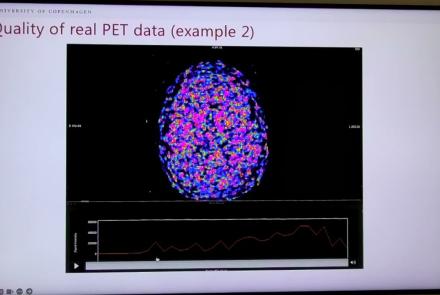
This session dives into practical PET tooling on BIDS data—showing how to run motion correction, register PET↔MRI, extract time–activity curves, and generate standardized PET-BIDS derivatives with clear QC reports. It introduces modular BIDS Apps (head-motion correction, TAC extraction), a full pipeline (PETPrep), and a PET/MRI defacer, with guidance on parameters, outputs, provenance, and why Dockerized containers are the reliable way to run them at scale.
Difficulty level: Intermediate
Duration: 1:05:38
Speaker: : Martin Nørgaard

This session introduces two PET quantification tools—bloodstream for processing arterial blood data and kinfitr for kinetic modeling and quantification—built to work with BIDS/BIDS-derivatives and containers. Bloodstream fuses autosampler and manual measurements (whole blood, plasma, parent fraction) using interpolation or fitted models (incl. hierarchical GAMs) to produce a clean arterial input function (AIF) and whole-blood curves with rich QC reports ready. TAC data (e.g., from PETPrep) and blood (e.g., from bloodstream) can be ingested using kinfitr to run reproducible, GUI-driven analyses: define combined ROIs, calculate weighting factors, estimate blood–tissue delay, choose and chain models (e.g., 2TCM → 1TCM with parameter inheritance), and export parameters/diagnostics. Both are available as Docker apps; workflows emphasize configuration files, reports, and standard outputs to support transparency and reuse.
Difficulty level: Intermediate
Duration: 1:20:56
Speaker: : Granville Matheson

This lecture covers positron emission tomography (PET) imaging and the Brain Imaging Data Structure (BIDS), and how they work together within the PET-BIDS standard to make neuroscience more open and FAIR.
Difficulty level: Beginner
Duration: 12:06
Speaker: : Melanie Ganz

Course:
This module covers many of the types of non-invasive neurotech and neuroimaging devices including electroencephalography (EEG), electromyography (EMG), electroneurography (ENG), magnetoencephalography (MEG), and more.
Difficulty level: Beginner
Duration: 13:36
Speaker: : Harrison Canning

This video provides a very quick introduction to some of the neuromorphic sensing devices, and how they offer unique, low-power applications.
Difficulty level: Intermediate
Duration: 2:37
Speaker: : Dan Goodman

This lecture covers the ethical implications of the use of brain-computer interfaces, brain-machine interfaces, and deep brain stimulation to enhance brain functions and was part of the Neuro Day Workshop held by the NeuroSchool of Aix Marseille University.
Difficulty level: Beginner
Duration: 1:02:00
Speaker: : Jens Clausen

Course:
In this module you will learn the basics of Brain Computer Interface (BCI). You will read an introduction to the different technologies available, the main components and steps required for BCI, associated safety and ethical issues, as well as an overview about the future of the field.
Difficulty level: Beginner
Duration: 11:02
Speaker: : Colin Fausnaught

Course:
In this module, users will learn about the different types of neurotechnology and how each of them works. This will be done through the metaphor of going to a symphony... in your brain. Like a symphony, brain processes emerge from collections of neural activity. This video encourages us to imagine ourselves moving to different areas in the concert hall to understand where different technologies interface. Once the concert ends, we talk about underlying neural mechanisms and technology that allow researchers and innovators to interact with the brain.
Difficulty level: Beginner
Duration: 10:49
Speaker: : Harrison Canning

Course:
This module addresses how neurotechnology is currently used for medical and non-medical applications, and how it might advance in the future.
Difficulty level: Beginner
Duration: 6:57
Speaker: : Colin Fausnaught

Course:
This module covers a brief history of the neurotechnology industry, bringing the history of brain-computer interfacing to life through engaging skits and stories.
Difficulty level: Beginner
Duration: 12:53
Speaker: : Colin Fausnaught

Course:
This module covers many types of invasive neurotechnology devices/interfaces for the central and peripheral nervous systems. Invasive neurotech devices are crucial, as they often provide the greatest accuracy and long-term use applicability.
Difficulty level: Beginner
Duration: 9:40
Speaker: : Colin Fausnaught

Course:
Neuromodulation refers to devices that influence the firing of neurons which can be useful in many medical applications. This modules covers what neuromodulation is, how it affects the functioning of neurons, and the many forms that these devices take on.
Difficulty level: Beginner
Duration: 12:18
Speaker: : Harrison Canning

Course:
This modules covers neuroprosthetic and cognitive enhancement devices that can help augment our capabilities by enhancing memory, as well as restoring or improving our senses.
Difficulty level: Beginner
Duration: 8:35
Speaker: : Colin Fausnaught
Course:
This module goes over the methods that neurotechnologists use to turn brain data into commands a computer or a machine can understand. We cover data collection, processing, filtering, analysis, how to generate an action in a device, asynchronous BCIs that use population encoding, and synchronous BCIs that use P300, SSVEP, N100, and N400 signals.
Difficulty level: Beginner
Duration: 14:47
Speaker: : Colin Fausnaught

Course:
This module covers the many things that brain-computer interfaces can and will be able to do, including motor neuroprosthetics like prosthetic arms, exosuits, and vehicle control, as well as computer and machine interfacing use-cases.
Difficulty level: Beginner
Duration: 16:39
Speaker: : Harrison Canning

Course:
This module covers how neurotechnology is perceived in media today. We discuss a few specific films and talk about how the perception of neurotechnology changes with our media. Finally, we introduce a few interesting terms related to ethics and address some future issues the technology may cause.
Difficulty level: Beginner
Duration: 12:03
Speaker: : Colin Fausnaught