
Lesson type
Difficulty level

This is the Introductory Module to the Deep Learning Course at CDS, a course that covered the latest techniques in deep learning and representation learning, focusing on supervised and unsupervised deep learning, embedding methods, metric learning, convolutional and recurrent nets, with applications to computer vision, natural language understanding, and speech recognition.
Difficulty level: Intermediate
Duration: 50:17
Speaker: : Yann LeCun and Alfredo Canziani

This module covers the concepts of gradient descent and the backpropagation algorithm and is a part of the Deep Learning Course at NYU's Center for Data Science.
Difficulty level: Intermediate
Duration: 1:51:03
Speaker: : Yann LeCun

This lesson provides a detailed description of some of the modules and architectures involved in the development of neural networks.
Difficulty level: Intermediate
Duration: 1:42:26
Speaker: : Yann LeCun and Alfredo Canziani

This lecture covers the concept of parameter sharing: recurrent and convolutional nets and is a part of the Deep Learning Course at NYU's Center for Data Science.
Difficulty level: Intermediate
Duration: 1:59:47
Speaker: : Yann LeCun and Alfredo Canziani

This lecture covers the concept of convolutional nets in practice and is a part of the Deep Learning Course at NYU's Center for Data Science.
Difficulty level: Intermediate
Duration: 51:40
Speaker: : Yann LeCun
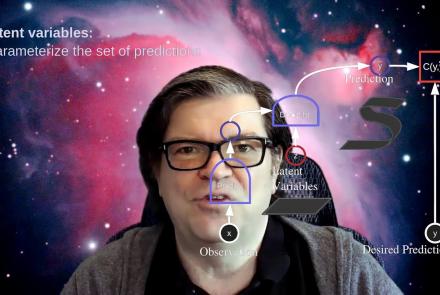
This lecture is a foundationational lecture for the concept of energy-based models with a particular focus on the joint embedding method and latent variable energy-based models (LV-EBMs) and is a part of the Deep Learning Course at NYU's Center for Data Science.
Difficulty level: Intermediate
Duration: 1:51:30
Speaker: : Yann LeCun

This lecture is a foundationational lecture for the concept of energy-based models with a particular focus on the joint embedding method and latent variable energy based models (LV-EBMs) and is a part of the Deep Learning Course at NYU's Center for Data Science.
Difficulty level: Intermediate
Duration: 1:48:53
Speaker: : Yann LeCun

This lecture covers advanced concepts of energy-based models. The lecture is a part of the Advanced Energy-Based Models module of the the Deep Learning Course at NYU's Center for Data Science. Prerequisites for this course include: Energy-Based Models I, Energy-Based Models II, and an Introduction to Data Science or a Graduate Level Machine Learning course.
Difficulty level: Advanced
Duration: 1:54:22
Speaker: : Yann LeCun

This lecture covers advanced concepts of energy-based models. The lecture is a part of the Advanced energy based models modules of the the Deep Learning Course at NYU's Center for Data Science. Prerequisites for this course include: Energy-Based Models I, Energy-Based Models II, Energy-Based Models III, and an Introduction to Data Science or a Graduate Level Machine Learning course.
Difficulty level: Advanced
Duration: 1:54:43
Speaker: : Yann LeCun

This lecture covers advanced concepts of energy-based models. The lecture is a part of the Advanced energy based models modules of the the Deep Learning Course at NYU's Center for Data Science. Prerequisites for this course include: Energy-Based Models I, Energy-Based Models II, Energy-Based Models III, Energy-Based Models IV, and an Introduction to Data Science or a Graduate Level Machine Learning course.
Difficulty level: Advanced
Duration: 2:00:28
Speaker: : Yann LeCun
This lecture covers advanced concepts of energy-based models. The lecture is a part of the Associative Memories module of the the Deep Learning Course at NYU's Center for Data Science. Prerequisites for this course include: Energy-Based Models I, Energy-Based Models II, Energy-Based Models III, Energy-Based Models IV, Energy-Based Models V, and an Introduction to Data Science or a Graduate Level Machine Learning course.
Difficulty level: Advanced
Duration: 2:00:28
Speaker: : Yann LeCun

Course:
This lecture provides an introduction to the problem of speech recognition using neural models, emphasizing the CTC loss for training and inference when input and output sequences are of different lengths. It also covers the concept of beam search for use during inference, and how that procedure may be modeled at training time using a Graph Transformer Network. It is a part of the Deep Learning Course at NYU's Center for Data Science. Prerequisites for this module include: Modules 1 - 5 of this course and an Introduction to Data Science or a Graduate Level Machine Learning course.
Difficulty level: Advanced
Duration: 1:55:03
Speaker: : Awni Hannun

Course:
This lecture covers the concepts of the architecture and convolution of traditional convolutional neural networks, the characteristics of graph and graph convolution, and spectral graph convolutional neural networks and how to perform spectral convolution, as well as the complete spectrum of Graph Convolutional Networks (GCNs), starting with the implementation of Spectral Convolution through Spectral Networks. It then provides insights on applicability of the other convolutional definition of Template Matching to graphs, leading to Spatial networks. This lecture is a part of the Deep Learning Course at NYU's Center for Data Science. Prerequisites for this module include: Modules 1 - 5 of this course and an Introduction to Data Science or a Graduate Level Machine Learning course.
Difficulty level: Advanced
Duration: 2:00:22
Speaker: : Xavier Bresson

Course:
This lecture covers the concepts of gradient descent, stochastic gradient descent, and momentum. It is a part of the Deep Learning Course at NYU's Center for Data Science. Prerequisites for this module include: Models 1-7 of this course and an Introduction to Data Science or a Graduate Level Machine Learning course.
Difficulty level: Advanced
Duration: 1:29:05
Speaker: : Aaron DeFazio
Course:
This lesson gives an introduction to deep learning, with a perspective via inductive biases and emphasis on correctly matching deep learning to the right research questions.
Difficulty level: Beginner
Duration: 01:35:12
Speaker: : Blake Richards

This lesson gives an in-depth introduction of ethics in the field of artificial intelligence, particularly in the context of its impact on humans and public interest. As the healthcare sector becomes increasingly affected by the implementation of ever stronger AI algorithms, this lecture covers key interests which must be protected going forward, including privacy, consent, human autonomy, inclusiveness, and equity.
Difficulty level: Beginner
Duration: 1:22:06
Speaker: : Daniel Buchman

This lesson describes a definitional framework for fairness and health equity in the age of the algorithm. While acknowledging the impressive capability of machine learning to positively affect health equity, this talk outlines potential (and actual) pitfalls which come with such powerful tools, ultimately making the case for collaborative, interdisciplinary, and transparent science as a way to operationalize fairness in health equity.
Difficulty level: Beginner
Duration: 1:06:35
Speaker: : Laura Sikstrom

This lesson contains the first part of the lecture Data Science and Reproducibility. You will learn about the development of data science and what the term currently encompasses, as well as how neuroscience and data science intersect.
Difficulty level: Beginner
Duration: 32:18
Speaker: : Ariel Rokem

This lecture presents selected theories of ethics as applied to questions raised by the Human Brain Project.
Difficulty level: Beginner
Duration: 38:49
Speaker: : Christine Mitchell

The HBP as an ICT flagship project crucially relies on ICT and will contribute important input into the development of new computing principles and artefacts. Individuals working on the HBP should therefore be aware of the long history of ethical issues discussed in computing. This lessson provides an overview of the most widely discussed ethical issues in computing and demonstrate that privacy and data protection are by no means the only issue worth worrying about.
Difficulty level: Beginner
Duration: 46:12
Speaker: : Bernd Stahl