
Lesson type
Difficulty level

Course:
In this lesson, users will learn about human brain signals as measured by electroencephalography (EEG), as well as associated neural signatures such as steady state visually evoked potentials (SSVEPs) and alpha oscillations.
Difficulty level: Intermediate
Duration: 8:51
Speaker: : Mike X. Cohen

This is a continuation of the talk on the cellular mechanisms of neuronal communication, this time at the level of brain microcircuits and associated global signals like those measureable by electroencephalography (EEG). This lecture also discusses EEG biomarkers in mental health disorders, and how those cortical signatures may be simulated digitally.
Difficulty level: Intermediate
Duration: 1:11:04
Speaker: : Etay Hay

This lesson provides an introduction to the lifecycle of EEG/ERP data, describing the various phases through which these data pass, from collection to publication.
Difficulty level: Beginner
Duration: 35:30
Speaker: : Kateřina Vařeková

In this lesson you will learn about experimental design for EEG acquisition, as well as the first phases of the EEG/ERP data lifecycle.
Difficulty level: Beginner
Duration: 30:04
Speaker: : Kateřina Vařeková

This lesson provides an overview of the current regulatory measures in place regarding experimental data security and privacy.
Difficulty level: Beginner
Duration: 31:00
Speaker: : Kateřina Vařeková

In this lesson, you will learn the appropriate methods for collection of both data and associated metadata during EEG experiments.
Difficulty level: Beginner
Duration: 29:14
Speaker: : Kateřina Vařeková

This lesson goes over methods for managing EEG/ERP data after it has been collected, from annotation to publication.
Difficulty level: Beginner
Duration: 39:25
Speaker: : Kateřina Vařeková

In this final lesson of the course, you will learn broadly about EEG signal processing, as well as specific applications which make this kind of brain signal valuable to researchers and clinicians.
Difficulty level: Beginner
Duration: 34:51
Speaker: : Kateřina Vařeková

This lecture gives an overview of how to prepare and preprocess neuroimaging (EEG/MEG) data for use in TVB.
Difficulty level: Intermediate
Duration: 1:40:52
Speaker: : Paul Triebkorn

This lecture contains an overview of the Australian Electrophysiology Data Analytics Platform (AEDAPT), how it works, how to scale it, and how it fits into the FAIR ecosystem.
Difficulty level: Beginner
Duration: 18:56
Speaker: : Tom Johnstone

Course:
This module covers many of the types of non-invasive neurotech and neuroimaging devices including electroencephalography (EEG), electromyography (EMG), electroneurography (ENG), magnetoencephalography (MEG), and more.
Difficulty level: Beginner
Duration: 13:36
Speaker: : Harrison Canning

This is the Introductory Module to the Deep Learning Course at CDS, a course that covered the latest techniques in deep learning and representation learning, focusing on supervised and unsupervised deep learning, embedding methods, metric learning, convolutional and recurrent nets, with applications to computer vision, natural language understanding, and speech recognition.
Difficulty level: Intermediate
Duration: 50:17
Speaker: : Yann LeCun and Alfredo Canziani

This module covers the concepts of gradient descent and the backpropagation algorithm and is a part of the Deep Learning Course at NYU's Center for Data Science.
Difficulty level: Intermediate
Duration: 1:51:03
Speaker: : Yann LeCun

This lesson provides a detailed description of some of the modules and architectures involved in the development of neural networks.
Difficulty level: Intermediate
Duration: 1:42:26
Speaker: : Yann LeCun and Alfredo Canziani

This lecture covers the concept of parameter sharing: recurrent and convolutional nets and is a part of the Deep Learning Course at NYU's Center for Data Science.
Difficulty level: Intermediate
Duration: 1:59:47
Speaker: : Yann LeCun and Alfredo Canziani

This lecture covers the concept of convolutional nets in practice and is a part of the Deep Learning Course at NYU's Center for Data Science.
Difficulty level: Intermediate
Duration: 51:40
Speaker: : Yann LeCun
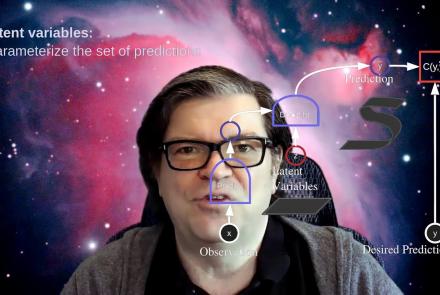
This lecture is a foundationational lecture for the concept of energy-based models with a particular focus on the joint embedding method and latent variable energy-based models (LV-EBMs) and is a part of the Deep Learning Course at NYU's Center for Data Science.
Difficulty level: Intermediate
Duration: 1:51:30
Speaker: : Yann LeCun

This lecture is a foundationational lecture for the concept of energy-based models with a particular focus on the joint embedding method and latent variable energy based models (LV-EBMs) and is a part of the Deep Learning Course at NYU's Center for Data Science.
Difficulty level: Intermediate
Duration: 1:48:53
Speaker: : Yann LeCun

This lecture covers advanced concepts of energy-based models. The lecture is a part of the Advanced Energy-Based Models module of the the Deep Learning Course at NYU's Center for Data Science. Prerequisites for this course include: Energy-Based Models I, Energy-Based Models II, and an Introduction to Data Science or a Graduate Level Machine Learning course.
Difficulty level: Advanced
Duration: 1:54:22
Speaker: : Yann LeCun

This lecture covers advanced concepts of energy-based models. The lecture is a part of the Advanced energy based models modules of the the Deep Learning Course at NYU's Center for Data Science. Prerequisites for this course include: Energy-Based Models I, Energy-Based Models II, Energy-Based Models III, and an Introduction to Data Science or a Graduate Level Machine Learning course.
Difficulty level: Advanced
Duration: 1:54:43
Speaker: : Yann LeCun