
Lesson type
Difficulty level

This is the Introductory Module to the Deep Learning Course at CDS, a course that covered the latest techniques in deep learning and representation learning, focusing on supervised and unsupervised deep learning, embedding methods, metric learning, convolutional and recurrent nets, with applications to computer vision, natural language understanding, and speech recognition.
Difficulty level: Intermediate
Duration: 50:17
Speaker: : Yann LeCun and Alfredo Canziani

This module covers the concepts of gradient descent and the backpropagation algorithm and is a part of the Deep Learning Course at NYU's Center for Data Science.
Difficulty level: Intermediate
Duration: 1:51:03
Speaker: : Yann LeCun

This lecture covers concepts associated with neural nets, including rotation and squashing, and is a part of the Deep Learning Course at New York University's Center for Data Science (CDS).
Difficulty level: Intermediate
Duration: 1:01:53
Speaker: : Alfredo Canziani

This lesson provides a detailed description of some of the modules and architectures involved in the development of neural networks.
Difficulty level: Intermediate
Duration: 1:42:26
Speaker: : Yann LeCun and Alfredo Canziani

This lecture covers the concept of neural nets training (tools, classification with neural nets, and PyTorch implementation) and is a part of the Deep Learning Course at NYU's Center for Data Science.
Difficulty level: Intermediate
Duration: 1:05:47
Speaker: : Alfredo Canziani

This lecture covers the concept of parameter sharing: recurrent and convolutional nets and is a part of the Deep Learning Course at NYU's Center for Data Science.
Difficulty level: Intermediate
Duration: 1:59:47
Speaker: : Yann LeCun and Alfredo Canziani

This lecture covers the concept of convolutional nets in practice and is a part of the Deep Learning Course at NYU's Center for Data Science.
Difficulty level: Intermediate
Duration: 51:40
Speaker: : Yann LeCun

This lecture discusses the concept of natural signals properties and the convolutional nets in practice and is a part of the Deep Learning Course at NYU's Center for Data Science.
Difficulty level: Intermediate
Duration: 1:09:12
Speaker: : Alfredo Canziani

This lecture covers the concept of recurrent neural networks: vanilla and gated (LSTM) and is a part of the Deep Learning Course at NYU's Center for Data Science.
Difficulty level: Intermediate
Duration: 1:05:36
Speaker: : Alfredo Canziani
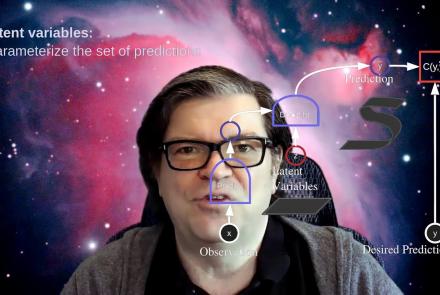
This lecture is a foundationational lecture for the concept of energy-based models with a particular focus on the joint embedding method and latent variable energy-based models (LV-EBMs) and is a part of the Deep Learning Course at NYU's Center for Data Science.
Difficulty level: Intermediate
Duration: 1:51:30
Speaker: : Yann LeCun

This lecture covers the concept of inference in latent variable energy based models (LV-EBMs) and is a part of the Deep Learning Course at NYU's Center for Data Science.
Difficulty level: Intermediate
Duration: 1:01:04
Speaker: : Alfredo Canziani

This panel discussion covers how energy based models are used and is a part of the Deep Learning Course at NYU's Center for Data Science.
Difficulty level: Intermediate
Duration: 10:42
Speaker: : Yann LeCun and Alfredo Canziani

This lecture is a foundationational lecture for the concept of energy-based models with a particular focus on the joint embedding method and latent variable energy based models (LV-EBMs) and is a part of the Deep Learning Course at NYU's Center for Data Science.
Difficulty level: Intermediate
Duration: 1:48:53
Speaker: : Yann LeCun

This tutorial covers the concept of training latent variable energy based models (LV-EBMs) and is is a part of the Deep Learning Course at NYU's Center for Data Science.
Difficulty level: Intermediate
Duration: 1:04:48
Speaker: : Alfredo Canziani

Course:
This tutorial introduces pipelines and methods to compute brain connectomes from fMRI data. With corresponding code and repositories, participants can follow along and learn how to programmatically preprocess, curate, and analyze functional and structural brain data to produce connectivity matrices.
Difficulty level: Intermediate
Duration: 1:39:04
Speaker: : Erin Dickie and John Griffiths

In this lecture, you will learn about current methods, approaches, and challenges to studying human neuroanatomy, particularly through the lense of neuroimaging data such as fMRI and diffusion tensor imaging (DTI).
Difficulty level: Intermediate
Duration: 1:35:14
Speaker: : Matt Glasser

This lesson delves into the human nervous system and the immense cellular, connectomic, and functional sophistication therein.
Difficulty level: Intermediate
Duration: 8:41
Speaker: : Marcus Ghosh

This lecture highlights the importance of correct annotation and assignment of location, and updated atlas resources to avoid errors in navigation and data interpretation.
Difficulty level: Intermediate
Duration: 22:04
Speaker: : Trygve Leergard

We are at the exciting technological stage where it has become feasible to represent the anatomy of an entire human brain at the cellular level. This lecture discusses how neuroanatomy in the 21st Century has become an effort towards the virtualization and standardization of brain tissue.
Difficulty level: Intermediate
Duration: 25:27
Speaker: : Jacopo Annese

This lecture covers essential features of digital brain models for neuroinformatics, particularly NeuroMaps.
Difficulty level: Intermediate
Duration: 22:26
Speaker: : Douglas Bowden