
Lesson type
Difficulty level

This is the Introductory Module to the Deep Learning Course at CDS, a course that covered the latest techniques in deep learning and representation learning, focusing on supervised and unsupervised deep learning, embedding methods, metric learning, convolutional and recurrent nets, with applications to computer vision, natural language understanding, and speech recognition.
Difficulty level: Intermediate
Duration: 50:17
Speaker: : Yann LeCun and Alfredo Canziani

This module covers the concepts of gradient descent and the backpropagation algorithm and is a part of the Deep Learning Course at NYU's Center for Data Science.
Difficulty level: Intermediate
Duration: 1:51:03
Speaker: : Yann LeCun

This lecture covers concepts associated with neural nets, including rotation and squashing, and is a part of the Deep Learning Course at New York University's Center for Data Science (CDS).
Difficulty level: Intermediate
Duration: 1:01:53
Speaker: : Alfredo Canziani

This lesson provides a detailed description of some of the modules and architectures involved in the development of neural networks.
Difficulty level: Intermediate
Duration: 1:42:26
Speaker: : Yann LeCun and Alfredo Canziani

This lecture covers the concept of neural nets training (tools, classification with neural nets, and PyTorch implementation) and is a part of the Deep Learning Course at NYU's Center for Data Science.
Difficulty level: Intermediate
Duration: 1:05:47
Speaker: : Alfredo Canziani

This lecture covers the concept of parameter sharing: recurrent and convolutional nets and is a part of the Deep Learning Course at NYU's Center for Data Science.
Difficulty level: Intermediate
Duration: 1:59:47
Speaker: : Yann LeCun and Alfredo Canziani

This lecture covers the concept of convolutional nets in practice and is a part of the Deep Learning Course at NYU's Center for Data Science.
Difficulty level: Intermediate
Duration: 51:40
Speaker: : Yann LeCun

This lecture discusses the concept of natural signals properties and the convolutional nets in practice and is a part of the Deep Learning Course at NYU's Center for Data Science.
Difficulty level: Intermediate
Duration: 1:09:12
Speaker: : Alfredo Canziani

This lecture covers the concept of recurrent neural networks: vanilla and gated (LSTM) and is a part of the Deep Learning Course at NYU's Center for Data Science.
Difficulty level: Intermediate
Duration: 1:05:36
Speaker: : Alfredo Canziani
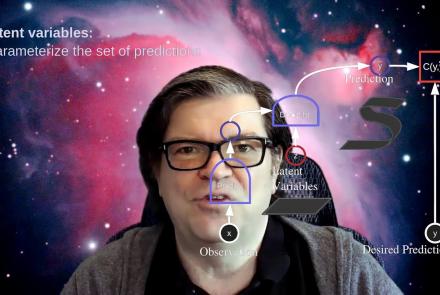
This lecture is a foundationational lecture for the concept of energy-based models with a particular focus on the joint embedding method and latent variable energy-based models (LV-EBMs) and is a part of the Deep Learning Course at NYU's Center for Data Science.
Difficulty level: Intermediate
Duration: 1:51:30
Speaker: : Yann LeCun

This lecture covers the concept of inference in latent variable energy based models (LV-EBMs) and is a part of the Deep Learning Course at NYU's Center for Data Science.
Difficulty level: Intermediate
Duration: 1:01:04
Speaker: : Alfredo Canziani

This panel discussion covers how energy based models are used and is a part of the Deep Learning Course at NYU's Center for Data Science.
Difficulty level: Intermediate
Duration: 10:42
Speaker: : Yann LeCun and Alfredo Canziani

This lecture is a foundationational lecture for the concept of energy-based models with a particular focus on the joint embedding method and latent variable energy based models (LV-EBMs) and is a part of the Deep Learning Course at NYU's Center for Data Science.
Difficulty level: Intermediate
Duration: 1:48:53
Speaker: : Yann LeCun

This tutorial covers the concept of training latent variable energy based models (LV-EBMs) and is is a part of the Deep Learning Course at NYU's Center for Data Science.
Difficulty level: Intermediate
Duration: 1:04:48
Speaker: : Alfredo Canziani

This lesson provides an overview of the current status in the field of neuroscientific ontologies, presenting examples of data organization and standards, particularly from neuroimaging and electrophysiology.
Difficulty level: Intermediate
Duration: 33:41
Speaker: : Yaroslav O. Halchenko

Following the previous lesson on neuronal structure, this lesson discusses neuronal function, particularly focusing on spike triggering and propogation.
Difficulty level: Intermediate
Duration: 6:58
Speaker: : Marcus Ghosh

This lesson introduces the practical exercises which accompany the previous lessons on animal and human connectomes in the brain and nervous system.
Difficulty level: Intermediate
Duration: 4:10
Speaker: : Dan Goodman

This lesson discusses a gripping neuroscientific question: why have neurons developed the discrete action potential, or spike, as a principle method of communication?
Difficulty level: Intermediate
Duration: 9:34
Speaker: : Dan Goodman

This lecture covers NeuronUnit, a library that builds upon SciUnit and integrates with several existing neuroinformatics resources to support validating single-neuron models using data gathered by neurophysiologists.
Difficulty level: Intermediate
Duration: 17:21
Speaker: : Richard Gerkin

This lesson provides an introduction to the NeuroElectro project, which aims to organize information on cellular neurophysiology.
Difficulty level: Intermediate
Duration: 17:41
Speaker: : Shreejoy Tripathy