
Lesson type
Difficulty level

This lecture gives an introduction to the European Academy of Neurology, its recent achievements and ambitions.
Difficulty level: Intermediate
Duration: 21:57
Speaker: : Paul Boon

This lecture discusses the the importance and need for data sharing in clinical neuroscience.
Difficulty level: Intermediate
Duration: 25:22
Speaker: : Thomas Berger

This lecture presents the Medical Informatic Platform's data federation for Traumatic Brain Injury.
Difficulty level: Intermediate
Duration: 25:55
Speaker: : Stefano Finazzi

This lecture gives an overview on the European Health Dataspace.
Difficulty level: Intermediate
Duration: 26:33
Speaker: : Licino Kustra Mano

This lecture presents the Medical Informatics Platform's data federation in epilepsy.
Difficulty level: Intermediate
Duration: 27:09
Speaker: : Philippe Ryvlin

This lesson describes how DataLad allows you to track and mange both your data and analysis code, thereby facilitating reliable, reproducible, and shareable research.
Difficulty level: Intermediate
Duration: 59:34
Speaker: : Yaroslav O. Halchenko

Course:
The International Brain Initiative (IBI) is a consortium of the world’s major large-scale brain initiatives and other organizations with a vested interest in catalyzing and advancing neuroscience research through international collaboration and knowledge sharing. This workshop introduces the IBI, the efforts of the Data Standards and Sharing Working Group, and keynote lectures on the impact of data standards and sharing on large-scale brain projects, as well as a discussion on prospects and needs for neural data sharing.
Difficulty level: Intermediate
Duration: 2:06:58

This lecture covers how you can make your data public through EBRAINS. This talk focuses on the ethical considerations for sharing data, the requirements that are imposed by various regulations, particularly for sharing human data. The lecture also includes a discussion of how EBRAINS designs its services to deal with the ethical and regulatory aspects of sharing these kinds of data.
Difficulty level: Intermediate
Duration: 16:15
Speaker: : Maaike van Swieten and Jan Bjaalie

This lecture discusses differential privacy and synthetic data in the context of medical data sharing in clinical neurosciences.
Difficulty level: Intermediate
Duration: 20:26
Speaker: : Minos Garofalakis

This presentation discusses the impact of data sharing in stroke.
Difficulty level: Intermediate
Duration: 16:33
Speaker: : Valeria Caso

This talks discusses data sharing in the context of dementia. It explains why data sharing in dementia is important, how data is usually shared in the field and illustrates two examples: the Netherlands Consortium Dementia cohorts and the European Platform for Neurodegenerative Diseases.
Difficulty level: Intermediate
Duration: 21:21
Speaker: : Pieter Jelle Visser

This talk introduces data sharing initiatives in Epilepsy, particularly across Europe.
Difficulty level: Intermediate
Duration: 13:56
Speaker: : J. Helen Cross

This lesson provides an overview of the current status in the field of neuroscientific ontologies, presenting examples of data organization and standards, particularly from neuroimaging and electrophysiology.
Difficulty level: Intermediate
Duration: 33:41
Speaker: : Yaroslav O. Halchenko

This tutorial provides instruction on how to simulate brain tumors with TVB (reproducing publication: Marinazzo et al. 2020 Neuroimage). This tutorial comprises a didactic video, jupyter notebooks, and full data set for the construction of virtual brains from patients and health controls.
Difficulty level: Intermediate
Duration: 10:01

The tutorial on modelling strokes in TVB includes a didactic video and jupyter notebooks (reproducing publication: Falcon et al. 2016 eNeuro).
Difficulty level: Intermediate
Duration: 7:43
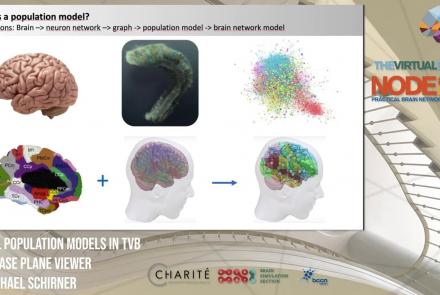
This lesson introduces population models and the phase plane, and is part of the The Virtual Brain (TVB) Node 10 Series, a 4-day workshop dedicated to learning about the full brain simulation platform TVB, as well as brain imaging, brain simulation, personalised brain models, and TVB use cases.
Difficulty level: Intermediate
Duration: 1:10:41
Speaker: : Michael Schirner

In this tutorial, you will learn how to run a typical TVB simulation.
Difficulty level: Intermediate
Duration: 1:29:13
Speaker: : Paul Triebkorn

This lesson introduces TVB-multi-scale extensions and other TVB tools which facilitate modeling and analyses of multi-scale data.
Difficulty level: Intermediate
Duration: 36:10
Speaker: : Dionysios Perdikis

This tutorial introduces The Virtual Mouse Brain (TVMB), walking users through the necessary steps for performing simulation operations on animal brain data.
Difficulty level: Intermediate
Duration: 42:43
Speaker: : Patrik Bey

In this tutorial, you will learn the necessary steps in modeling the brain of one of the most commonly studied animals among non-human primates, the macaque.
Difficulty level: Intermediate
Duration: 1:00:08
Speaker: : Julie Courtiol