
Below you will find the latest courses. Please search or select the courses based on the below filters.

Data Science and Neuroinformatics
INCFMuch like neuroinformatics, data science uses techniques from computational science to derive meaningful results from large complex datasets. In this session, we will explore the relationship between neuroinformatics and data science, by emphasizing a range of data science approaches and activities, ranging from the development and application of statistical methods, through the establishment of communities and platforms, and through the implementation of open-source software tools.

Session 2: FAIR Sharing, Integration, & Analysis of Neuroscience Data
INCFThis course corresponds to the second session of INCF's Neuroinformatics Assembly 2023. This series of talks continues a discussion of FAIR principles from the first session, with a greater emphasis on brain data (humans and animals) atlases for data analysis and integation.

Open Data in Neuroscience: Data Sharing in EBRAINS
Maaike van Swieten, Ida Aasebø, the EBRAINS curation services and HBP-EBRAINSThere is a broad consensus among researchers, publishers, and funding bodies that open sharing of data is needed to address major reproducibility and transparency challenges that currently exist in all scientific disciplines. In addition to potentially increasing the utilization of shared data through re-analysis and integration with other data, data sharing is beneficial for individual researchers through data citation and increased exposure of research.
Introduction to Computational Neuroscience
INCFMost who enter the field of computational neuroscience have a prior background in either mathematics, physics, computer science, or (neuro)biology. Since computational neuroscience requires a bit of knowledge from all these fields, with some basic knowledge of neurons and a familiarity with certain types of equations and mathematical concepts, we recommend two different "starting tracks" depending on the student's background before you begin the lectures listed below:
The Virtual Brain Education Pack (TVB EduPack)
The Virtual BrainThe Virtual Brain EduPack provides didactic use cases for The Virtual Brain (TVB). Typically a use case consists of a jupyter notebook and a didactic video. EduPack use cases help the user to reproduce TVB-based publications or to get started quickly with TVB.

Population-Based Data Resources & Integrative Research Methods
Krembil Centre for NeuroinformaticsAs research methods and experimental technologies become ever more sophisticated, the amount of health-related data per individual which has become accessible is vast, giving rise to a corresponding need for cross-domain data integration, whole-person modelling, and improved precision medicine. This course provides lessons describing state of the art methods and repositories, as well as a tutorial on computational methods for data integration.
Introduction to Neurodata Without Borders (NWB) for Python Users I
NWB Core Development TeamThe Neurodata Without Borders: Neurophysiology project (NWB, https://www.nwb.org/) is an effort to standardize the description and storage of neurophysiology data and metadata. NWB enables data sharing and reuse and reduces the energy-barrier to applying data analytics both within and across labs. Several laboratories, including the Allen Institute for Brain Science, have wholeheartedly adopted NWB.

FAIR Approaches for Electrophysiology
INCFThe course provides an introduction to the growing field of electrophysiology standards, infrastructure, and initiatives. From data curation on open research infrastructures like EBRAINS, to overviews of national data analytics platforms like Australia's AEDAPT, the lessons in this course highlight already available resources for the global neuroinformatics commuity while also reinforcing the need for and importance of FAIR science principles in future research projects.
Simulating Brain Microcircuit Activity and Signals in Mental Health
Krembil Centre for NeuroinformaticsThis course offers lectures on the origin and functional significance of certain electrophysiological signals in the brain, as well as a hands-on tutorial on how to simulate, statistically evaluate, and visualize such signals. Participants will learn the simulation of signals at different spatial scales, including single-cell (neuronal spiking) and global (EEG), and how these may serve as biomarkers in the evaluation of mental health data.
Population-Based Data Resources & Integrative Research Methods
Krembil Centre for NeuroinformaticsAs research methods and experimental technologies become ever more sophisticated, the amount of health-related data per individual which has become accessible is vast, giving rise to a corresponding need for cross-domain data integration, whole-person modelling, and improved precision medicine. This course provides lessons describing state of the art methods and repositories, as well as a tutorial on computational methods for data integration.
Fundamental Methods for Single-Cell Transcriptome Analysis
Krembil Centre for NeuroinformaticsThis course, consisting of one lecture and two workshops, is presented by the Computational Genomics Lab at the Centre for Addiction and Mental Health and University of Toronto. The lecture deals with single-cell and bulk level transciptomics, while the two hands-on workshops introduce users to transcriptomic data types (e.g., RNAseq) and how to perform analyses in specific use cases (e.g., cellular changes in major depression).
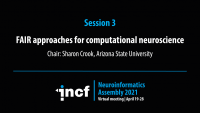
FAIR Approaches for Computational Neuroscience
INCFAs models in neuroscience have become increasingly complex, it has become more difficult to share all aspects of models and model analysis, hindering model accessibility and reproducibility. In this session, we will discuss existing resources for promoting FAIR data and models in computational neuroscience, their impact on the field, and remaining barriers.

Cellular Mechanisms of Brain Function
EPFLThis course, arranged by EPFL and also available as a MOOC on edX, aims for a mechanistic description of mammalian brain function at the level of individual nerve cells and their synaptic interactions.

Foundations of Machine Learning in Python
NeurotechEUCourse designed for advanced learners interested in understanding the foundations of Machine Learning in Python.
General: The course consists of 15 lectures (ca. 1-2 hours each) and 15 exercise sheets (for ca. 6 hours of programming each).
Institution: High-Performance Computing and Analytics Lab, University of Bonn
Population-Based Data Resources & Integrative Research Methods
Krembil Centre for NeuroinformaticsAs research methods and experimental technologies become ever more sophisticated, the amount of health-related data per individual which has become accessible is vast, giving rise to a corresponding need for cross-domain data integration, whole-person modelling, and improved precision medicine. This course provides lessons describing state of the art methods and repositories, as well as a tutorial on computational methods for data integration.
Introduction to EEGLAB
Swartz Center for Computational NeuroscienceEEGLAB is an interactive MATLAB toolbox for processing continuous and event-related EEG, MEG, and other electrophysiological data. In this course, you will learn about features incorporated into EEGLAB, including independent component analysis (ICA), time/frequency analysis, artifact rejection, event-related statistics, and several useful modes of visualization of the averaged and single-trial data. EEGLAB runs under Linux, Unix, Windows, and Mac OS X.
Preprocessing Data in EEGLAB
Swartz Center for Computational NeuroscienceEEGLAB is an interactive MATLAB toolbox for processing continuous and event-related EEG, MEG, and other electrophysiological data incorporating independent component analysis (ICA), time/frequency analysis, artifact rejection, event-related statistics, and several useful modes of visualization of the averaged and single-trial data.
Programming
A number of programming languages are ubiquitous in modern neuroscience and are key to the competence, freedom, and creativity necessary in neuroscience research. This course offers lectures on the fundamentals of data science and specific neuroinformatic tools used in the investigation of brain data. Attendees of this course will be learn about the programming languages Python, R, and MATLAB, as well as their associated packages and software environments.
High-Performance Computing (HPC)
The dimensionality and size of datasets in many fields of neuroscience research require massively parallel computing power. Fortunately, the maturity and accessibility of virtualization technologies has made it feasible to run the same analysis environments on platforms ranging from single laptop computers up to high-performance computing networks.
Introduction to Neurodata Without Borders (NWB) for MATLAB Users I
NWB Core Development TeamThe Neurodata Without Borders: Neurophysiology project (NWB, https://www.nwb.org/) is an effort to standardize the description and storage of neurophysiology data and metadata. NWB enables data sharing and reuse and reduces the energy-barrier to applying data analytics both within and across labs. Several laboratories, including the Allen Institute for Brain Science, have wholeheartedly adopted NWB.