
Lesson type
Difficulty level

Course:
This lesson introduces the EEGLAB toolbox, as well as motivations for its use.
Difficulty level: Beginner
Duration: 15:32
Speaker: : Arnaud Delorme
Course:
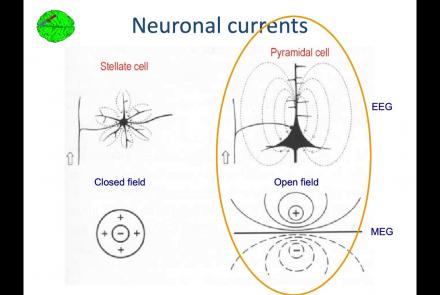
In this lesson, you will learn about the biological activity which generates and is measured by the EEG signal.
Difficulty level: Beginner
Duration: 6:53
Speaker: : Arnaud Delorme

Course:
This lesson goes over the characteristics of EEG signals when analyzed in source space (as opposed to sensor space).
Difficulty level: Beginner
Duration: 10:56
Speaker: : Arnaud Delorme

Course:
This lesson describes the development of EEGLAB as well as to what extent it is used by the research community.
Difficulty level: Beginner
Duration: 6:06
Speaker: : Arnaud Delorme

Course:
This lesson provides instruction as to how to build a processing pipeline in EEGLAB for a single participant.
Difficulty level: Beginner
Duration: 9:20
Speaker: :

Course:
Whereas the previous lesson of this course outlined how to build a processing pipeline for a single participant, this lesson discusses analysis pipelines for multiple participants simultaneously.
Difficulty level: Beginner
Duration: 10:55
Speaker: : Arnaud Delorme

Course:
In addition to outlining the motivations behind preprocessing EEG data in general, this lesson covers the first step in preprocessing data with EEGLAB, importing raw data.
Difficulty level: Beginner
Duration: 8:30
Speaker: : Arnaud Delorme

Course:
Continuing along the EEGLAB preprocessing pipeline, this tutorial walks users through how to import data events as well as EEG channel locations.
Difficulty level: Beginner
Duration: 11:53
Speaker: : Arnaud Delorme

Course:
This tutorial demonstrates how to re-reference and resample raw data in EEGLAB, why such steps are important or useful in the preprocessing pipeline, and how choices made at this step may affect subsequent analyses.
Difficulty level: Beginner
Duration: 11:48
Speaker: : Arnaud Delorme

Course:
In this tutorial, users learn about the various filtering options in EEGLAB, how to inspect channel properties for noisy signals, as well as how to filter out specific components of EEG data (e.g., electrical line noise).
Difficulty level: Beginner
Duration: 10:46
Speaker: : Arnaud Delorme

Course:
This tutorial instructs users how to visually inspect partially pre-processed neuroimaging data in EEGLAB, specifically how to use the data browser to investigate specific channels, epochs, or events for removable artifacts, biological (e.g., eye blinks, muscle movements, heartbeat) or otherwise (e.g., corrupt channel, line noise).
Difficulty level: Beginner
Duration: 5:08
Speaker: : Arnaud Delorme

Course:
This tutorial provides instruction on how to use EEGLAB to further preprocess EEG datasets by identifying and discarding bad channels which, if left unaddressed, can corrupt and confound subsequent analysis steps.
Difficulty level: Beginner
Duration: 13:01
Speaker: : Arnaud Delorme

Course:
Users following this tutorial will learn how to identify and discard bad EEG data segments using the MATLAB toolbox EEGLAB.
Difficulty level: Beginner
Duration: 11:25
Speaker: : Arnaud Delorme

This lecture gives an overview of how to prepare and preprocess neuroimaging (EEG/MEG) data for use in TVB.
Difficulty level: Intermediate
Duration: 1:40:52
Speaker: : Paul Triebkorn

Course:
This module covers many of the types of non-invasive neurotech and neuroimaging devices including electroencephalography (EEG), electromyography (EMG), electroneurography (ENG), magnetoencephalography (MEG), and more.
Difficulty level: Beginner
Duration: 13:36
Speaker: : Harrison Canning

Hierarchical Event Descriptors (HED) fill a major gap in the neuroinformatics standards toolkit, namely the specification of the nature(s) of events and time-limited conditions recorded as having occurred during time series recordings (EEG, MEG, iEEG, fMRI, etc.). Here, the HED Working Group presents an online INCF workshop on the need for, structure of, tools for, and use of HED annotation to prepare neuroimaging time series data for storing, sharing, and advanced analysis.
Difficulty level: Beginner
Duration: 03:37:42
Speaker: :

In this session the Medical Informatics Platform (MIP) federated analytics is presented. The current and future analytical tools implemented in the MIP will be detailed along with the constructs, tools, processes, and restrictions that formulate the solution provided. MIP is a platform providing advanced federated analytics for diagnosis and research in clinical neuroscience research. It is targeting clinicians, clinical scientists and clinical data scientists. It is designed to help adopt advanced analytics, explore harmonized medical data of neuroimaging, neurophysiological and medical records as well as research cohort datasets, without transferring original clinical data. It can be perceived as a virtual database that seamlessly presents aggregated data from distributed sources, provides access and analyze imaging and clinical data, securely stored in hospitals, research archives and public databases. It leverages and re-uses decentralized patient data and research cohort datasets, without transferring original data. Integrated statistical analysis tools and machine learning algorithms are exposed over harmonized, federated medical data.
Difficulty level: Intermediate
Duration: 15:05
Speaker: : Giorgos Papanikos

The Medical Informatics Platform (MIP) is a platform providing federated analytics for diagnosis and research in clinical neuroscience research. The federated analytics is possible thanks to a distributed engine that executes computations and transfers information between the members of the federation (hospital nodes). In this talk the speaker will describe the process of designing and implementing new analytical tools, i.e. statistical and machine learning algorithms. Mr. Sakellariou will further describe the environment in which these federated algorithms run, the challenges and the available tools, the principles that guide its design and the followed general methodology for each new algorithm. One of the most important challenges which are faced is to design these tools in a way that does not compromise the privacy of the clinical data involved. The speaker will show how to address the main questions when designing such algorithms: how to decompose and distribute the computations and what kind of information to exchange between nodes, in order to comply with the privacy constraint mentioned above. Finally, also the subject of validating these federated algorithms will be briefly touched.
Difficulty level: Intermediate
Duration: 20:26
Speaker: : Jason Skellariou

The Medical Informatics Platform (MIP) Dementia had been installed in several memory clinics across Europe allowing them to federate their real-world databases. Research open access databases had also been integrated such as ADNI (Alzheimer’s Dementia Neuroimaging Initiative), reaching a cumulative case load of more than 5,000 patients (major cognitive disorder due to Alzheimer’s disease, other major cognitive disorder, minor cognitive disorder, controls). The statistic and machine learning tools implemented in the MIP allowed researchers to conduct easily federated analyses among Italian memory clinics (Redolfi et al. 2020) and also across borders between the French (Lille), the Swiss (Lausanne) and the Italian (Brescia) datasets.
Difficulty level: Intermediate
Duration: 16:44
Speaker: : Mélanie Leroy
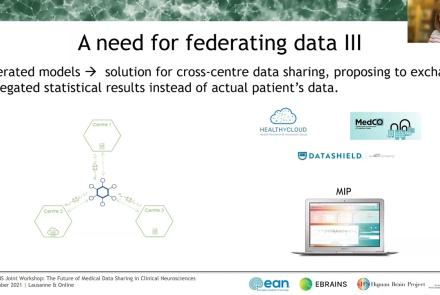
This talks presents ethics requirements of the Medical Informatics Platform, a data sharing platform for medical data using data federation mechanisms. The talk presents how the Medical Informatics Platform (MIP) works and which ethical requirements need to be considered when working with federated data.
Difficulty level: Intermediate
Duration: 16:25
Speaker: : Erika Borcel