
Lesson type
Difficulty level

This lecture covers the linking neuronal activity to behavior using AI-based online detection.
Difficulty level: Beginner
Duration: 30:39
Speaker: : Martin K. Schwarz and Jens Schweihoff

This lesson gives an in-depth introduction of ethics in the field of artificial intelligence, particularly in the context of its impact on humans and public interest. As the healthcare sector becomes increasingly affected by the implementation of ever stronger AI algorithms, this lecture covers key interests which must be protected going forward, including privacy, consent, human autonomy, inclusiveness, and equity.
Difficulty level: Beginner
Duration: 1:22:06
Speaker: : Daniel Buchman

This lecture provides an introduction to the course "Cognitive Science & Psychology: Mind, Brain, and Behavior".
Difficulty level: Beginner
Duration: 1:06:49
Speaker: : Paul F.M.J. Verschure

This lecture goes into further detail about the hard problem of developing a scientific discipline for subjective consciousness.
Difficulty level: Beginner
Duration: 58:03
Speaker: : Paul F.M.J. Verschure

This lecture covers a lot of post-war developments in the science of the mind, focusing first on the cognitive revolution, and concluding with living machines.
Difficulty level: Beginner
Duration: 2:24:35
Speaker: : Paul F.M.J. Verschure

This brief talk goes into work being done at The Alan Turing Institute to solve real-world challenges and democratize computer vision methods to support interdisciplinary and international researchers.
Difficulty level: Beginner
Duration: 7:10
Speaker: : Alden Connor & Beatriz Costa Gomes

In this final lecture of the INCF Short Course: Introduction to Neuroinformatics, you will hear about new advances in the application of machine learning methods to clinical neuroscience data. In particular, this talk discusses the performance of SynthSeg, an image segmentation tool for automated analysis of highly heterogeneous brain MRI clinical scans.
Difficulty level: Intermediate
Duration: 1:32:01
Speaker: : Juan Eugenio Iglesias

This lecture presents the Medical Informatic Platform's data federation for Traumatic Brain Injury.
Difficulty level: Intermediate
Duration: 25:55
Speaker: : Stefano Finazzi

This lecture gives insights into the Medical Informatics Platform's current and future data privacy model.
Difficulty level: Intermediate
Duration: 17:29
Speaker: : Yannis Ioannidis

This lecture explains the concept of federated analysis in the context of medical data, associated challenges. The lecture also presents an example of hospital federations via the Medical Informatics Platform.
Difficulty level: Intermediate
Duration: 19:15
Speaker: : Yannis Ioannidis

This talk discusses what are usually considered successful outcomes of scientific research consortia, and how those outcomes can be translated into lasting impacts.
Difficulty level: Beginner
Duration: 18:24
Speaker: : Anita Bandrowski
In this lesson, you will learn about the BRAIN Initiative Cell Atlas Network (BICAN) and how this project adopts a federated approach to data sharing.
Difficulty level: Beginner
Duration: 11:23
Speaker: : Owen White

This talks presents an overview of the potential for data federation in stroke research.
Difficulty level: Intermediate
Duration: 21:37
Speaker: : Maurizio A. Leone

This lecture explains the need for data federation in medicine and how it can be achieved.
Difficulty level: Intermediate
Duration: 27:09
Speaker: : Philippe Ryvlin
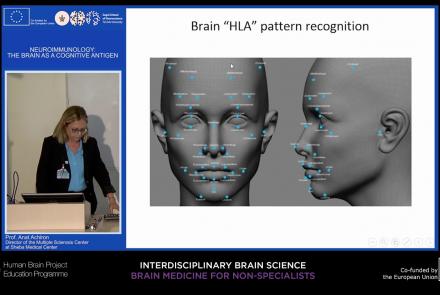
This lecture focuses on how the immune system can target and attack the nervous system to produce autoimmune responses that may result in diseases such as multiple sclerosis, neuromyelitis, and lupus cerebritis manifested by motor, sensory, and cognitive impairments. Despite the fact that the brain is an immune-privileged site, autoreactive lymphocytes producing proinflammatory cytokines can cause active brain inflammation, leading to myelin and axonal loss.
Difficulty level: Beginner
Duration: 37:36
Speaker: : Anat Achiron