
Lesson type
Difficulty level

Course:
The state of the field regarding the diagnosis and treatment of major depressive disorder (MDD) is discussed. Current challenges and opportunities facing the research and clinical communities are outlined, including appropriate quantitative and qualitative analyses of the heterogeneity of biological, social, and psychiatric factors which may contribute to MDD.
Difficulty level: Beginner
Duration: 1:29:28
Speaker: : Brett Jones, Victor Tang

This lesson gives a description of the BrainHealth Databank, a repository of many types of health-related data, whose aim is to accelerate research, improve care, and to help better understand and diagnose mental illness, as well as develop new treatments and prevention strategies.
This lesson corresponds to slides 46-78 of the PDF below.
Difficulty level: Beginner
Duration: 1:12:25
Speaker: : Joanna Yu

This lesson describes not only the need for precision medicine, but also the current state of the methods, pharmacogenetic approaches, utility and implementation of such care today.
This lesson corresponds to slides 1-50 of the PowerPoint below.
Difficulty level: Beginner
Duration: 1:24:30
Speaker: : Dan Felsky

This lecture discusses what defines an integrative approach regarding research and methods, including various study designs and models which are appropriate choices when attempting to bridge data domains; a necessity when whole-person modelling.
Difficulty level: Beginner
Duration: 1:28:14
Speaker: : Dan Felsky

Course:
This lecture covers computational principles that growth cones employ to detect and respond to environmental chemotactic gradients, focusing particularly on growth-cone shape dynamics.
Difficulty level: Intermediate
Duration: 26:12
Speaker: : Geoff Goodhill

Course:
In this lecture you will learn that in developing mouse somatosensory cortex, endogenous Btbd3 translocate to the cell nucleus in response to neuronal activity and oriente primary dendrites toward active axons in the barrel hollow.
Difficulty level: Intermediate
Duration: 27:32
Speaker: : Tomomi Shimogori

Course:
In this presentation, the speaker describes some of their recent efforts to characterize the transcriptome of the developing human brain, and and introduction to the BrainSpan project.
Difficulty level: Intermediate
Duration: 30:45
Speaker: : Nenad Sestan

Course:
How does the brain learn? This lecture discusses the roles of development and adult plasticity in shaping functional connectivity.
Difficulty level: Beginner
Duration: 1:08:45
Speaker: : Clay Reid
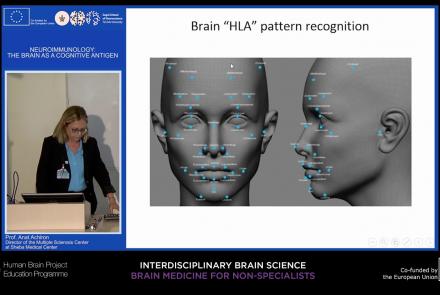
This lecture focuses on how the immune system can target and attack the nervous system to produce autoimmune responses that may result in diseases such as multiple sclerosis, neuromyelitis, and lupus cerebritis manifested by motor, sensory, and cognitive impairments. Despite the fact that the brain is an immune-privileged site, autoreactive lymphocytes producing proinflammatory cytokines can cause active brain inflammation, leading to myelin and axonal loss.
Difficulty level: Beginner
Duration: 37:36
Speaker: : Anat Achiron