
Lesson type
Difficulty level

Course:
This lesson recaps why math, in a number of ways, is extremely useful in data science.
Difficulty level: Beginner
Duration: 1:35
Speaker: : Barton Poulson

Course:
This lesson provides an introduction to the lessons in this course that deal with statistics and why they are useful for data science.
Difficulty level: Beginner
Duration: 4:01
Speaker: : Barton Poulson

Course:
In this lesson, users will learn about the importance of exploratory analysis, as well as how statistics enables one to become familiar with and understand one's data.
Difficulty level: Beginner
Duration: 2:23
Speaker: : Barton Poulson

Course:
This lesson goes over graphical data exploration, including motivations for its use as well as practical examples of visualizing data distributions.
Difficulty level: Beginner
Duration: 8:01
Speaker: : Barton Poulson

Course:
In this lesson, users learn about exploratory statistics, and are introduced to various methods for numerical data exploration.
Difficulty level: Beginner
Duration: 5:05
Speaker: : Barton Poulson

Course:
This lesson overview some simple descriptions of statistical data.
Difficulty level: Beginner
Duration: 10:16
Speaker: : Barton Poulson

Course:
This lesson covers the basics of hypothesis testing.
Difficulty level: Beginner
Duration: 6:04
Speaker: : Barton Poulson

Course:
This lesson provides instruction on how to infer results from incomplete data.
Difficulty level: Beginner
Duration: 4:28
Speaker: : Barton Poulson

Course:
This lesson provides instruction on finding parameter values, computing confidence levels, and other various statistical methods employed in data investigation.
Difficulty level: Beginner
Duration: 08:04
Speaker: : Barton Poulson

Course:
In this lesson, statistical methods and tools are described for estimating parameters in your dataset.
Difficulty level: Beginner
Duration: 5:29
Speaker: : Barton Poulson

Course:
This lesson covers how to measure the correspondece between data and model.
Difficulty level: Beginner
Duration: 3:30
Speaker: : Barton Poulson

Course:
In this lesson, you will learn the concepts behind choosing useful variables, as well as various analyses and tools to do so.
Difficulty level: Beginner
Duration: 6:15
Speaker: : Barton Poulson
Course:
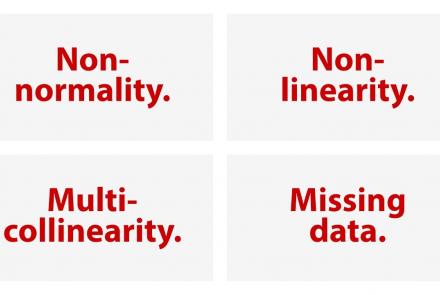
This lesson goes over some of the common problems in statistical modeling.
Difficulty level: Beginner
Duration: 5:58
Speaker: : Barton Poulson

Course:
This lesson continues describing some of the common problems in statistical modelling, particularly when it comes to model validation.
Difficulty level: Beginner
Duration: 3:50
Speaker: : Barton Poulson

Course:
You don't have to be a wizard to do statistics!
Difficulty level: Beginner
Duration: 3:18
Speaker: : Barton Poulson

Course:
This lesson provides an overview of possible follow-up courses and subjects from the same publisher.
Difficulty level: Beginner
Duration: 1:43
Speaker: : Barton Poulson

Course:
In an overview of the structure of the mammalian neocortex, this lecture explains how the mammalian cortex is organized in a hierarchy, describing the columnar principle and canonical microcircuits.
Difficulty level: Beginner
Duration: 1:02:02
Speaker: : Clay Reid

Course:
The retina has 60 different types of neurons. What are their functions? This lecture explores the definition of cell types and their functions in the mammalian retina.
Difficulty level: Beginner
Duration: 1:07:19
Speaker: : Christof Koch

Course:
Optical imaging offers a look inside the working brain. This lecture takes a look at orientation and ocular dominance columns in the visual cortex, and shows how they can be viewed with calcium imaging.
Difficulty level: Beginner
Duration: 26:17
Speaker: : Clay Reid
Course:
This lecture explains these ideas and explores the task of characterizing neuronal response properties using information theory.
Difficulty level: Beginner
Duration: 1:01:18
Speaker: : Christof Koch