
Lesson type
Difficulty level

In this session the Medical Informatics Platform (MIP) federated analytics is presented. The current and future analytical tools implemented in the MIP will be detailed along with the constructs, tools, processes, and restrictions that formulate the solution provided. MIP is a platform providing advanced federated analytics for diagnosis and research in clinical neuroscience research. It is targeting clinicians, clinical scientists and clinical data scientists. It is designed to help adopt advanced analytics, explore harmonized medical data of neuroimaging, neurophysiological and medical records as well as research cohort datasets, without transferring original clinical data. It can be perceived as a virtual database that seamlessly presents aggregated data from distributed sources, provides access and analyze imaging and clinical data, securely stored in hospitals, research archives and public databases. It leverages and re-uses decentralized patient data and research cohort datasets, without transferring original data. Integrated statistical analysis tools and machine learning algorithms are exposed over harmonized, federated medical data.
Difficulty level: Intermediate
Duration: 15:05
Speaker: : Giorgos Papanikos

The Medical Informatics Platform (MIP) is a platform providing federated analytics for diagnosis and research in clinical neuroscience research. The federated analytics is possible thanks to a distributed engine that executes computations and transfers information between the members of the federation (hospital nodes). In this talk the speaker will describe the process of designing and implementing new analytical tools, i.e. statistical and machine learning algorithms. Mr. Sakellariou will further describe the environment in which these federated algorithms run, the challenges and the available tools, the principles that guide its design and the followed general methodology for each new algorithm. One of the most important challenges which are faced is to design these tools in a way that does not compromise the privacy of the clinical data involved. The speaker will show how to address the main questions when designing such algorithms: how to decompose and distribute the computations and what kind of information to exchange between nodes, in order to comply with the privacy constraint mentioned above. Finally, also the subject of validating these federated algorithms will be briefly touched.
Difficulty level: Intermediate
Duration: 20:26
Speaker: : Jason Skellariou

The Medical Informatics Platform (MIP) Dementia had been installed in several memory clinics across Europe allowing them to federate their real-world databases. Research open access databases had also been integrated such as ADNI (Alzheimer’s Dementia Neuroimaging Initiative), reaching a cumulative case load of more than 5,000 patients (major cognitive disorder due to Alzheimer’s disease, other major cognitive disorder, minor cognitive disorder, controls). The statistic and machine learning tools implemented in the MIP allowed researchers to conduct easily federated analyses among Italian memory clinics (Redolfi et al. 2020) and also across borders between the French (Lille), the Swiss (Lausanne) and the Italian (Brescia) datasets.
Difficulty level: Intermediate
Duration: 16:44
Speaker: : Mélanie Leroy
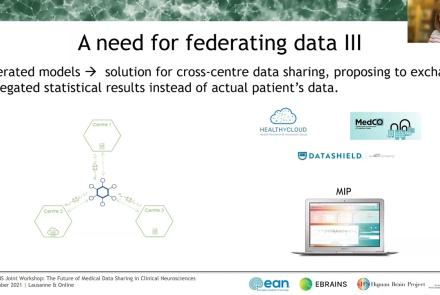
This talks presents ethics requirements of the Medical Informatics Platform, a data sharing platform for medical data using data federation mechanisms. The talk presents how the Medical Informatics Platform (MIP) works and which ethical requirements need to be considered when working with federated data.
Difficulty level: Intermediate
Duration: 16:25
Speaker: : Erika Borcel

This lecture talks about the usage of knowledge graphs in hospitals and related challenges of semantic interoperability.
Difficulty level: Intermediate
Duration: 24:32
Speaker: : Cristophe Gaudet-Blavignac

This lecture discusses risk-based anonymization approaches for medical research.
Difficulty level: Intermediate
Duration: 15:43
Speaker: : Fabian Prasser

Course:
This tutorial demonstrates how to work with neuronal data using MATLAB, including actional potentials and spike counts, orientation tuing curves in visual cortex, and spatial maps of firing rates.
Difficulty level: Intermediate
Duration: 5:17
Speaker: : Mike X. Cohen

Course:
This lesson instructs users on how to import electrophysiological neural data into MATLAB, as well as how to convert spikes to a data matrix.
Difficulty level: Intermediate
Duration: 11:37
Speaker: : Mike X. Cohen

This lecture provides an introduction to Plato’s concept of rationality and Aristotle’s concept of empiricism, and the enduring discussion between rationalism and empiricism to this day.
Difficulty level: Beginner
Duration: 1:13:45
Speaker: : Paul F.M.J. Verschure

This lecture goes into further detail about the hard problem of developing a scientific discipline for subjective consciousness.
Difficulty level: Beginner
Duration: 58:03
Speaker: : Paul F.M.J. Verschure

This opening lecture from INCF's Short Course in Neuroinformatics provides an overview of the field of neuroinformatics itself, as well as laying out an argument for the necessity for developing more sophisticated approaches towards FAIR data management principles in neuroscience.
Difficulty level: Beginner
Duration: 1:19:14
Speaker: : Maryann Martone

This lesson provides a thorough description of neuroimaging development over time, both conceptually and technologically. You will learn about the fundamentals of imaging techniques such as MRI and PET, as well as how the resultant data may be used to generate novel data visualization schemas.
Difficulty level: Beginner
Duration: 1:43:57
Speaker: : Jack Van Horn

This lesson contains the first part of the lecture Data Science and Reproducibility. You will learn about the development of data science and what the term currently encompasses, as well as how neuroscience and data science intersect.
Difficulty level: Beginner
Duration: 32:18
Speaker: : Ariel Rokem

This lecture aims to help researchers, students, and health care professionals understand the place for neuroinformatics in the patient journey using the exemplar of an epilepsy patient.
Difficulty level: Intermediate
Duration: 1:32:53
Speaker: : Randy Gollub & Prantik Kundu

As the previous lesson of this course described how researchers acquire neural data, this lesson will discuss how to go about interpreting and analysing the data.
Difficulty level: Intermediate
Duration: 9:24
Speaker: : Marcus Ghosh

In this lesson you will learn about the motivation behind manipulating neural activity, and what forms that may take in various experimental designs.
Difficulty level: Intermediate
Duration: 8:42
Speaker: : Marcus Ghosh

In this lesson, you will learn about one particular aspect of decision making: reaction times. In other words, how long does it take to take a decision based on a stream of information arriving continuously over time?
Difficulty level: Intermediate
Duration: 6:01
Speaker: : Dan Goodman

In this lesson, you will hear about some of the open issues in the field of neuroscience, as well as a discussion about whether neuroscience works, and how can we know?
Difficulty level: Intermediate
Duration: 6:54
Speaker: : Marcus Ghosh

This lesson discusses a gripping neuroscientific question: why have neurons developed the discrete action potential, or spike, as a principle method of communication?
Difficulty level: Intermediate
Duration: 9:34
Speaker: : Dan Goodman

Course:
This module explores sensation in the brain: what organs are involved, sensory pathways, processing centers, and theories of integration.
Difficulty level: Beginner
Duration: 7:17
Speaker: : Colin Fausnaught