
Lesson type
Difficulty level

This lecture covers a wide range of aspects regarding neuroinformatics and data governance, describing both their historical developments and current trajectories. Particular tools, platforms, and standards to make your research more FAIR are also discussed.
Difficulty level: Beginner
Duration: 54:58
Speaker: : Franco Pestilli

Course:
This lecture introduces you to the basics of the Amazon Web Services public cloud. It covers the fundamentals of cloud computing and goes through both the motivations and processes involved in moving your research computing to the cloud.
Difficulty level: Intermediate
Duration: 3:09:12
Speaker: : Amanda Tan & Ariel Rokem

This lecture discusses how FAIR practices affect personalized data models, including workflows, challenges, and how to improve these practices.
Difficulty level: Beginner
Duration: 13:16
Speaker: : Kelly Shen

In this talk, you will learn how brainlife.io works, and how it can be applied to neuroscience data.
Difficulty level: Beginner
Duration: 10:14
Speaker: : Franco Pestilli

Course:
As a part of NeuroHackademy 2020, this lecture delves into cloud computing, focusing on Amazon Web Services.
Difficulty level: Beginner
Duration: 01:43:59
Speaker: : Tara Madhyastha, Andrew Crabb, Ariel Rokem

Course:
This talk presents an overview of CBRAIN, a web-based platform that allows neuroscientists to perform computationally intensive data analyses by connecting them to high-performance computing facilities across Canada and around the world.
Difficulty level: Beginner
Duration: 56:07
Speaker: : Shawn Brown

This is the Introductory Module to the Deep Learning Course at CDS, a course that covered the latest techniques in deep learning and representation learning, focusing on supervised and unsupervised deep learning, embedding methods, metric learning, convolutional and recurrent nets, with applications to computer vision, natural language understanding, and speech recognition.
Difficulty level: Intermediate
Duration: 50:17
Speaker: : Yann LeCun and Alfredo Canziani

This module covers the concepts of gradient descent and the backpropagation algorithm and is a part of the Deep Learning Course at NYU's Center for Data Science.
Difficulty level: Intermediate
Duration: 1:51:03
Speaker: : Yann LeCun

This lesson provides a detailed description of some of the modules and architectures involved in the development of neural networks.
Difficulty level: Intermediate
Duration: 1:42:26
Speaker: : Yann LeCun and Alfredo Canziani

This lecture covers the concept of parameter sharing: recurrent and convolutional nets and is a part of the Deep Learning Course at NYU's Center for Data Science.
Difficulty level: Intermediate
Duration: 1:59:47
Speaker: : Yann LeCun and Alfredo Canziani

This lecture covers the concept of convolutional nets in practice and is a part of the Deep Learning Course at NYU's Center for Data Science.
Difficulty level: Intermediate
Duration: 51:40
Speaker: : Yann LeCun
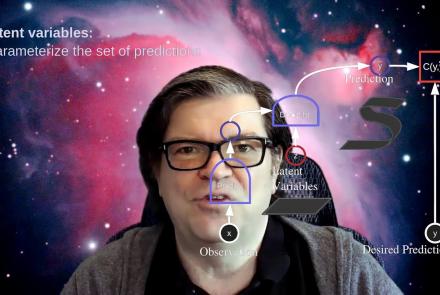
This lecture is a foundationational lecture for the concept of energy-based models with a particular focus on the joint embedding method and latent variable energy-based models (LV-EBMs) and is a part of the Deep Learning Course at NYU's Center for Data Science.
Difficulty level: Intermediate
Duration: 1:51:30
Speaker: : Yann LeCun

This lecture is a foundationational lecture for the concept of energy-based models with a particular focus on the joint embedding method and latent variable energy based models (LV-EBMs) and is a part of the Deep Learning Course at NYU's Center for Data Science.
Difficulty level: Intermediate
Duration: 1:48:53
Speaker: : Yann LeCun

This lecture covers advanced concepts of energy-based models. The lecture is a part of the Advanced Energy-Based Models module of the the Deep Learning Course at NYU's Center for Data Science. Prerequisites for this course include: Energy-Based Models I, Energy-Based Models II, and an Introduction to Data Science or a Graduate Level Machine Learning course.
Difficulty level: Advanced
Duration: 1:54:22
Speaker: : Yann LeCun

This lecture covers advanced concepts of energy-based models. The lecture is a part of the Advanced energy based models modules of the the Deep Learning Course at NYU's Center for Data Science. Prerequisites for this course include: Energy-Based Models I, Energy-Based Models II, Energy-Based Models III, and an Introduction to Data Science or a Graduate Level Machine Learning course.
Difficulty level: Advanced
Duration: 1:54:43
Speaker: : Yann LeCun

This lecture covers advanced concepts of energy-based models. The lecture is a part of the Advanced energy based models modules of the the Deep Learning Course at NYU's Center for Data Science. Prerequisites for this course include: Energy-Based Models I, Energy-Based Models II, Energy-Based Models III, Energy-Based Models IV, and an Introduction to Data Science or a Graduate Level Machine Learning course.
Difficulty level: Advanced
Duration: 2:00:28
Speaker: : Yann LeCun
This lecture covers advanced concepts of energy-based models. The lecture is a part of the Associative Memories module of the the Deep Learning Course at NYU's Center for Data Science. Prerequisites for this course include: Energy-Based Models I, Energy-Based Models II, Energy-Based Models III, Energy-Based Models IV, Energy-Based Models V, and an Introduction to Data Science or a Graduate Level Machine Learning course.
Difficulty level: Advanced
Duration: 2:00:28
Speaker: : Yann LeCun

Course:
This lecture provides an introduction to the problem of speech recognition using neural models, emphasizing the CTC loss for training and inference when input and output sequences are of different lengths. It also covers the concept of beam search for use during inference, and how that procedure may be modeled at training time using a Graph Transformer Network. It is a part of the Deep Learning Course at NYU's Center for Data Science. Prerequisites for this module include: Modules 1 - 5 of this course and an Introduction to Data Science or a Graduate Level Machine Learning course.
Difficulty level: Advanced
Duration: 1:55:03
Speaker: : Awni Hannun

Course:
This lecture covers the concepts of the architecture and convolution of traditional convolutional neural networks, the characteristics of graph and graph convolution, and spectral graph convolutional neural networks and how to perform spectral convolution, as well as the complete spectrum of Graph Convolutional Networks (GCNs), starting with the implementation of Spectral Convolution through Spectral Networks. It then provides insights on applicability of the other convolutional definition of Template Matching to graphs, leading to Spatial networks. This lecture is a part of the Deep Learning Course at NYU's Center for Data Science. Prerequisites for this module include: Modules 1 - 5 of this course and an Introduction to Data Science or a Graduate Level Machine Learning course.
Difficulty level: Advanced
Duration: 2:00:22
Speaker: : Xavier Bresson

Course:
This lecture covers the concepts of gradient descent, stochastic gradient descent, and momentum. It is a part of the Deep Learning Course at NYU's Center for Data Science. Prerequisites for this module include: Models 1-7 of this course and an Introduction to Data Science or a Graduate Level Machine Learning course.
Difficulty level: Advanced
Duration: 1:29:05
Speaker: : Aaron DeFazio