
Lesson type
Difficulty level

This lecture covers advanced concept of energy based models. The lecture is a part of the Advanced energy based models modules of the the Deep Learning Course at NYU's Center for Data Science. Prerequisites for this course include: Energy-Based Models I, Energy-Based Models II, Energy-Based Models III, and an Introduction to Data Science or a Graduate Level Machine Learning course.
Difficulty level: Beginner
Duration: 56:41
Speaker: : Alfredo Canziani
Course:
This lesson gives an introduction to deep learning, with a perspective via inductive biases and emphasis on correctly matching deep learning to the right research questions.
Difficulty level: Beginner
Duration: 01:35:12
Speaker: : Blake Richards
Course:
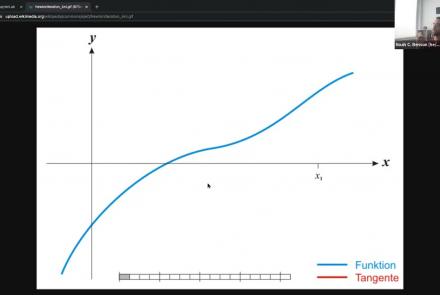
As a part of NeuroHackademy 2021, Noah Benson gives an introduction to Pytorch, one of the two most common software packages for deep learning applications to the neurosciences.
Difficulty level: Beginner
Duration: 00:50:40
Speaker: :

Course:
Learn how to use TensorFlow 2.0 in this full tutorial for beginners. This course is designed for Python programmers looking to enhance their knowledge and skills in machine learning and artificial intelligence.
Throughout the 8 modules in this course you will learn about fundamental concepts and methods in ML & AI like core learning algorithms, deep learning with neural networks, computer vision with convolutional neural networks, natural language processing with recurrent neural networks, and reinforcement learning.
Difficulty level: Beginner
Duration: 06:52:07
Speaker: :

Course:
In this hands-on tutorial, Dr. Robert Guangyu Yang works through a number of coding exercises to see how RNNs can be easily used to study cognitive neuroscience questions, with a quick demonstration of how we can train and analyze RNNs on various cognitive neuroscience tasks. Familiarity of Python and basic knowledge of Pytorch are assumed.
Difficulty level: Beginner
Duration: 00:26:38
Speaker: :

This lesson continues with the second workshop on reproducible science, focusing on additional open source tools for researchers and data scientists, such as the R programming language for data science, as well as associated tools like RStudio and R Markdown. Additionally, users are introduced to Python and iPython notebooks, Google Colab, and are given hands-on tutorials on how to create a Binder environment, as well as various containers in Docker and Singularity.
Difficulty level: Beginner
Duration: 1:16:04
Speaker: : Erin Dickie and Sejal Patel

This lesson contains both a lecture and a tutorial component. The lecture (0:00-20:03 of YouTube video) discusses both the need for intersectional approaches in healthcare as well as the impact of neglecting intersectionality in patient populations. The lecture is followed by a practical tutorial in both Python and R on how to assess intersectional bias in datasets. Links to relevant code and data are found below.
Difficulty level: Beginner
Duration: 52:26

Course:
Maximize Your Research With Cloud Workspaces is a talk aimed at researchers who are looking for innovative ways to set up and execute their life science data analyses in a collaborative, extensible, open-source cloud environment. This panel discussion is brought to you by MetaCell and scientists from leading universities who share their experiences of advanced analysis and collaborative learning through the Cloud.
Difficulty level: Beginner
Duration: 55:43

This talk describes the relevance and power of using brain atlases as part of one's data integration pipeline.
Difficulty level: Beginner
Duration: 15:37
Speaker: : Timo Dickscheid

In this hands-on session, you will learn how to explore and work with DataLad datasets, containers, and structures using Jupyter notebooks.
Difficulty level: Beginner
Duration: 58:05
Speaker: : Michał Szczepanik

This lesson provides a thorough description of neuroimaging development over time, both conceptually and technologically. You will learn about the fundamentals of imaging techniques such as MRI and PET, as well as how the resultant data may be used to generate novel data visualization schemas.
Difficulty level: Beginner
Duration: 1:43:57
Speaker: : Jack Van Horn

This lecture covers a wide range of aspects regarding neuroinformatics and data governance, describing both their historical developments and current trajectories. Particular tools, platforms, and standards to make your research more FAIR are also discussed.
Difficulty level: Beginner
Duration: 54:58
Speaker: : Franco Pestilli

Course:
This video will demonstrate how to create and launch a pipeline using FreeSurfer on brainlife.io.
Difficulty level: Beginner
Duration: 0:25
Speaker: :

Course:
This lecture covers the description and characterization of an input-output relationship in a information-theoretic context.
Difficulty level: Beginner
Duration: 1:35:33
Speaker: : Jonathan D. Victor

Course:
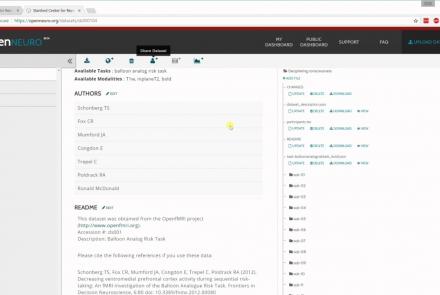
In this tutorial, you will learn the basic features of uploading and versioning your data within OpenNeuro.org.
Difficulty level: Beginner
Duration: 5:36
Speaker: : OpenNeuro
Course:
This tutorial shows how to share your data in OpenNeuro.org.
Difficulty level: Beginner
Duration: 1:22
Speaker: : OpenNeuro

Course:
Following the previous two tutorials on uploading and sharing data with OpenNeuro.org, this tutorial briefly covers how to run various analyses on your datasets.
Difficulty level: Beginner
Duration: 2:26
Speaker: : OpenNeuro

Course:
This lesson provides instruction on how to infer results from incomplete data.
Difficulty level: Beginner
Duration: 4:28
Speaker: : Barton Poulson

Course:
This lesson provides instruction on finding parameter values, computing confidence levels, and other various statistical methods employed in data investigation.
Difficulty level: Beginner
Duration: 08:04
Speaker: : Barton Poulson

Course:
In this lesson, statistical methods and tools are described for estimating parameters in your dataset.
Difficulty level: Beginner
Duration: 5:29
Speaker: : Barton Poulson