
Displaying 938 results

In this tutorial, you will learn how to run a typical TVB simulation.
Difficulty level: Intermediate
Duration: 1:29:13
Speaker: : Paul Triebkorn

This lesson introduces TVB-multi-scale extensions and other TVB tools which facilitate modeling and analyses of multi-scale data.
Difficulty level: Intermediate
Duration: 36:10
Speaker: : Dionysios Perdikis

This tutorial introduces The Virtual Mouse Brain (TVMB), walking users through the necessary steps for performing simulation operations on animal brain data.
Difficulty level: Intermediate
Duration: 42:43
Speaker: : Patrik Bey

In this tutorial, you will learn the necessary steps in modeling the brain of one of the most commonly studied animals among non-human primates, the macaque.
Difficulty level: Intermediate
Duration: 1:00:08
Speaker: : Julie Courtiol
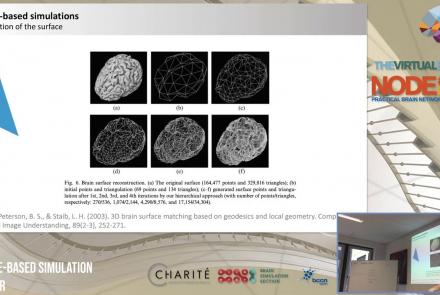
This lecture delves into cortical (i.e., surface-based) brain simulations, as well as subcortical (i.e., deep brain) stimulations, covering the definitions, motivations, and implementations of both.
Difficulty level: Intermediate
Duration: 39:05
Speaker: : Jil Meier

This lecture provides an introduction to entropy in general, and multi-scale entropy (MSE) in particular, highlighting the potential clinical applications of the latter.
Difficulty level: Intermediate
Duration: 39:05
Speaker: : Jil Meier

This lecture gives an overview of how to prepare and preprocess neuroimaging (EEG/MEG) data for use in TVB.
Difficulty level: Intermediate
Duration: 1:40:52
Speaker: : Paul Triebkorn

In this lecture, you will learn about various neuroinformatic resources which allow for 3D reconstruction of brain models.
Difficulty level: Intermediate
Duration: 1:36:57
Speaker: : Michael Schirner

This lecture provides an general introduction to epilepsy, as well as why and how TVB can prove useful in building and testing epileptic models.
Difficulty level: Intermediate
Duration: 37:12
Speaker: : Julie Courtiol

Course:
This lesson outlines Neurodata Without Borders (NWB), a data standard for neurophysiology which provides neuroscientists with a common standard to share, archive, use, and build analysis tools for neurophysiology data.
Difficulty level: Intermediate
Duration: 29:53
Speaker: : Oliver Ruebel

This lecture on model types introduces the advantages of modeling, provide examples of different model types, and explain what modeling is all about.
Difficulty level: Beginner
Duration: 27:48
Speaker: : Gunnar Blohm
Course:
Marr 1-3
Difficulty level: Beginner
Duration: 00:30
Speaker: :
Course:
Recap session, The role of models in discovery
Difficulty level: Beginner
Duration: 00:30
Speaker: :
Course:
"What"/"How"/"Why"
Difficulty level: Beginner
Duration: 00:30
Speaker: :
Course:
NMA organization, expectations, code of conduct, modeling vs. data
Difficulty level: Beginner
Duration: 00:30
Speaker: :
Course:
Data into, preprocessing, link of neural data to behavior
Difficulty level: Beginner
Duration: 00:30
Speaker: :
Course:
Tuning (RFs, motor, STA), What is means to "understand" (signal detection)
Difficulty level: Beginner
Duration: 00:30
Speaker: :

This lesson provides a brief introduction to the Computational Modeling of Neuronal Plasticity.
Difficulty level: Intermediate
Duration: 0:40
Speaker: : Florence I. Kleberg

In this lesson, you will be introducted to a type of neuronal model known as the leaky integrate-and-fire (LIF) model.
Difficulty level: Intermediate
Duration: 1:23
Speaker: : Florence I. Kleberg