
Below you will find the latest courses. Please search or select the courses based on the below filters.
Machine Learning (CONP)
This course begins with the conceptual basics of machine learning and then moves on to some Python-based applications of popular supervised learning algorithms to neuroscience data. This is followed by a series of lectures that explore the history and applications of deep learning, ending with a presentation on the potential of deep learning for neuroscience applications/mis-applications.

Bayesian Models of Learning and Integration of Neuroimaging Data
Krembil Centre for NeuroinformaticsBayesian inference (using prior knowledge to generate more accurate predictions about future events or outcomes) has become increasingly applied to the fields of neuroscience and neuroinformatics. In this course, participants are taught how Bayesian statistics may be used to build cognitive models of processes like learning or perception. This course also offers theoretical and practical instruction on dynamic causal modeling as applied to fMRI and EEG data.

Linear Systems
Neuromatch AcademyNeuromatch Academy aims to introduce traditional and emerging tools of computational neuroscience to trainees.

Lifecycle of Human Electroencephalography/Event-Related Potential Data
Czech National Node for NeuroinformaticsThis course is intended for those interested in electroencephalography (EEG) and event-related potentials (ERPs) techniques, and those interested in collecting, annotating, standardizing, storing, processing, sharing, and publishing data from electrical activity of the human brain.

Introduction to Neurodata Without Borders (NWB) for MATLAB Users II
NWB Core Development TeamThe Neurodata Without Borders: Neurophysiology project (NWB, https://www.nwb.org/) is an effort to standardize the description and storage of neurophysiology data and metadata. NWB enables data sharing and reuse and reduces the energy-barrier to applying data analytics both within and across labs. Several laboratories, including the Allen Institute for Brain Science, have wholeheartedly adopted NWB.
Simulating Brain Microcircuit Activity and Signals in Mental Health
Krembil Centre for NeuroinformaticsThis course offers lectures on the origin and functional significance of certain electrophysiological signals in the brain, as well as a hands-on tutorial on how to simulate, statistically evaluate, and visualize such signals. Participants will learn the simulation of signals at different spatial scales, including single-cell (neuronal spiking) and global (EEG), and how these may serve as biomarkers in the evaluation of mental health data.

Bayesian Statistics
Neuromatch AcademyNeuromatch Academy aims to introduce traditional and emerging tools of computational neuroscience to trainees.
Digital Health for Mental Health
Krembil Centre for NeuroinformaticsAs technological improvements continue to facilitate innovations in the mental health space, researchers and clinicians are faced with novel opportunities and challenges regarding study design, diagnoses, treatments, and follow-up care. This course includes a lecture outlining these new developments, as well as a workshop which introduces users to Synapse, an open-source platform for collaborative data analysis.
INCF Assembly 2022 - Training Day 2
INCFThis course contains sessions from the second day of INCF's Neuroinformatics Assembly 2022.
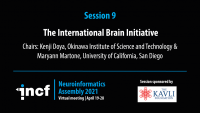
The International Brain Initiative (IBI)
INCFThe International Brain Initiative (IBI) is a consortium of the world’s major large-scale brain initiatives and other organizations with a vested interest in catalyzing and advancing neuroscience research through international collaboration and knowledge sharing. This session will introduce the IBI and the current efforts of the Data Standards and Sharing Working Group with a view to gain input from a wider neuroscience and neuroinformatics community.

Using brainlife.io
brainlife.ioThis course provides several visual walkthroughs documenting how to execute various processes in brainlife.io, an open-source, free and secure reproducible neuroscience analysis platform. The platform allows to analyze Magnetic Resonance Imaging (MRI), electroencephalography (EEG) and magnetoencephalography (MEG) data. Data can either be uploaded from local computers or imported from public archives such as OpenNeuro.org.
Lifecycle of Human Electroencephalography/Event-Related Potential Data
Czech National Node for NeuroinformaticsThis course is intended for those interested in electroencephalography (EEG) and event-related potentials (ERPs) techniques, and those interested in collecting, annotating, standardizing, storing, processing, sharing, and publishing data from electrical activity of the human brain.

Data Management, Repositories, & Search Engines
The importance of Research Data Management in the conduct of open and reproducible science is better understood and technically supported than ever, and many of the underlying principles apply as much to everyday activities of a single researcher as to large-scale, multi-center open data sharing.

High-Performance Computing (HPC)
The dimensionality and size of datasets in many fields of neuroscience research require massively parallel computing power. Fortunately, the maturity and accessibility of virtualization technologies has made it feasible to run the same analysis environments on platforms ranging from single laptop computers up to high-performance computing networks.
Biochemical Models
INCFThis course consists of introductory lectures on different aspects of biochemical models. By following this course, you will learn about the various forms plasticity can take at different levels in the brain, how to model chemical computation in the brain, as well as computationally demanding studies of synaptic plasticity on the molecular level.
Bayesian Models of Learning and Integration of Neuroimaging Data
Krembil Centre for NeuroinformaticsBayesian inference (using prior knowledge to generate more accurate predictions about future events or outcomes) has become increasingly applied to the fields of neuroscience and neuroinformatics. In this course, participants are taught how Bayesian statistics may be used to build cognitive models of processes like learning or perception. This course also offers theoretical and practical instruction on dynamic causal modeling as applied to fMRI and EEG data.
Population-Based Data Resources & Integrative Research Methods
Krembil Centre for NeuroinformaticsAs research methods and experimental technologies become ever more sophisticated, the amount of health-related data per individual which has become accessible is vast, giving rise to a corresponding need for cross-domain data integration, whole-person modelling, and improved precision medicine. This course provides lessons describing state of the art methods and repositories, as well as a tutorial on computational methods for data integration.

INCF Assembly 2022 - Day 2 Sessions
INCFSessions from the INCF Neuroinformatics Assembly 2022 day 2.
INCF Assembly 2022 - Training Day 1
INCFThis course contains sessions from the first day of INCF's Neuroinformatics Assembly 2022.
Session 2: FAIR Sharing, Integration, & Analysis of Neuroscience Data
INCFThis course corresponds to the second session of INCF's Neuroinformatics Assembly 2023. This series of talks continues a discussion of FAIR principles from the first session, with a greater emphasis on brain data (humans and animals) atlases for data analysis and integation.