
Lesson type
Difficulty level

Course:
This lesson describes the principles underlying functional magnetic resonance imaging (fMRI), diffusion-weighted imaging (DWI), tractography, and parcellation. These tools and concepts are explained in a broader context of neural connectivity and mental health.
Difficulty level: Intermediate
Duration: 1:47:22
Speaker: : Erin Dickie and John Griffiths

Course:
This tutorial introduces pipelines and methods to compute brain connectomes from fMRI data. With corresponding code and repositories, participants can follow along and learn how to programmatically preprocess, curate, and analyze functional and structural brain data to produce connectivity matrices.
Difficulty level: Intermediate
Duration: 1:39:04
Speaker: : Erin Dickie and John Griffiths

This lesson introduces the practical exercises which accompany the previous lessons on animal and human connectomes in the brain and nervous system.
Difficulty level: Intermediate
Duration: 4:10
Speaker: : Dan Goodman

Course:
This lecture and tutorial focuses on measuring human functional brain networks, as well as how to account for inherent variability within those networks.
Difficulty level: Intermediate
Duration: 50:44
Speaker: : Caterina Gratton

Course:
This lecture presents an overview of functional brain parcellations, as well as a set of tutorials on bootstrap agregation of stable clusters (BASC) for fMRI brain parcellation.
Difficulty level: Advanced
Duration: 50:28
Speaker: : Pierre Bellec
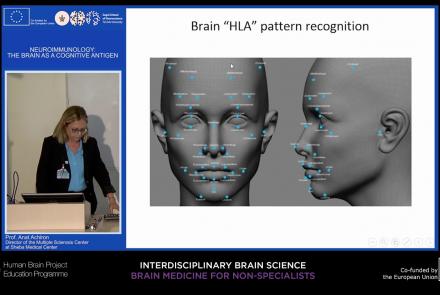
This lecture focuses on how the immune system can target and attack the nervous system to produce autoimmune responses that may result in diseases such as multiple sclerosis, neuromyelitis, and lupus cerebritis manifested by motor, sensory, and cognitive impairments. Despite the fact that the brain is an immune-privileged site, autoreactive lymphocytes producing proinflammatory cytokines can cause active brain inflammation, leading to myelin and axonal loss.
Difficulty level: Beginner
Duration: 37:36
Speaker: : Anat Achiron

This lecture provides an overview of some of the essential concepts in neuropharmacology (e.g. receptor binding, agonism, antagonism), an introduction to pharmacodynamics and pharmacokinetics, and an overview of the drug discovery process relative to diseases of the central nervous system.
Difficulty level: Beginner
Duration: 45:47
Speaker: : Sandra Santos-Sierra

This lecture covers the ethical implications of the use of pharmaceuticals to enhance brain functions and was part of the Neuro Day Workshop held by the NeuroSchool of Aix Marseille University.
Difficulty level: Beginner
Duration: 1:09:29
Speaker: : Eric Racine