
Lesson type
Difficulty level

Course:
This lesson gives an introduction to the Mathematics chapter of Datalabcc's Foundations in Data Science series.
Difficulty level: Beginner
Duration: 2:53
Speaker: : Barton Poulson

Course:
This lesson serves a primer on elementary algebra.
Difficulty level: Beginner
Duration: 3:03
Speaker: : Barton Poulson

Course:
This lesson provides a primer on linear algebra, aiming to demonstrate how such operations are fundamental to many data science.
Difficulty level: Beginner
Duration: 5:38
Speaker: : Barton Poulson

Course:
In this lesson, users will learn about linear equation systems, as well as follow along some practical use cases.
Difficulty level: Beginner
Duration: 5:24
Speaker: : Barton Poulson

Course:
This talk gives a primer on calculus, emphasizing its role in data science.
Difficulty level: Beginner
Duration: 4:17
Speaker: : Barton Poulson

Course:
This lesson clarifies how calculus relates to optimization in a data science context.
Difficulty level: Beginner
Duration: 8:43
Speaker: : Barton Poulson

Course:
This lesson covers Big O notation, a mathematical notation that describes the limiting behavior of a function as it tends towards a certain value or infinity, proving useful for data scientists who want to evaluate their algorithms' efficiency.
Difficulty level: Beginner
Duration: 5:19
Speaker: : Barton Poulson

Course:
This lesson serves as a primer on the fundamental concepts underlying probability.
Difficulty level: Beginner
Duration: 7:33
Speaker: : Barton Poulson

Serving as good refresher, this lesson explains the maths and logic concepts that are important for programmers to understand, including sets, propositional logic, conditional statements, and more.
This compilation is courtesy of freeCodeCamp.
Difficulty level: Beginner
Duration: 1:00:07
Speaker: : Shawn Grooms

This lesson provides a useful refresher which will facilitate the use of Matlab, Octave, and various matrix-manipulation and machine-learning software.
This lesson was created by RootMath.
Difficulty level: Beginner
Duration: 1:21:30
Speaker: :

Course:
This presentation by the OHBM OpenScienceSIG covers common scenarios where Git can be extremely valuable. The essentials covered include cloning a repository and keeping it up to date, how to create and use your own repository, and how to contribute to other projects via forking and pull requests.
Difficulty level: Beginner
Duration: 51:55
Speaker: : Saskia Bollmann, Steffen Bollmann

Course:
DataLad is a versatile data management and data publication multi-tool. In this session, you can learn the basic concepts and commands for version control and reproducible data analysis. You’ll get to see, create, and install DataLad datasets of many shapes and sizes, master local version workflows and provenance-captured analysis-execution, and you will get ideas for your next data analysis project.
Difficulty level: Beginner
Duration: 01:29:08
Speaker: : Adina Wagner

Course:
Overview of the content for Day 1 of this course.
Difficulty level: Beginner
Duration: 00:01:59
Speaker: : Tristan Shuman

Course:
Overview of Day 2 of this course.
Difficulty level: Beginner
Duration: 00:03:28
Speaker: : Tristan Shuman

Course:
Best practices: the tips and tricks on how to get your Miniscope to work and how to get your experiments off the ground.
Difficulty level: Beginner
Duration: 00:53:34

Course:
This talk compares various sensors and resolutions for in vivo neural recordings.
Difficulty level: Beginner
Duration: 00:24:03
Speaker: : Susie Feng, Zach Pennington, Caleb Kemere
Course:
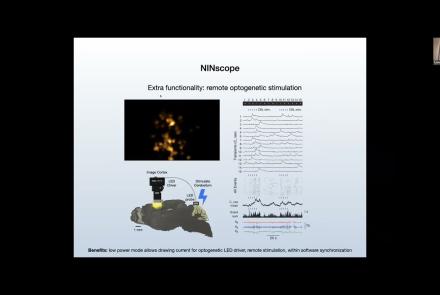
This talk delves into challenges and opportunities of Miniscope design, seeking the optimal balance between scale and function.
Difficulty level: Beginner
Duration: 00:21:51
Speaker: : Susie Feng, Zach Pennington, Tycho Hoogland

Course:
Attendees of this talk will learn aobut computational imaging systems and associated pipelines, as well as open-source software solutions supporting miniscope use.
Difficulty level: Beginner
Duration: 00:17:56
Speaker: : Susie Feng, Zach Pennington, Laura Waller

Course:
This talk covers the present state and future directions of calcium imaging data analysis, particularly in the context of one-photon vs two-photon approaches.
Difficulty level: Beginner
Duration: 00:21:06

Course:
In this talk, results from rodent experimentation using in vivo imaging are presented, demonstrating how the monitoring of neural ensembles may reveal patterns of learning during spatial tasks.
Difficulty level: Beginner
Duration: 00:19:43
Speaker: : Susie Feng, Zach Pennington, William Mau