
Lesson type
Difficulty level

This lecture covers advanced concepts of energy-based models. The lecture is a part of the Associative Memories module of the the Deep Learning Course at NYU's Center for Data Science. Prerequisites for this course include: Energy-Based Models I, Energy-Based Models II, Energy-Based Models III, Energy-Based Models IV, Energy-Based Models V, and an Introduction to Data Science or a Graduate Level Machine Learning course.
Difficulty level: Advanced
Duration: 2:00:28
Speaker: : Yann LeCun

This tutorial covers advanced concept of energy-based models. The lecture is a part of the Associative Memories module of the the Deep Learning Course at NYU's Center for Data Science.
Difficulty level: Advanced
Duration: 1:12:00
Speaker: : Alfredo Canziani

Course:
This lecture provides an introduction to the problem of speech recognition using neural models, emphasizing the CTC loss for training and inference when input and output sequences are of different lengths. It also covers the concept of beam search for use during inference, and how that procedure may be modeled at training time using a Graph Transformer Network. It is a part of the Deep Learning Course at NYU's Center for Data Science. Prerequisites for this module include: Modules 1 - 5 of this course and an Introduction to Data Science or a Graduate Level Machine Learning course.
Difficulty level: Advanced
Duration: 1:55:03
Speaker: : Awni Hannun

Course:
This lecture covers the concepts of the architecture and convolution of traditional convolutional neural networks, the characteristics of graph and graph convolution, and spectral graph convolutional neural networks and how to perform spectral convolution, as well as the complete spectrum of Graph Convolutional Networks (GCNs), starting with the implementation of Spectral Convolution through Spectral Networks. It then provides insights on applicability of the other convolutional definition of Template Matching to graphs, leading to Spatial networks. This lecture is a part of the Deep Learning Course at NYU's Center for Data Science. Prerequisites for this module include: Modules 1 - 5 of this course and an Introduction to Data Science or a Graduate Level Machine Learning course.
Difficulty level: Advanced
Duration: 2:00:22
Speaker: : Xavier Bresson

Course:
This tutuorial covers the concept of graph convolutional networks and is a part of the Deep Learning Course at NYU's Center for Data Science. Prerequisites for this module include: Modules 1 - 5 of this course and an Introduction to Data Science or a Graduate Level Machine Learning course.
Difficulty level: Advanced
Duration: 57:33
Speaker: : Alfredo Canziani

Course:
This lecture covers the concept of model predictive control and is a part of the Deep Learning Course at NYU's Center for Data Science. Prerequisites for this module include: Models 1-6 of this course and an Introduction to Data Science or a Graduate Level Machine Learning course.
Difficulty level: Advanced
Duration: 1:10:22
Speaker: : Alfredo Canziani

Course:
This lecture covers the concepts of emulation of kinematics from observations and training a policy. It is a part of the Deep Learning Course at NYU's Center for Data Science. Prerequisites for this module include: Models 1-6 of this course and an Introduction to Data Science or a Graduate Level Machine Learning course.
Difficulty level: Advanced
Duration: 1:01:21
Speaker: : Alfredo Canziani

Course:
This lecture covers the concept of predictive policy learning under uncertainty and is a part of the Deep Learning Course at NYU's Center for Data Science. Prerequisites for this module include: Models 1-6 of this course and an Introduction to Data Science or a Graduate Level Machine Learning course.
Difficulty level: Advanced
Duration: 1:14:44
Speaker: : Alfredo Canziani

Course:
This lecture covers the concepts of gradient descent, stochastic gradient descent, and momentum. It is a part of the Deep Learning Course at NYU's Center for Data Science. Prerequisites for this module include: Models 1-7 of this course and an Introduction to Data Science or a Graduate Level Machine Learning course.
Difficulty level: Advanced
Duration: 1:29:05
Speaker: : Aaron DeFazio

Course:
This lecture continues on the topic of descent from the previous lesson, Optimization I. This lesson is a part of the Deep Learning Course at NYU's Center for Data Science. Prerequisites for this module include: Models 1-7 of this course and an Introduction to Data Science or a Graduate Level Machine Learning course.
Difficulty level: Advanced
Duration: 1:51:32
Speaker: : Alfredo Canziani
Course:
This lesson gives an introduction to deep learning, with a perspective via inductive biases and emphasis on correctly matching deep learning to the right research questions.
Difficulty level: Beginner
Duration: 01:35:12
Speaker: : Blake Richards
Course:
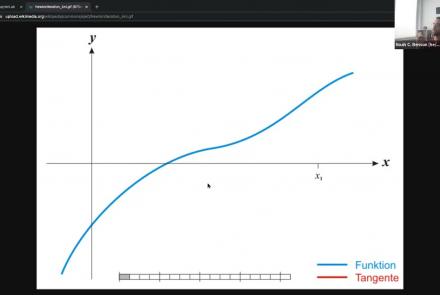
As a part of NeuroHackademy 2021, Noah Benson gives an introduction to Pytorch, one of the two most common software packages for deep learning applications to the neurosciences.
Difficulty level: Beginner
Duration: 00:50:40
Speaker: :

Course:
Learn how to use TensorFlow 2.0 in this full tutorial for beginners. This course is designed for Python programmers looking to enhance their knowledge and skills in machine learning and artificial intelligence.
Throughout the 8 modules in this course you will learn about fundamental concepts and methods in ML & AI like core learning algorithms, deep learning with neural networks, computer vision with convolutional neural networks, natural language processing with recurrent neural networks, and reinforcement learning.
Difficulty level: Beginner
Duration: 06:52:07
Speaker: :

Course:
In this hands-on tutorial, Dr. Robert Guangyu Yang works through a number of coding exercises to see how RNNs can be easily used to study cognitive neuroscience questions, with a quick demonstration of how we can train and analyze RNNs on various cognitive neuroscience tasks. Familiarity of Python and basic knowledge of Pytorch are assumed.
Difficulty level: Beginner
Duration: 00:26:38
Speaker: :

In this session the Medical Informatics Platform (MIP) federated analytics is presented. The current and future analytical tools implemented in the MIP will be detailed along with the constructs, tools, processes, and restrictions that formulate the solution provided. MIP is a platform providing advanced federated analytics for diagnosis and research in clinical neuroscience research. It is targeting clinicians, clinical scientists and clinical data scientists. It is designed to help adopt advanced analytics, explore harmonized medical data of neuroimaging, neurophysiological and medical records as well as research cohort datasets, without transferring original clinical data. It can be perceived as a virtual database that seamlessly presents aggregated data from distributed sources, provides access and analyze imaging and clinical data, securely stored in hospitals, research archives and public databases. It leverages and re-uses decentralized patient data and research cohort datasets, without transferring original data. Integrated statistical analysis tools and machine learning algorithms are exposed over harmonized, federated medical data.
Difficulty level: Intermediate
Duration: 15:05
Speaker: : Giorgos Papanikos

The Medical Informatics Platform (MIP) is a platform providing federated analytics for diagnosis and research in clinical neuroscience research. The federated analytics is possible thanks to a distributed engine that executes computations and transfers information between the members of the federation (hospital nodes). In this talk the speaker will describe the process of designing and implementing new analytical tools, i.e. statistical and machine learning algorithms. Mr. Sakellariou will further describe the environment in which these federated algorithms run, the challenges and the available tools, the principles that guide its design and the followed general methodology for each new algorithm. One of the most important challenges which are faced is to design these tools in a way that does not compromise the privacy of the clinical data involved. The speaker will show how to address the main questions when designing such algorithms: how to decompose and distribute the computations and what kind of information to exchange between nodes, in order to comply with the privacy constraint mentioned above. Finally, also the subject of validating these federated algorithms will be briefly touched.
Difficulty level: Intermediate
Duration: 20:26
Speaker: : Jason Skellariou

The Medical Informatics Platform (MIP) Dementia had been installed in several memory clinics across Europe allowing them to federate their real-world databases. Research open access databases had also been integrated such as ADNI (Alzheimer’s Dementia Neuroimaging Initiative), reaching a cumulative case load of more than 5,000 patients (major cognitive disorder due to Alzheimer’s disease, other major cognitive disorder, minor cognitive disorder, controls). The statistic and machine learning tools implemented in the MIP allowed researchers to conduct easily federated analyses among Italian memory clinics (Redolfi et al. 2020) and also across borders between the French (Lille), the Swiss (Lausanne) and the Italian (Brescia) datasets.
Difficulty level: Intermediate
Duration: 16:44
Speaker: : Mélanie Leroy
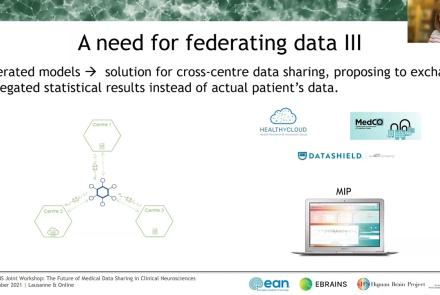
This talks presents ethics requirements of the Medical Informatics Platform, a data sharing platform for medical data using data federation mechanisms. The talk presents how the Medical Informatics Platform (MIP) works and which ethical requirements need to be considered when working with federated data.
Difficulty level: Intermediate
Duration: 16:25
Speaker: : Erika Borcel

This lecture talks about the usage of knowledge graphs in hospitals and related challenges of semantic interoperability.
Difficulty level: Intermediate
Duration: 24:32
Speaker: : Cristophe Gaudet-Blavignac

This lecture discusses risk-based anonymization approaches for medical research.
Difficulty level: Intermediate
Duration: 15:43
Speaker: : Fabian Prasser