
Lesson type
Difficulty level

Course:
The Mouse Phenome Database (MPD) provides access to primary experimental trait data, genotypic variation, protocols and analysis tools for mouse genetic studies. Data are contributed by investigators worldwide and represent a broad scope of phenotyping endpoints and disease-related traits in naïve mice and those exposed to drugs, environmental agents or other treatments. MPD ensures rigorous curation of phenotype data and supporting documentation using relevant ontologies and controlled vocabularies. As a repository of curated and integrated data, MPD provides a means to access/re-use baseline data, as well as allows users to identify sensitized backgrounds for making new mouse models with genome editing technologies, analyze trait co-inheritance, benchmark assays in their own laboratories, and many other research applications. MPD’s primary source of funding is NIDA. For this reason, a majority of MPD data is neuro- and behavior-related.
Difficulty level: Beginner
Duration: 55:36
Speaker: : Elissa Chesler

This lesson provides an overview of the current status in the field of neuroscientific ontologies, presenting examples of data organization and standards, particularly from neuroimaging and electrophysiology.
Difficulty level: Intermediate
Duration: 33:41
Speaker: : Yaroslav O. Halchenko

This lesson continues from part one of the lecture Ontologies, Databases, and Standards, diving deeper into a description of ontologies and knowledg graphs.
Difficulty level: Intermediate
Duration: 50:18
Speaker: : Jeff Grethe

This lecture covers the NIDM data format within BIDS to make your datasets more searchable, and how to optimize your dataset searches.
Difficulty level: Beginner
Duration: 12:33
Speaker: : David Keator
This lecture covers positron emission tomography (PET) imaging and the Brain Imaging Data Structure (BIDS), and how they work together within the PET-BIDS standard to make neuroscience more open and FAIR.
Difficulty level: Beginner
Duration: 12:06
Speaker: : Melanie Ganz

This lecture discusses the FAIR principles as they apply to electrophysiology data and metadata, the building blocks for community tools and standards, platforms and grassroots initiatives, and the challenges therein.
Difficulty level: Beginner
Duration: 8:11
Speaker: : Thomas Wachtler
This lecture discusses how to standardize electrophysiology data organization to move towards being more FAIR.
Difficulty level: Beginner
Duration: 15:51
Speaker: : Sylvain Takerkart

Course:
The International Brain Initiative (IBI) is a consortium of the world’s major large-scale brain initiatives and other organizations with a vested interest in catalyzing and advancing neuroscience research through international collaboration and knowledge sharing. This workshop introduces the IBI, the efforts of the Data Standards and Sharing Working Group, and keynote lectures on the impact of data standards and sharing on large-scale brain projects, as well as a discussion on prospects and needs for neural data sharing.
Difficulty level: Intermediate
Duration: 2:06:58

This is the Introductory Module to the Deep Learning Course at CDS, a course that covered the latest techniques in deep learning and representation learning, focusing on supervised and unsupervised deep learning, embedding methods, metric learning, convolutional and recurrent nets, with applications to computer vision, natural language understanding, and speech recognition.
Difficulty level: Intermediate
Duration: 50:17
Speaker: : Yann LeCun and Alfredo Canziani

This module covers the concepts of gradient descent and the backpropagation algorithm and is a part of the Deep Learning Course at NYU's Center for Data Science.
Difficulty level: Intermediate
Duration: 1:51:03
Speaker: : Yann LeCun

This lecture covers concepts associated with neural nets, including rotation and squashing, and is a part of the Deep Learning Course at New York University's Center for Data Science (CDS).
Difficulty level: Intermediate
Duration: 1:01:53
Speaker: : Alfredo Canziani

This lesson provides a detailed description of some of the modules and architectures involved in the development of neural networks.
Difficulty level: Intermediate
Duration: 1:42:26
Speaker: : Yann LeCun and Alfredo Canziani

This lecture covers the concept of neural nets training (tools, classification with neural nets, and PyTorch implementation) and is a part of the Deep Learning Course at NYU's Center for Data Science.
Difficulty level: Intermediate
Duration: 1:05:47
Speaker: : Alfredo Canziani

This lecture covers the concept of parameter sharing: recurrent and convolutional nets and is a part of the Deep Learning Course at NYU's Center for Data Science.
Difficulty level: Intermediate
Duration: 1:59:47
Speaker: : Yann LeCun and Alfredo Canziani

This lecture covers the concept of convolutional nets in practice and is a part of the Deep Learning Course at NYU's Center for Data Science.
Difficulty level: Intermediate
Duration: 51:40
Speaker: : Yann LeCun

This lecture discusses the concept of natural signals properties and the convolutional nets in practice and is a part of the Deep Learning Course at NYU's Center for Data Science.
Difficulty level: Intermediate
Duration: 1:09:12
Speaker: : Alfredo Canziani

This lecture covers the concept of recurrent neural networks: vanilla and gated (LSTM) and is a part of the Deep Learning Course at NYU's Center for Data Science.
Difficulty level: Intermediate
Duration: 1:05:36
Speaker: : Alfredo Canziani
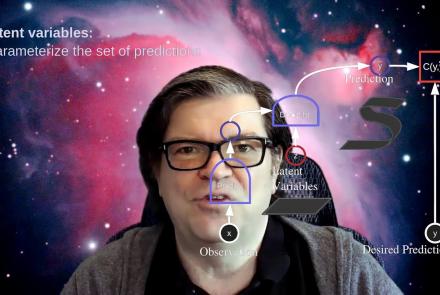
This lecture is a foundationational lecture for the concept of energy-based models with a particular focus on the joint embedding method and latent variable energy-based models (LV-EBMs) and is a part of the Deep Learning Course at NYU's Center for Data Science.
Difficulty level: Intermediate
Duration: 1:51:30
Speaker: : Yann LeCun

This lecture covers the concept of inference in latent variable energy based models (LV-EBMs) and is a part of the Deep Learning Course at NYU's Center for Data Science.
Difficulty level: Intermediate
Duration: 1:01:04
Speaker: : Alfredo Canziani

This panel discussion covers how energy based models are used and is a part of the Deep Learning Course at NYU's Center for Data Science.
Difficulty level: Intermediate
Duration: 10:42
Speaker: : Yann LeCun and Alfredo Canziani