
Lesson type
Difficulty level

This lesson continues with the second workshop on reproducible science, focusing on additional open source tools for researchers and data scientists, such as the R programming language for data science, as well as associated tools like RStudio and R Markdown. Additionally, users are introduced to Python and iPython notebooks, Google Colab, and are given hands-on tutorials on how to create a Binder environment, as well as various containers in Docker and Singularity.
Difficulty level: Beginner
Duration: 1:16:04
Speaker: : Erin Dickie and Sejal Patel

This lesson describes how DataLad allows you to track and mange both your data and analysis code, thereby facilitating reliable, reproducible, and shareable research.
Difficulty level: Intermediate
Duration: 59:34
Speaker: : Yaroslav O. Halchenko

This video gives a short introduction to the EBRAINS data sharing platform, why it was developed, and how it contributes to open data sharing.
Difficulty level: Beginner
Duration: 17:32
Speaker: : Ida Aasebø

This video introduces the key principles for data organization and explains how you could make your data FAIR for data sharing on EBRAINS.
Difficulty level: Beginner
Duration: 10:54
Speaker: : Maaike van Swieten

This video introduces the importance of writing a Data Descriptor to accompany your dataset on EBRAINS. It gives concrete examples on what information to include and highlights how this makes your data more FAIR.
Difficulty level: Beginner
Duration: 9:48
Speaker: : Ingrid Reiten

This video demonstrates how to find, access, and download data on EBRAINS.
Difficulty level: Beginner
Duration: 14:27
Speaker: : Maaike van Swieten

Course:
KnowledgeSpace (KS) is a data discoverability portal and neuroscience encyclopedia that was developed to make it easier for the neuroscience community to find publicly available datasets that adhere to the FAIR Principles and to provide an integrated view of neuroscience concepts found in Wikipedia and NeuroLex linked with PubMed and 17 of the world's leading neuroscience repositories. In short, KS provides a single point of entry where reseaerchers can search for a neuroscience concept of interest and receive results that include: i. a description of the term found in Wikipedia/NeuroLex, ii. links to publicly available datasets related to the concept of interest, and iii. up-to-date references that support the concept of interests found in PubMed. APIs are available so that developers of other neuroscience research infrastructures can integrate KS components in their infrastructures. If your repository or your favorite repository is not indexed in KS, please contact us.
Difficulty level: Beginner
Duration: 6:14
Speaker: : Heather Topple

This is a hands-on tutorial on PLINK, the open source whole genome association analysis toolset. The aims of this tutorial are to teach users how to perform basic quality control on genetic datasets, as well as to identify and understand GWAS summary statistics.
Difficulty level: Intermediate
Duration: 1:27:18
Speaker: : Dan Felsky

In this workshop talk, you will receive a tour of the Code Ocean ScienceOps Platform, a centralized cloud workspace for all teams.
Difficulty level: Beginner
Duration: 10:24
Speaker: : Frank Zappulla

This talk describes approaches to maintaining integrated workflows and data management schema, taking advantage of the many open source, collaborative platforms already existing.
Difficulty level: Beginner
Duration: 15:15
Speaker: : Erik C. Johnson

In this third and final hands-on tutorial from the Research Workflows for Collaborative Neuroscience workshop, you will learn about workflow orchestration using open source tools like DataJoint and Flyte.
Difficulty level: Intermediate
Duration: 22:36
Speaker: : Daniel Xenes

This lesson provides an introduction to the DataLad, a free and open source distributed data management system that keeps track of your data, creates structure, ensures reproducibility, supports collaboration, and integrates with widely used data infrastructure.
Difficulty level: Beginner
Duration: 22:56
Speaker: : Michał Szczepanik

This lesson introduces several open science tools like Docker and Apptainer which can be used to develop portable and reproducible software environments.
Difficulty level: Beginner
Duration: 17:22
Speaker: : Joanes Grandjean

This lecture provides a detailed description of how to incorporate HED annotation into your neuroimaging data pipeline.
Difficulty level: Beginner
Duration: 33:36
Speaker: : Dung Truong

This lecture describes how to build research workflows, including a demonstrate using DataJoint Elements to build data pipelines.
Difficulty level: Intermediate
Duration: 47:00
Speaker: : Dimitri Yatsenko

Course:
This video will teach you the basics of navigating the Open Science Framework and creating your first projects.
Difficulty level: Beginner
Duration: 2:11
Speaker: :

Course:
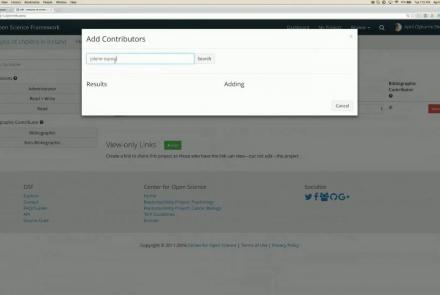
This webinar walks you through the basics of creating an OSF project, structuring it to fit your research needs, adding collaborators, and tying your favorite online tools into your project structure.
Difficulty level: Beginner
Duration: 55:02
Speaker: : Ian Sullivan
Course:
This webinar will introduce how to use the Open Science Framework (OSF) in a classroom setting.
Difficulty level: Beginner
Duration: 32:01
Speaker: : April Clyburne-Sherin

Course:
This lesson provides instruction on how to organize related projects with OSF features such as links, forks, and templates.
Difficulty level: Beginner
Duration: 51:14
Speaker: : Ian Sullivan

This webinar will introduce the integration of JASP Statistical Software with the Open Science Framework (OSF).
Difficulty level: Beginner
Duration: 30:56
Speaker: : Alexander Etz