
Lesson type
Difficulty level

Course:
This lesson is a general overview of overarching concepts in neuroinformatics research, with a particular focus on clinical approaches to defining, measuring, studying, diagnosing, and treating various brain disorders. Also described are the complex, multi-level nature of brain disorders and the data associated with them, from genes and individual cells up to cortical microcircuits and whole-brain network dynamics. Given the heterogeneity of brain disorders and their underlying mechanisms, this lesson lays out a case for multiscale neuroscience data integration.
Difficulty level: Intermediate
Duration: 1:09:33
Speaker: : Sean Hill

This lesson gives an in-depth introduction of ethics in the field of artificial intelligence, particularly in the context of its impact on humans and public interest. As the healthcare sector becomes increasingly affected by the implementation of ever stronger AI algorithms, this lecture covers key interests which must be protected going forward, including privacy, consent, human autonomy, inclusiveness, and equity.
Difficulty level: Beginner
Duration: 1:22:06
Speaker: : Daniel Buchman

This is a continuation of the talk on the cellular mechanisms of neuronal communication, this time at the level of brain microcircuits and associated global signals like those measureable by electroencephalography (EEG). This lecture also discusses EEG biomarkers in mental health disorders, and how those cortical signatures may be simulated digitally.
Difficulty level: Intermediate
Duration: 1:11:04
Speaker: : Etay Hay
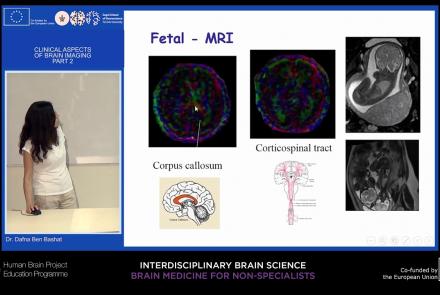
This lecture picks up from the previous lesson, providing an overview of neuroimaging techniques and their clinical applications.
Difficulty level: Beginner
Duration: 41:00
Speaker: : Dafna Ben Bashat

This lesson provides a basic introduction to clinical presentation of schizophrenia, its etiology, and current treatment options.
Difficulty level: Beginner
Duration: 51:49
Speaker: : Wolfgang Fleischhacker

This lecture focuses on the rationale for employing neuroimaging methods for movement disorders.
Difficulty level: Beginner
Duration: 1:04:04
Speaker: : Bogdan Draganski

This lecture provides an introduction to the course "Cognitive Science & Psychology: Mind, Brain, and Behavior".
Difficulty level: Beginner
Duration: 1:06:49
Speaker: : Paul F.M.J. Verschure

This lecture covers the emergence of cognitive science after the Second World War as an interdisciplinary field for studying the mind, with influences from anthropology, cybernetics, and artificial intelligence.
Difficulty level: Beginner
Duration: 51:07
Speaker: : Paul F.M.J. Verschure

This lecture covers different perspectives on the study of the mental, focusing on the difference between Mind and Brain.
Difficulty level: Beginner
Duration: 1:16:30
Speaker: : Paul F.M.J. Verschure

This lecture outlines various approaches to studying Mind, Brain, and Behavior.
Difficulty level: Beginner
Duration: 1:02:34
Speaker: : Paul F.M.J. Verschure

This lecture covers the history of behaviorism and the ultimate challenge to behaviorism.
Difficulty level: Beginner
Duration: 1:19:08
Speaker: : Paul F.M.J. Verschure

This lecture covers various learning theories.
Difficulty level: Beginner
Duration: 1:00:42
Speaker: : Paul F.M.J. Verschure

This lecture covers a lot of post-war developments in the science of the mind, focusing first on the cognitive revolution, and concluding with living machines.
Difficulty level: Beginner
Duration: 2:24:35
Speaker: : Paul F.M.J. Verschure