
Below you will find the latest courses. Please search or select the courses based on the below filters.

INCF Assembly 2022 - Day 1 Sessions
INCFSessions from the INCF Neuroinformatics Assembly 2022 day 1.
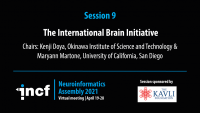
The International Brain Initiative (IBI)
INCFThe International Brain Initiative (IBI) is a consortium of the world’s major large-scale brain initiatives and other organizations with a vested interest in catalyzing and advancing neuroscience research through international collaboration and knowledge sharing. This session will introduce the IBI and the current efforts of the Data Standards and Sharing Working Group with a view to gain input from a wider neuroscience and neuroinformatics community.

INCF Assembly 2023 - Lightning Talks (Day 2)
INCFThis course consists of several lightning talks from the second day of INCF's Neuroinformatics Assembly 2023. Covering a wide range of topics, these brief talks provide snapshots of various neuroinformatic efforts such as brain-computer interface standards, dealing with multimodal animal MRI datasets, distributed data management, and several more.

Neuroscience for Machine Learners (Neuro4ML)
Neural Reckoning GroupThis is a freely available online course on neuroscience for people with a machine learning background. The aim is to bring together these two fields that have a shared goal in understanding intelligent processes. Rather than pushing for “neuroscience-inspired” ideas in machine learning, the idea is to broaden the conceptions of both fields to incorporate elements of the other in the hope that this will lead to new, creative thinking.

Data Science and Neuroinformatics
INCFMuch like neuroinformatics, data science uses techniques from computational science to derive meaningful results from large complex datasets. In this session, we will explore the relationship between neuroinformatics and data science, by emphasizing a range of data science approaches and activities, ranging from the development and application of statistical methods, through the establishment of communities and platforms, and through the implementation of open-source software tools.

Hypothes.is: A Web-Based Annotation Tool
Hypothes.isThis short course covers Hypothes.is, an annotation tool that enables users to collaboratively annotate course readings and other internet resources.
Features of Hypothes.is:

Current Methods in Neurotechnology
NeurotechEUThe lecture series focuses on current trends in modern techniques in neuroscience. Inspiring scientists from the NeurotechEU Alliance will give an overview of the latest advances and developments.

Digital Health for Mental Health
Krembil Centre for NeuroinformaticsAs technological improvements continue to facilitate innovations in the mental health space, researchers and clinicians are faced with novel opportunities and challenges regarding study design, diagnoses, treatments, and follow-up care. This course includes a lecture outlining these new developments, as well as a workshop which introduces users to Synapse, an open-source platform for collaborative data analysis.

High-Performance Computing (HPC)
The dimensionality and size of datasets in many fields of neuroscience research require massively parallel computing power. Fortunately, the maturity and accessibility of virtualization technologies has made it feasible to run the same analysis environments on platforms ranging from single laptop computers up to high-performance computing networks.
The Virtual Brain Node #10 Workshop: Personalized Multi-Scale Brain Simulation
The Virtual BrainThis workshop provides basic knowledge on personalized brain network modeling using the open-source simulation platform The Virtual Brain (TVB). Participants will gain theoretical knowledge and apply this knowledge to construct brain models, process multimodal neuroimaging data for reconstructing individual brains, run simulations, and use supporting neuroinformatics tools such as collaboratories, pipelines, workflows, and data repositories.
Session 2: FAIR Sharing, Integration, & Analysis of Neuroscience Data
INCFThis course corresponds to the second session of INCF's Neuroinformatics Assembly 2023. This series of talks continues a discussion of FAIR principles from the first session, with a greater emphasis on brain data (humans and animals) atlases for data analysis and integation.
Foundations of Neurotechnology
The BCI GuysThis course provides a broad, non-technical overview of the field of neurotechnology. It is intended to provide users with a fundamental understanding of how neurotechnology works.

Using brainlife.io
brainlife.ioThis course provides several visual walkthroughs documenting how to execute various processes in brainlife.io, an open-source, free and secure reproducible neuroscience analysis platform. The platform allows to analyze Magnetic Resonance Imaging (MRI), electroencephalography (EEG) and magnetoencephalography (MEG) data. Data can either be uploaded from local computers or imported from public archives such as OpenNeuro.org.

The Future of Medical Data Sharing in Clinical Neurosciences
EBRAINSThis workshop hosted by HBP, EBRAINS, and the European Academy of Neurology (EAN) aimed to identify and openly discuss all issues and challenges associated with data sharing in Europe: from ethics to data safety and privacy including those specific to data federation such as the development and validation of federated algorithms.
Whole-Brain Modelling
Krembil Centre for NeuroinformaticsGiven the extreme interconnectedness of the human brain, studying any one cerebral area in isolation may lead to spurious results or incomplete, if not problematic, interpretations. This course introduces participants to the various spatial scales of neuroscience and the fundamentals of whole-brain modelling, used to generate a more thorough picture of brain activity.
The Virtual Brain Education Pack (TVB EduPack)
The Virtual BrainThe Virtual Brain EduPack provides didactic use cases for The Virtual Brain (TVB). Typically a use case consists of a jupyter notebook and a didactic video. EduPack use cases help the user to reproduce TVB-based publications or to get started quickly with TVB.

Module 2: EEG
Mike X. CohenIn this module, you will work with human EEG data recorded during a steady-state visual evoked potential study (SSVEP, aka flicker). You will learn about spectral analysis, alpha activity, and topographical mapping. The MATLAB code introduces functions, sorting, and correlation analysis.
High-Performance Computing (HPC)
The dimensionality and size of datasets in many fields of neuroscience research require massively parallel computing power. Fortunately, the maturity and accessibility of virtualization technologies has made it feasible to run the same analysis environments on platforms ranging from single laptop computers up to high-performance computing networks.
Module 4: fMRI
Mike X. CohenThis module covers fMRI data, including creating and interpreting flatmaps, exploring variability and average responses, and visual eccenticity. You will learn about processing BOLD signals, trial-averaging, and t-tests. The MATLAB code introduces data animations, multicolor visualizations, and linear indexing.

Bayesian Statistics
Neuromatch AcademyNeuromatch Academy aims to introduce traditional and emerging tools of computational neuroscience to trainees.