
Below you will find the latest courses. Please search or select the courses based on the below filters.

Lifecycle of Human Electroencephalography/Event-Related Potential Data
Czech National Node for NeuroinformaticsThis course is intended for those interested in electroencephalography (EEG) and event-related potentials (ERPs) techniques, and those interested in collecting, annotating, standardizing, storing, processing, sharing, and publishing data from electrical activity of the human brain.

Fundamental Methods for Genomic Analysis
Krembil Centre for NeuroinformaticsThis course includes both lectures and tutorials around the management and analysis of genomic data in clinical research and care. Participants are led through the basics of genome-wide association studies (GWAS), genotypes, and polygenic risk scores, as well as novel concepts and tools for more sophisticated consideration of population stratification in GWAS.
Introduction to Neurodata Without Borders (NWB) for MATLAB Users I
NWB Core Development TeamThe Neurodata Without Borders: Neurophysiology project (NWB, https://www.nwb.org/) is an effort to standardize the description and storage of neurophysiology data and metadata. NWB enables data sharing and reuse and reduces the energy-barrier to applying data analytics both within and across labs. Several laboratories, including the Allen Institute for Brain Science, have wholeheartedly adopted NWB.
Population-Based Data Resources & Integrative Research Methods
Krembil Centre for NeuroinformaticsAs research methods and experimental technologies become ever more sophisticated, the amount of health-related data per individual which has become accessible is vast, giving rise to a corresponding need for cross-domain data integration, whole-person modelling, and improved precision medicine. This course provides lessons describing state of the art methods and repositories, as well as a tutorial on computational methods for data integration.

Module 2: EEG
Mike X. CohenIn this module, you will work with human EEG data recorded during a steady-state visual evoked potential study (SSVEP, aka flicker). You will learn about spectral analysis, alpha activity, and topographical mapping. The MATLAB code introduces functions, sorting, and correlation analysis.

INCF Assembly 2022 - Day 2 Sessions
INCFSessions from the INCF Neuroinformatics Assembly 2022 day 2.
Versioning & Containerization
This course outlines how versioning code, data, and analysis software is crucially important to rigorous and open neuroscience workflows that maximize reproducibility and minimize errors.Version control systems, code-capable notebooks, and virtualization containers such as Git, Jupyter, and Docker, respectively, have become essential tools in data science.

Coding and Vision 101
Allen Institute for Brain ScienceThis course consists of 12 lectures on the visual system and neural coding produced by the Allen Institute for Brain Science. The lectures cover broad neurophysiological concepts such as information theory and the mammalian visual system, as well as more specific topics such as cell types and their functions in the mammalian retina.
Deep Learning: Associative Memories
NYU Center for Data ScienceThis module covers the concept of associative memories in deep learning. It is a part of the Deep Learning Course at NYU's Center for Data Science. Prerequisites for this module include: Introduction to Deep Learning (module 1 of the course), Parameter Sharing (module 2 of the course),

The Future of Medical Data Sharing in Clinical Neurosciences
EBRAINSThis workshop hosted by HBP, EBRAINS, and the European Academy of Neurology (EAN) aimed to identify and openly discuss all issues and challenges associated with data sharing in Europe: from ethics to data safety and privacy including those specific to data federation such as the development and validation of federated algorithms.
Applied Ethics in Machine Learning and Mental Health
Krembil Centre for NeuroinformaticsThis course tackles the issue of maintaining ethical research and healthcare practices in the age of increasingly powerful technological tools like machine learning and artificial intelligence. While there is great potential for innovation and improvement in the clinical space thanks to AI development, lecturers in this course advocate for a greater emphasis on human-centric care, calling for algorithm design which takes the full intersectionality of individuals into account.

Introduction to Neurodata Without Borders (NWB) for MATLAB Users II
NWB Core Development TeamThe Neurodata Without Borders: Neurophysiology project (NWB, https://www.nwb.org/) is an effort to standardize the description and storage of neurophysiology data and metadata. NWB enables data sharing and reuse and reduces the energy-barrier to applying data analytics both within and across labs. Several laboratories, including the Allen Institute for Brain Science, have wholeheartedly adopted NWB.

INCF Assembly 2022 - Day 3 Sessions
INCFSessions from the INCF Neuroinformatics Assembly 2022 Day 3.

Linear Systems
Neuromatch AcademyNeuromatch Academy aims to introduce traditional and emerging tools of computational neuroscience to trainees.
Module 4: fMRI
Mike X. CohenThis module covers fMRI data, including creating and interpreting flatmaps, exploring variability and average responses, and visual eccenticity. You will learn about processing BOLD signals, trial-averaging, and t-tests. The MATLAB code introduces data animations, multicolor visualizations, and linear indexing.
2021 Virtual Miniscope Workshop
MetaCellA virtual workshop with lectures and hands-on tutorials that will teach participants how to use open-source Miniscopes for in vivo calcium imaging. This workshop is designed to introduce all aspects of using Miniscopes, including basic principles of Miniscope design and imaging, how to build and attach a Miniscope, how to implant a GRIN lens for imaging deep structures, and how to analyze imaging data.
The Virtual Brain: Bernstein Center Lectures 2019
The Virtual BrainThis course provides a general overview about brain simulation, including its fundamentals as well as clinical applications in populations with stroke, neurodegeneration, epilepsy, and brain tumors. This course also introduces the mathematical framework of multi-scale brain modeling and its analysis.
Population-Based Data Resources & Integrative Research Methods
Krembil Centre for NeuroinformaticsAs research methods and experimental technologies become ever more sophisticated, the amount of health-related data per individual which has become accessible is vast, giving rise to a corresponding need for cross-domain data integration, whole-person modelling, and improved precision medicine. This course provides lessons describing state of the art methods and repositories, as well as a tutorial on computational methods for data integration.
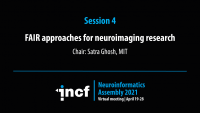
FAIR Approaches for Neuroimaging Research
INCFOver the last three decades, neuroimaging research has seen large strides in the scale, diversity, and complexity of studies, the open availability of data and methodological resources, the quality of instrumentation and multimodal studies, and the number of researchers and consortia. The awareness of rigor and reproducibility has increased with the advent of funding mandates, and with the work done by national and international brain initiatives.

NeuroTools Webinar Series
Neuroscience Information FrameworkPresented by the Neuroscience Information Framework (NIF), this series consists of several lectures characterizing cutting-edge, open-source software platforms and computational tools for neuroscientists. This course offers detailed descriptions of various neuroinformatic resources such as cloud-computing services, web-based annotation tools, genome browsers, and platforms for designing and building biophysically detailed models of neurons and neural ensembles.