
Lesson type
Difficulty level

To encapsulate the emerging concerns at the convergence between brain and environmental health whilst aligning it with ethical considerations, the Emerging Issues Task Force of the International Neuroethics Society organized a virtual panel discussion. The panel focused on four areas of analysis. Specific attention was given to how these four tiers come together to provide directions for future ethically-minded and behaviorally-driven environmental health research.
Difficulty level: Beginner
Duration: 1:03:34
Course:
This lesson provides an overview of the ethical issues that have arisen as a result of the application of advancements in neurotechnology.
Difficulty level: Beginner
Duration: 9:31

Course:
This module covers how neurotechnology is perceived in media today. We discuss a few specific films and talk about how the perception of neurotechnology changes with our media. Finally, we introduce a few interesting terms related to ethics and address some future issues the technology may cause.
Difficulty level: Beginner
Duration: 12:03
Speaker: : Colin Fausnaught
Course:
In response to a growing need in the neuroscience community for concrete guidance concerning ethically sound and pragmatically feasible open data-sharing, the CONP has created an ‘Ethics Toolkit’. These documents (links found below in 'Documents' section) are meant to help researchers identify key elements in the design and conduct of their projects that are often required for the open sharing of neuroscience data, such as model consent language and approaches to de-identification.
This guidance is the product of extended discussions and careful drafting by the CONP Ethics and Governance Committee that considers both Canadian and international ethical frameworks and research practice. The best way to cite these resources is with their associated Zenodo DOI:

Difficulty level: Beginner
Duration:
Speaker: :
Course:
Open Brain Consent is an international initiative aiming to address the challenge of creating participant consent language that will promote the open sharing of data, protect participant privacy, and conform to legal norms and institutional review boards.
Open Brain Consent addresses the aforementioned difficulties in neuroscience research with human participants by collecting:
- widely acceptable consent forms (with various translations) allowing deposition of anonymized data to public data archives
- collection of tools/pipelines to help anonymization of neuroimaging data making it ready for sharing
Difficulty level: Beginner
Duration:
Speaker: :

This lecture covers how you can make your data public through EBRAINS. This talk focuses on the ethical considerations for sharing data, the requirements that are imposed by various regulations, particularly for sharing human data. The lecture also includes a discussion of how EBRAINS designs its services to deal with the ethical and regulatory aspects of sharing these kinds of data.
Difficulty level: Intermediate
Duration: 16:15
Speaker: : Maaike van Swieten and Jan Bjaalie

This lecture discusses differential privacy and synthetic data in the context of medical data sharing in clinical neurosciences.
Difficulty level: Intermediate
Duration: 20:26
Speaker: : Minos Garofalakis
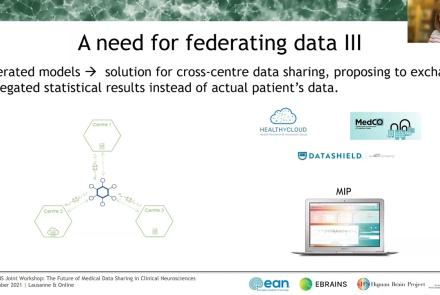
This talks presents ethics requirements of the Medical Informatics Platform, a data sharing platform for medical data using data federation mechanisms. The talk presents how the Medical Informatics Platform (MIP) works and which ethical requirements need to be considered when working with federated data.
Difficulty level: Intermediate
Duration: 16:25
Speaker: : Erika Borcel