
Lesson type
Difficulty level

This lesson describes the fundamentals of genomics, from central dogma to design and implementation of GWAS, to the computation, analysis, and interpretation of polygenic risk scores.
Difficulty level: Intermediate
Duration: 1:28:16
Speaker: : Dan Felsky

Course:
This lesson provides an overview of the database of Genotypes and Phenotypes (dbGaP), which was developed to archive and distribute the data and results from studies that have investigated the interaction of genotype and phenotype in humans.
Difficulty level: Beginner
Duration: 48:22
Speaker: : Michael Feolo

This lecture covers visualizing extracellular neurotransmitter dynamics
Difficulty level: Beginner
Duration: 23:20
Speaker: : Christian Henneberger

This lesson goes over the basic mechanisms of neural synapses, the space between neurons where signals may be transmitted.
Difficulty level: Intermediate
Duration: 7:03
Speaker: : Marcus Ghosh

This lesson describes spike timing-dependent plasticity (STDP), a biological process that adjusts the strength of connections between neurons in the brain, and how one can implement or mimic this process in a computational model. You will also find links for practical exercises at the bottom of this page.
Difficulty level: Intermediate
Duration: 12:50
Speaker: : Dan Goodman

This lesson discusses a gripping neuroscientific question: why have neurons developed the discrete action potential, or spike, as a principle method of communication?
Difficulty level: Intermediate
Duration: 9:34
Speaker: : Dan Goodman

This lecture consists of the second half of the introduction to signal transduction, here focusing on cell receptors and signalling cascades.
Difficulty level: Beginner
Duration: 41:38
Speaker: : Christoph Schwarzer

In this lesson, you will learn about GABAergic interneurons and local inhibition on the circuit level.
Difficulty level: Beginner
Duration: 16:27
Speaker: : Carl Petersen
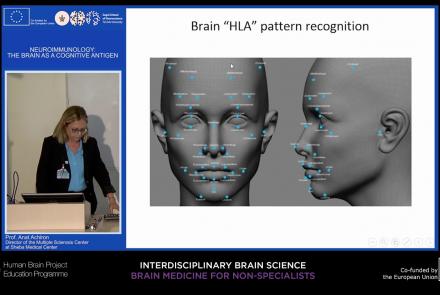
This lecture focuses on how the immune system can target and attack the nervous system to produce autoimmune responses that may result in diseases such as multiple sclerosis, neuromyelitis, and lupus cerebritis manifested by motor, sensory, and cognitive impairments. Despite the fact that the brain is an immune-privileged site, autoreactive lymphocytes producing proinflammatory cytokines can cause active brain inflammation, leading to myelin and axonal loss.
Difficulty level: Beginner
Duration: 37:36
Speaker: : Anat Achiron