
Lesson type
Difficulty level

This is the third and final lecture of this course on neuroinformatics infrastructure for handling sensitive data.
Difficulty level: Beginner
Duration: 1:11:22
Speaker: : Michael Schirner

This lesson gives a quick introduction to the rest of this course, Research Workflows for Collaborative Neuroscience.
Difficulty level: Beginner
Duration: 3:23
Speaker: : Dimitri Yatsenko

This lesson introduces several open science tools like Docker and Apptainer which can be used to develop portable and reproducible software environments.
Difficulty level: Beginner
Duration: 17:22
Speaker: : Joanes Grandjean

This brief video gives an introduction to the eighth session of INCF's Neuroinformatics Assembly 2023, focusing on FAIR data and the role of academic journals.
Difficulty level: Beginner
Duration: 5:57
Speaker: : Jan G. Bjaalie

This brief talk outlines the obstacles and opportunities involved in striving for more open and reproducible publishing, highlighting the need for investment in the technical and governance sectors of FAIR data and software.
Difficulty level: Beginner
Duration: 8:38
Speaker: : Jean-Babtiste Poline

This talk gives an overview of the complicated nature of sharing of neuroscientific data in an environment of numerous and often conflicting legal systems around the world.
Difficulty level: Beginner
Duration: 14:00
Speaker: : Franco Pestilli

This talk describes the challenges in sharing personal, and in particular, health data, such as data anonymization and maintaining GDPR compliance.
Difficulty level: Beginner
Duration: 15:57
Speaker: : Petra Ritter

This talk gives an overview of the perspectives and FAIR-aligned policies of the academic journal Public Library of Science, better known as PLOS. This journal is a nonprofit, open access publisher empowering researchers to accelerate progress in science.
Difficulty level: Beginner
Duration: 11:53
Speaker: : Iain Hrynaszkiewicz

This brief video provides a welcome and short introduction to the outline of the INCF Short Course in Neuroinformatics, held Seattle, Washington in October 2023, in coordination with the West Big Data Hub and the University of Washington.
Difficulty level: Beginner
Duration: 4:58
Speaker: : Ariel Rokem

This opening lecture from INCF's Short Course in Neuroinformatics provides an overview of the field of neuroinformatics itself, as well as laying out an argument for the necessity for developing more sophisticated approaches towards FAIR data management principles in neuroscience.
Difficulty level: Beginner
Duration: 1:19:14
Speaker: : Maryann Martone

This lecture gives a tour of what neuroethics is and how it applies to neuroscience and neurotechnology, while also addressing justice concerns within both fields.
Difficulty level: Beginner
Duration: 58:45
Speaker: : Tim Brown

This lecture covers a wide range of aspects regarding neuroinformatics and data governance, describing both their historical developments and current trajectories. Particular tools, platforms, and standards to make your research more FAIR are also discussed.
Difficulty level: Beginner
Duration: 54:58
Speaker: : Franco Pestilli
Overview of the evolution of scientific paradigms and the growing role of digital infrastructures in modern neuroscience
Difficulty level: Beginner
Duration: 17:16
Speaker: : Jeanette Hellgren Kotaleski
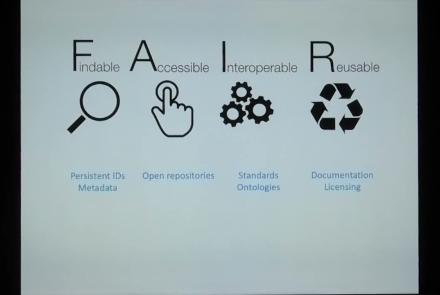
Mathew Abrams, Director of Science & Training at INCF, outlined how INCF and its global community advance standards, software, infrastructure, and education to enable FAIR and open neuroscience.
Difficulty level: Beginner
Duration: 33:20
Speaker: : Mathew Abrams

EBRAINS is an open research infrastructure which gathering data, tools and computing facilities for brain-related research. In this lecture, professor Trygve Leergaard will introduce the EBRAINS ecosystem and give overview of services for sharing, finding, and using brain research data. He will provide practical examples of how EBRAINS can add values to neuroscience research projects and explain how researchers can engage and utilize the different resources available
Difficulty level: Beginner
Duration: 41:51
Speaker: : Trygve Leergard
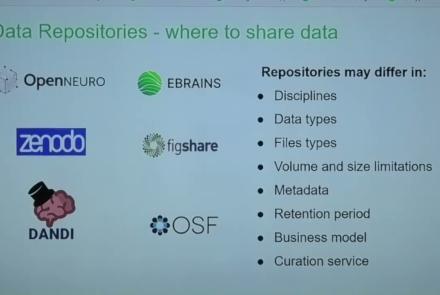
This session introduced EBRAINS data and knowledge services and explained how to achieve impactful data sharing through proper curation, FAIR principles, and secure handling of both non-sensitive and sensitive data.
Difficulty level: Beginner
Duration: 25:48
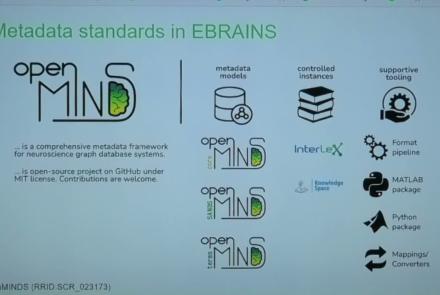
This lesson focused on the importance of organizing data and metadata effectively to ensure that datasets are FAIR and to make data sharing more impactful.
Difficulty level: Beginner
Duration: 14:32

Research Resource Identifiers (RRIDs) are ID numbers assigned to help researchers cite key resources (e.g., antibodies, model organisms, and software projects) in biomedical literature to improve the transparency of research methods.
Difficulty level: Beginner
Duration: 1:01:36
Speaker: : Maryann Martone

Course:
The Brain Imaging Data Structure (BIDS) is a standard prescribing a formal way to name and organize MRI data and metadata in a file system that simplifies communication and collaboration between users and enables easier data validation and software development through using consistent paths and naming for data files.
Difficulty level: Beginner
Duration: 0:56
Speaker: : Jean-Babtiste Poline

Course:
Neurodata Without Borders (NWB) is a data standard for neurophysiology that provides neuroscientists with a common standard to share, archive, use, and build common analysis tools for neurophysiology data.
Difficulty level: Beginner
Duration: 1:11
Speaker: : Ben Dichter