
Lesson type
Difficulty level

Course:
This lecture covers the description and characterization of an input-output relationship in a information-theoretic context.
Difficulty level: Beginner
Duration: 1:35:33
Speaker: : Jonathan D. Victor

This lesson is part 1 of 2 of a tutorial on statistical models for neural data.
Difficulty level: Beginner
Duration: 1:45:48
Speaker: : Jonathan Pillow
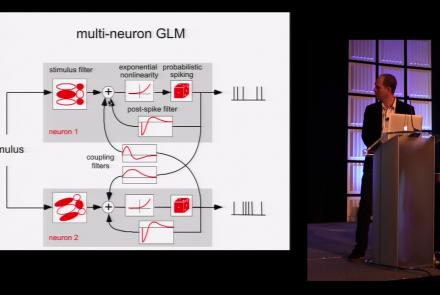
This lesson is part 2 of 2 of a tutorial on statistical models for neural data.
Difficulty level: Beginner
Duration: 1:50:31
Speaker: : Jonathan Pillow

Course:
From the retina to the superior colliculus, the lateral geniculate nucleus into primary visual cortex and beyond, this lecture gives a tour of the mammalian visual system highlighting the Nobel-prize winning discoveries of Hubel & Wiesel.
Difficulty level: Beginner
Duration: 56:31
Speaker: : Clay Reid

Course:
From Universal Turing Machines to McCulloch-Pitts and Hopfield associative memory networks, this lecture explains what is meant by computation.
Difficulty level: Beginner
Duration: 55:27
Speaker: : Christof Koch

In this lesson you will learn about ion channels and the movement of ions across the cell membrane, one of the key mechanisms underlying neuronal communication.
Difficulty level: Beginner
Duration: 25:51
Speaker: : Carl Petersen

This lecture provides an introduction to the course "Cognitive Science & Psychology: Mind, Brain, and Behavior".
Difficulty level: Beginner
Duration: 1:06:49
Speaker: : Paul F.M.J. Verschure

This lecture covers the emergence of cognitive science after the Second World War as an interdisciplinary field for studying the mind, with influences from anthropology, cybernetics, and artificial intelligence.
Difficulty level: Beginner
Duration: 51:07
Speaker: : Paul F.M.J. Verschure

This lecture covers different perspectives on the study of the mental, focusing on the difference between Mind and Brain.
Difficulty level: Beginner
Duration: 1:16:30
Speaker: : Paul F.M.J. Verschure

This lecture outlines various approaches to studying Mind, Brain, and Behavior.
Difficulty level: Beginner
Duration: 1:02:34
Speaker: : Paul F.M.J. Verschure

This lecture covers the history of behaviorism and the ultimate challenge to behaviorism.
Difficulty level: Beginner
Duration: 1:19:08
Speaker: : Paul F.M.J. Verschure

This lecture covers various learning theories.
Difficulty level: Beginner
Duration: 1:00:42
Speaker: : Paul F.M.J. Verschure

This lecture covers a lot of post-war developments in the science of the mind, focusing first on the cognitive revolution, and concluding with living machines.
Difficulty level: Beginner
Duration: 2:24:35
Speaker: : Paul F.M.J. Verschure