Below you will find the latest courses. Please search or select the courses based on the below filters.

Session 4: "Is This FAIR?": Transparency in EDI, Career Development, & Management
INCFThere is a growing recognition and adoption of open and FAIR science practices in neuroscience research. This is predominately regarded as scientific progress and has enabled significant opportunities for large, collaborative, team science. The efforts and practical work that go into creating an open and FAIR landscape extend far beyond just the science.

Whole-Brain Modelling
Krembil Centre for NeuroinformaticsGiven the extreme interconnectedness of the human brain, studying any one cerebral area in isolation may lead to spurious results or incomplete, if not problematic, interpretations. This course introduces participants to the various spatial scales of neuroscience and the fundamentals of whole-brain modelling, used to generate a more thorough picture of brain activity.

Using brainlife.io
brainlife.ioThis course provides several visual walkthroughs documenting how to execute various processes in brainlife.io, an open-source, free and secure reproducible neuroscience analysis platform. The platform allows to analyze Magnetic Resonance Imaging (MRI), electroencephalography (EEG) and magnetoencephalography (MEG) data. Data can either be uploaded from local computers or imported from public archives such as OpenNeuro.org.
Fundamental Methods for Genomic Analysis
Krembil Centre for NeuroinformaticsThis course includes both lectures and tutorials around the management and analysis of genomic data in clinical research and care. Participants are led through the basics of genome-wide association studies (GWAS), genotypes, and polygenic risk scores, as well as novel concepts and tools for more sophisticated consideration of population stratification in GWAS.
Simulating Brain Microcircuit Activity and Signals in Mental Health
Krembil Centre for NeuroinformaticsThis course offers lectures on the origin and functional significance of certain electrophysiological signals in the brain, as well as a hands-on tutorial on how to simulate, statistically evaluate, and visualize such signals. Participants will learn the simulation of signals at different spatial scales, including single-cell (neuronal spiking) and global (EEG), and how these may serve as biomarkers in the evaluation of mental health data.

INCF Assembly 2022 - Day 2 Sessions
INCFSessions from the INCF Neuroinformatics Assembly 2022 day 2.

Foundations of Machine Learning in Python
NeurotechEUCourse designed for advanced learners interested in understanding the foundations of Machine Learning in Python.
General: The course consists of 15 lectures (ca. 1-2 hours each) and 15 exercise sheets (for ca. 6 hours of programming each).
Institution: High-Performance Computing and Analytics Lab, University of Bonn

Model Types
Neuromatch AcademyNeuromatch Academy aims to introduce traditional and emerging tools of computational neuroscience to trainees.

Module 1: Spikes
Mike X. CohenThe goal of this module is to work with action potential data taken from a publicly available database. You will learn about spike counts, orientation tuning, and spatial maps. The MATLAB code introduces data types, for-loops and vectorizations, indexing, and data visualization.
Session 5: Infrastructure for Sensitive Data
INCFThis course consists of a three-part session from the second day of INCF's Neuroinformatics Assembly 2023. The lessons describe various on-going efforts within the fields of neuroinformatics and clinical neuroscience to adjust to the increasingly vast volumes of brain data being collected and stored.
Bayesian Models of Learning and Integration of Neuroimaging Data
Krembil Centre for NeuroinformaticsBayesian inference (using prior knowledge to generate more accurate predictions about future events or outcomes) has become increasingly applied to the fields of neuroscience and neuroinformatics. In this course, participants are taught how Bayesian statistics may be used to build cognitive models of processes like learning or perception. This course also offers theoretical and practical instruction on dynamic causal modeling as applied to fMRI and EEG data.
Using brainlife.io
brainlife.ioThis course provides several visual walkthroughs documenting how to execute various processes in brainlife.io, an open-source, free and secure reproducible neuroscience analysis platform. The platform allows to analyze Magnetic Resonance Imaging (MRI), electroencephalography (EEG) and magnetoencephalography (MEG) data. Data can either be uploaded from local computers or imported from public archives such as OpenNeuro.org.

Coding and Vision 101
Allen Institute for Brain ScienceThis course consists of 12 lectures on the visual system and neural coding produced by the Allen Institute for Brain Science. The lectures cover broad neurophysiological concepts such as information theory and the mammalian visual system, as well as more specific topics such as cell types and their functions in the mammalian retina.
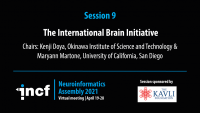
The International Brain Initiative (IBI)
INCFThe International Brain Initiative (IBI) is a consortium of the world’s major large-scale brain initiatives and other organizations with a vested interest in catalyzing and advancing neuroscience research through international collaboration and knowledge sharing. This session will introduce the IBI and the current efforts of the Data Standards and Sharing Working Group with a view to gain input from a wider neuroscience and neuroinformatics community.

INCF Assembly 2022 - Day 1 Sessions
INCFSessions from the INCF Neuroinformatics Assembly 2022 day 1.

NeuroTools Webinar Series
Neuroscience Information FrameworkPresented by the Neuroscience Information Framework (NIF), this series consists of several lectures characterizing cutting-edge, open-source software platforms and computational tools for neuroscientists. This course offers detailed descriptions of various neuroinformatic resources such as cloud-computing services, web-based annotation tools, genome browsers, and platforms for designing and building biophysically detailed models of neurons and neural ensembles.

Introduction to Neurodata Without Borders (NWB) for Python Users I
NWB Core Development TeamThe Neurodata Without Borders: Neurophysiology project (NWB, https://www.nwb.org/) is an effort to standardize the description and storage of neurophysiology data and metadata. NWB enables data sharing and reuse and reduces the energy-barrier to applying data analytics both within and across labs. Several laboratories, including the Allen Institute for Brain Science, have wholeheartedly adopted NWB.