
Lesson type
Difficulty level

This lecture covers the emergence of cognitive science after the Second World War as an interdisciplinary field for studying the mind, with influences from anthropology, cybernetics, and artificial intelligence.
Difficulty level: Beginner
Duration: 51:07
Speaker: : Paul F.M.J. Verschure

This lecture provides an introduction to Plato’s concept of rationality and Aristotle’s concept of empiricism, and the enduring discussion between rationalism and empiricism to this day.
Difficulty level: Beginner
Duration: 1:13:45
Speaker: : Paul F.M.J. Verschure

This lecture covers different perspectives on the study of the mental, focusing on the difference between Mind and Brain.
Difficulty level: Beginner
Duration: 1:16:30
Speaker: : Paul F.M.J. Verschure

This lecture covers the three big questions: What is the universe?, what is life?, and what is consciousness?
Difficulty level: Beginner
Duration: 1:07:52
Speaker: : Paul F.M.J. Verschure
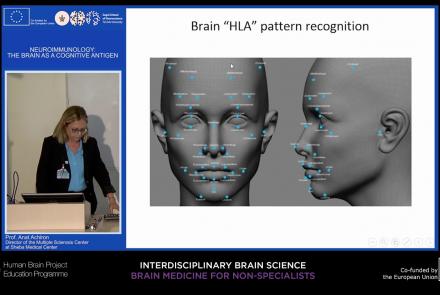
This lecture focuses on how the immune system can target and attack the nervous system to produce autoimmune responses that may result in diseases such as multiple sclerosis, neuromyelitis, and lupus cerebritis manifested by motor, sensory, and cognitive impairments. Despite the fact that the brain is an immune-privileged site, autoreactive lymphocytes producing proinflammatory cytokines can cause active brain inflammation, leading to myelin and axonal loss.
Difficulty level: Beginner
Duration: 37:36
Speaker: : Anat Achiron

This lecture provides an overview of some of the essential concepts in neuropharmacology (e.g. receptor binding, agonism, antagonism), an introduction to pharmacodynamics and pharmacokinetics, and an overview of the drug discovery process relative to diseases of the central nervous system.
Difficulty level: Beginner
Duration: 45:47
Speaker: : Sandra Santos-Sierra

This lecture covers the ethical implications of the use of pharmaceuticals to enhance brain functions and was part of the Neuro Day Workshop held by the NeuroSchool of Aix Marseille University.
Difficulty level: Beginner
Duration: 1:09:29
Speaker: : Eric Racine