
Lesson type
Difficulty level

Course:
This presentation by the OHBM OpenScienceSIG covers common scenarios where Git can be extremely valuable. The essentials covered include cloning a repository and keeping it up to date, how to create and use your own repository, and how to contribute to other projects via forking and pull requests.
Difficulty level: Beginner
Duration: 51:55
Speaker: : Saskia Bollmann, Steffen Bollmann

Course:
DataLad is a versatile data management and data publication multi-tool. In this session, you can learn the basic concepts and commands for version control and reproducible data analysis. You’ll get to see, create, and install DataLad datasets of many shapes and sizes, master local version workflows and provenance-captured analysis-execution, and you will get ideas for your next data analysis project.
Difficulty level: Beginner
Duration: 01:29:08
Speaker: : Adina Wagner

This lecture covers the emergence of cognitive science after the Second World War as an interdisciplinary field for studying the mind, with influences from anthropology, cybernetics, and artificial intelligence.
Difficulty level: Beginner
Duration: 51:07
Speaker: : Paul F.M.J. Verschure

This lecture provides an introduction to Plato’s concept of rationality and Aristotle’s concept of empiricism, and the enduring discussion between rationalism and empiricism to this day.
Difficulty level: Beginner
Duration: 1:13:45
Speaker: : Paul F.M.J. Verschure

This lecture covers different perspectives on the study of the mental, focusing on the difference between Mind and Brain.
Difficulty level: Beginner
Duration: 1:16:30
Speaker: : Paul F.M.J. Verschure

This lecture goes into further detail about the hard problem of developing a scientific discipline for subjective consciousness.
Difficulty level: Beginner
Duration: 58:03
Speaker: : Paul F.M.J. Verschure

This lecture outlines various approaches to studying Mind, Brain, and Behavior.
Difficulty level: Beginner
Duration: 1:02:34
Speaker: : Paul F.M.J. Verschure
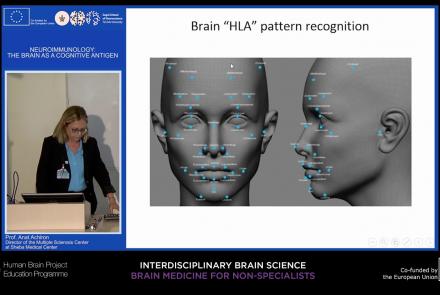
This lecture focuses on how the immune system can target and attack the nervous system to produce autoimmune responses that may result in diseases such as multiple sclerosis, neuromyelitis, and lupus cerebritis manifested by motor, sensory, and cognitive impairments. Despite the fact that the brain is an immune-privileged site, autoreactive lymphocytes producing proinflammatory cytokines can cause active brain inflammation, leading to myelin and axonal loss.
Difficulty level: Beginner
Duration: 37:36
Speaker: : Anat Achiron