
Lesson type
Difficulty level

Course:
This lesson describes the principles underlying functional magnetic resonance imaging (fMRI), diffusion-weighted imaging (DWI), tractography, and parcellation. These tools and concepts are explained in a broader context of neural connectivity and mental health.
Difficulty level: Intermediate
Duration: 1:47:22
Speaker: : Erin Dickie and John Griffiths

Course:
This tutorial introduces pipelines and methods to compute brain connectomes from fMRI data. With corresponding code and repositories, participants can follow along and learn how to programmatically preprocess, curate, and analyze functional and structural brain data to produce connectivity matrices.
Difficulty level: Intermediate
Duration: 1:39:04
Speaker: : Erin Dickie and John Griffiths

In this lesson, you will learn about the connectome, the collective system of neural pathways in an organism, with a closer look at the neurons, synapses, and connections of particular species.
Difficulty level: Intermediate
Duration: 6:48
Speaker: : Marcus Ghosh

This lesson delves into the human nervous system and the immense cellular, connectomic, and functional sophistication therein.
Difficulty level: Intermediate
Duration: 8:41
Speaker: : Marcus Ghosh

In this lesson, you will hear about some of the open issues in the field of neuroscience, as well as a discussion about whether neuroscience works, and how can we know?
Difficulty level: Intermediate
Duration: 6:54
Speaker: : Marcus Ghosh

Course:
Panel discussion by leading scientists, engineers and philosophers discuss what brain-computer interfaces are and the unique scientific and ethical challenges they pose. hosted by Lynne Malcolm from ABC Radio National's All in the Mind program and features:
- Dr Hannah Maslen, Deputy Director, Oxford Uehiro Centre for Practical Ethics, University of Oxford
- Prof. Eric Racine, Director, Pragmatic Health Ethics Research Unity, Montreal Institute of Clinical Research
- Prof Jeffrey Rosenfeld, Director, Monash Institute of Medical Engineering, Monash University
- Dr Isabell Kiral-Kornek, AI and Life Sciences Researcher, IBM Research
- A/Prof Adrian Carter, Neuroethics Program Coordinator, ARC Centre of Excellence for Integrative Brain Function
Difficulty level: Intermediate
Duration: 1:14:34

Course:
Panel of experts discuss the virtues and risks of our digital health data being captured and used by others in the age of Facebook, metadata retention laws, Cambridge Analytica and a rapidly evolving neuroscience. The discussion was moderated by Jon Faine, ABC Radio presenter. The panelists were:
- Mr Sven Bluemmel, Victorian Information Commissioner
- Prof Judy Illes, Neuroethics Canada, University of British Columbia, Order of Canada
- Prof Mark Andrejevic, Professor of Media Studies, Monash University
- Ms Vrinda Edan, Chief Operating Officer, Victorian Mental Illness Awareness Council
Difficulty level: Intermediate
Duration: 1:10:30

This lecture covers how you can make your data public through EBRAINS. This talk focuses on the ethical considerations for sharing data, the requirements that are imposed by various regulations, particularly for sharing human data. The lecture also includes a discussion of how EBRAINS designs its services to deal with the ethical and regulatory aspects of sharing these kinds of data.
Difficulty level: Intermediate
Duration: 16:15
Speaker: : Maaike van Swieten and Jan Bjaalie

This lecture discusses differential privacy and synthetic data in the context of medical data sharing in clinical neurosciences.
Difficulty level: Intermediate
Duration: 20:26
Speaker: : Minos Garofalakis
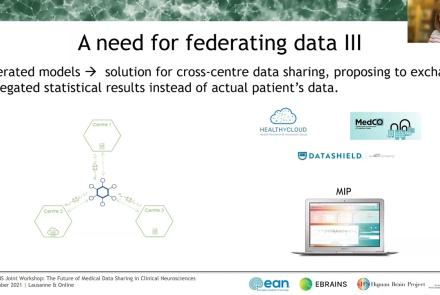
This talks presents ethics requirements of the Medical Informatics Platform, a data sharing platform for medical data using data federation mechanisms. The talk presents how the Medical Informatics Platform (MIP) works and which ethical requirements need to be considered when working with federated data.
Difficulty level: Intermediate
Duration: 16:25
Speaker: : Erika Borcel